
A radiographer assists with a portable chest exam in a crowded ICU where the primary beam strikes the patient and the technologist must remain near the bed to hold the detector. The tube housing and the patient both emit radiation during exposure. Which personnel protection principle best identifies exposure sources from primary, scatter, leakage, and patient emission?
Select an answer to reveal the explanation.
Short Explanation
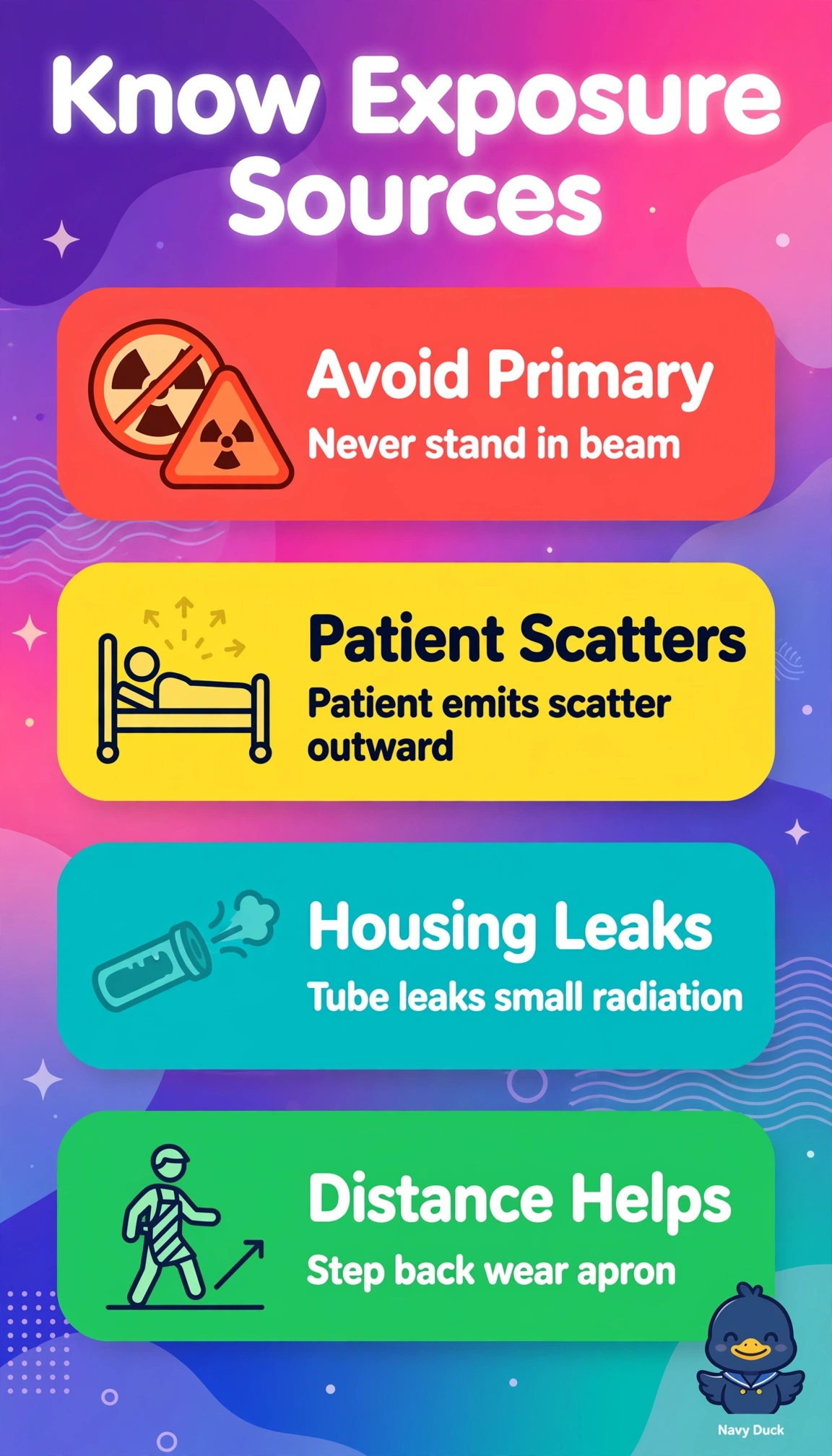
You're dodging invisible splashes from every direction, not just the hose. Remembering the patient scatters and the housing leaks keeps you out of harm's way with scatter-awareness.
Full Explanation
The correct principle holds because protection requires staying out of the primary beam even while holding the detector in a crowded ICU, while recognizing two concurrent sources active only during exposure: Compton scatter originating principally from the patient volume struck by the beam and leakage penetrating the tube housing despite shielding. The distractor about intact housing eliminating leakage fails on shielding concept because diagnostic housings attenuate but never fully stop leakage, which is regulated and always assumed present during exposure, so assuming zero leakage underestimates dose. The distractor attributing scatter mainly to walls and equipment fails on interaction concept because the patient intercepts the intense primary beam and becomes the dominant scatter source, with room surfaces contributing only minor secondary scatter. The distractor extending emission after exposure ends fails on temporal concept because tubes and patients emit only while energized, with no residual radioactivity after a plain radiograph unlike nuclear medicine. An exam caveat is to classify sources by origin rather than intensity and remember distance and shielding still apply during close contact. A practical check is to collimate tightly, wear apron and thyroid shield, stand as far as holding allows, and confirm timing by indicators.