
A 55-year-old emergency patient after a low-speed motorcycle crash has lateral pelvic pain and suspected pelvic ring disruption. She is hemodynamically stable, can remain supine, and tolerates small tube angles but cannot roll into oblique positions. Which pelvic projection should the technologist add to the AP pelvis to best evaluate superior-inferior displacement of the ring?
Select an answer to reveal the explanation.
Short Explanation
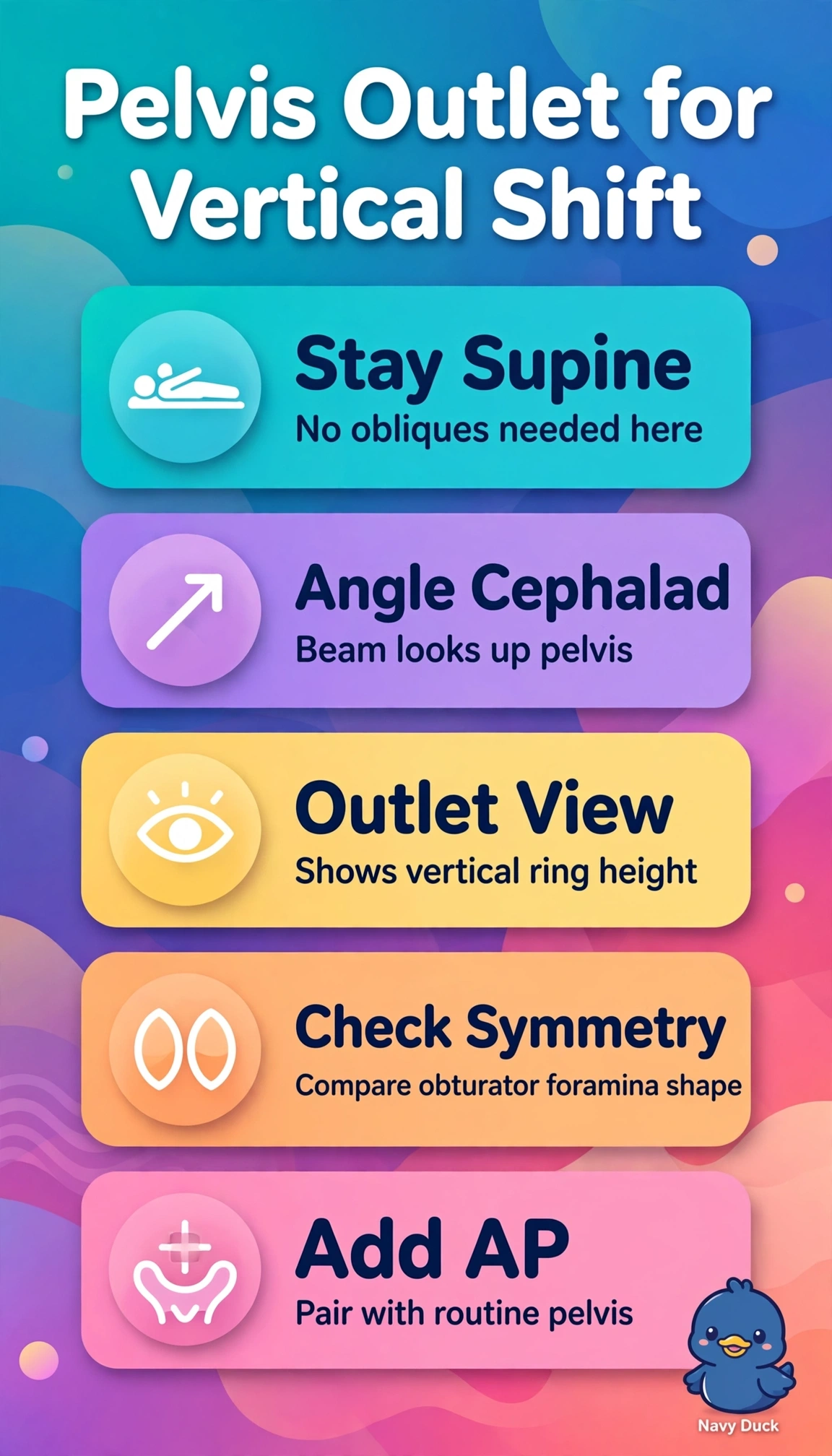
You spotted the up-down clue in a stable pelvis. The outlet fans the front like opening a book, putting displacement in clear vertical relief.
Full Explanation
The AP axial outlet projection directs the beam cephalad to project the anterior pelvis and pubic rami below the posterior structures, elongating the obturator foramina and displaying cephalad migration, sacral foramina symmetry and superior-inferior ring displacement without requiring patient rotation. The AP axial inlet projection angles caudad to look down the pelvic brim and profiles anterior-posterior displacement and internal rotation of the ring, so it answers inward-outward disruption rather than the requested vertical shift. The frog-leg lateral centers on the hips with flexion and abduction to open the femoral necks and acetabula, but it evaluates proximal femora rather than ring height and requires painful abduction that this patient cannot tolerate. The Danelius-Miller axial lateral isolates the traumatized hip and acetabulum with the opposite leg elevated, which is ideal for a femoral neck that cannot be moved but does not survey the entire pelvic ring for bilateral vertical displacement. Exam caveat: inlet equals AP displacement and outlet equals vertical displacement, and practical check is to keep the patient truly supine without rotation and center low to include the ischial tuberosities and iliac crests.