
A technologist sends a portable chest to PACS and the radiologist calls it too dark with washed-out lungs but does not want a repeat exposure, and the raw data remain available. Which image-processing adjustment should the technologist apply to improve display contrast and brightness?
Select an answer to reveal the explanation.
Short Explanation
You're rescuing density without extra dose here. Windowing lets you remap the same data into a clearer gray scale for lungs.
Full Explanation
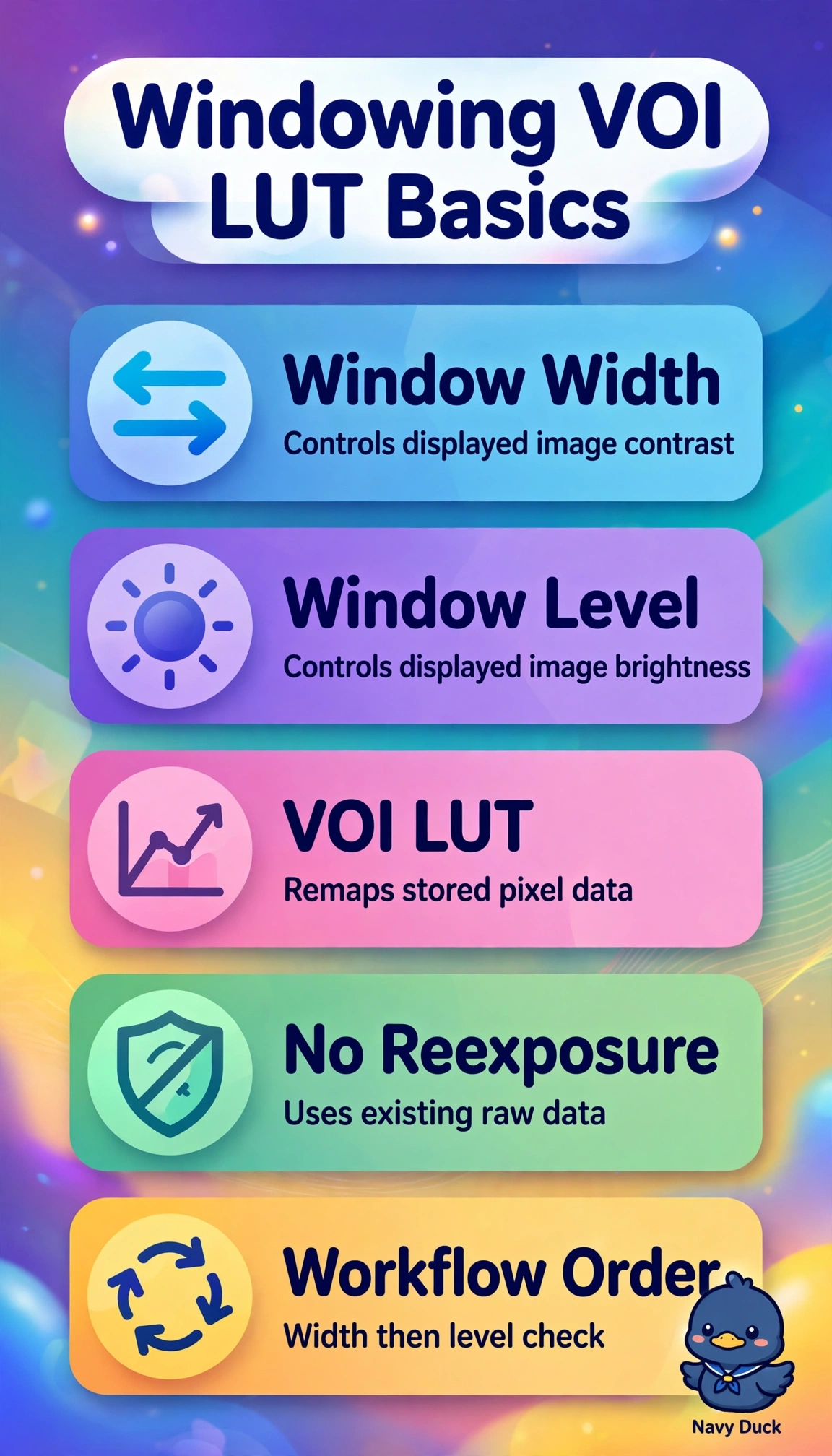
Window width and level applied through the value-of-interest lookup table remap stored pixel values to display brightness and contrast, with width controlling the range of values shown and therefore contrast and level controlling the center value and therefore brightness, all without new exposure. The ROI approach fails because region-of-interest tools measure mean, area, or histogram values but do not globally rescale display contrast, the stitching approach fails because stitching joins long-length anatomy such as spine or legs and does not alter gray-scale mapping, and the cropping approach fails because cropping or shuttering only removes borders or electronic collimation for presentation and does not change photometric mapping. Exam caveat: ARRT distinguishes acquisition LUT, VOI LUT for windowing, and display LUT, so choose VOI LUT language for postprocessing brightness and contrast. Practical check: adjust width first for lung contrast, then level for brightness, and confirm mediastinum remains visible before sending back to PACS.