
A 24-year-old rock climber with ulnar-sided wrist pain after a fall needs evaluation for suspected scapholunate injury and hook of hamate fracture, with moderate swelling but no deformity. The physician orders PA, oblique, lateral and scaphoid views plus ulnar deviation. Which projection set should the radiographer perform for this wrist assessment?
Select an answer to reveal the explanation.
Short Explanation
You're opening a tight fan to see hidden bones. Ulnar deviation stretches the scaphoid straight like pulling a kinked rope.
Full Explanation
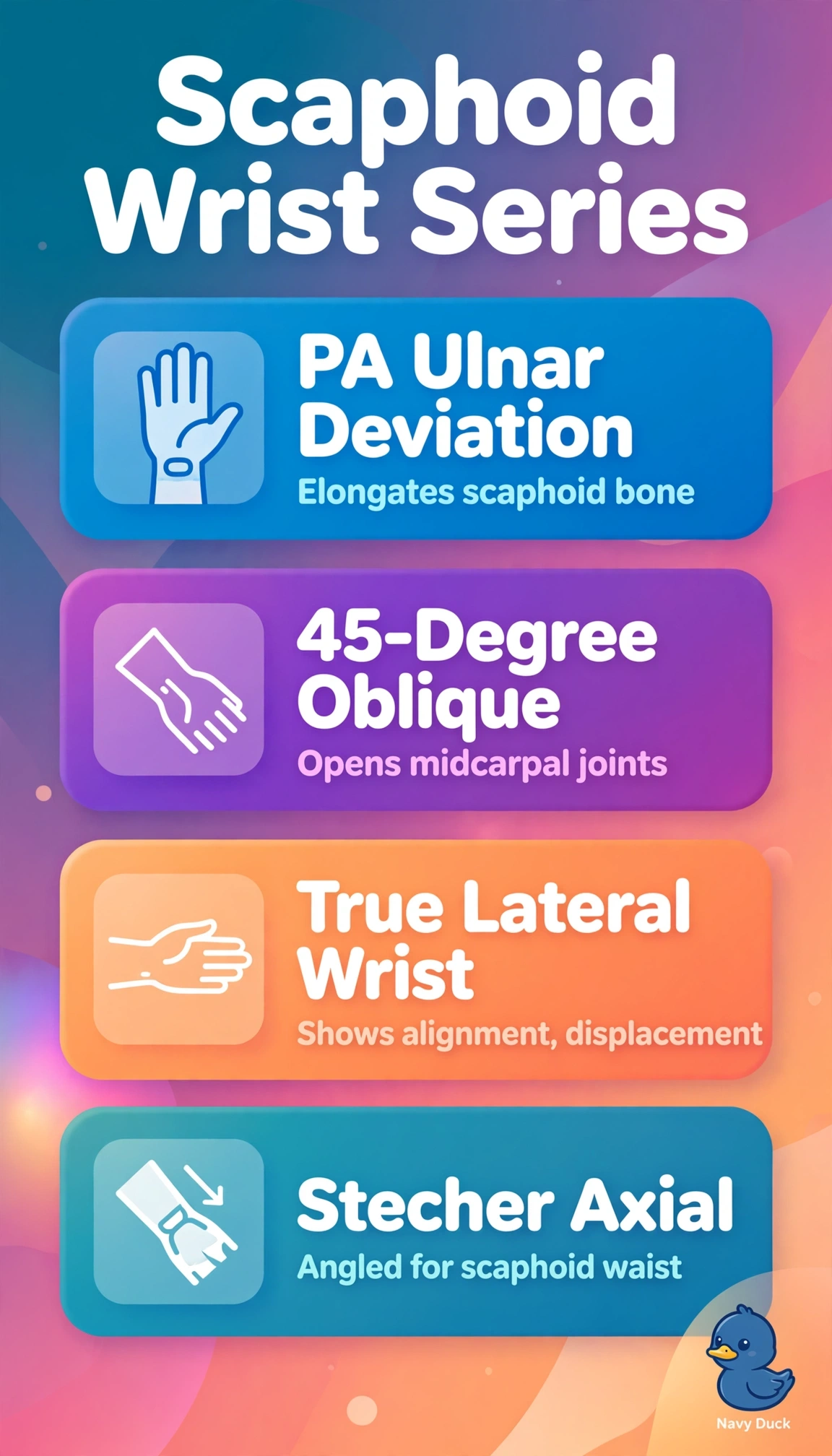
The ordered series matches both suspected injuries and standard positioning principles: PA in ulnar deviation elongates the scaphoid and stresses the scapholunate ligament to open the scapholunate interval for diastasis, 45-degree oblique separates dorsal and volar carpal structures to show cortical continuity, true lateral shows carpal alignment with scapholunate and capitolunate angles for dorsal intercalated instability, and Stecher PA axial with distal cephalic angulation projects the scaphoid along its long axis to reveal waist fractures. The radial-deviation set fails by biomechanical concept because radial deviation foreshortens the scaphoid and closes the scapholunate space, hiding the exact diastasis sought despite correct oblique, lateral and Stecher components. The Gaynor-Hart carpal tunnel set fails by substitution concept because that axial projection excellently shows the hook of hamate but does not elongate the scaphoid or profile the scapholunate joint, so the ordered scaphoid assessment for scapholunate injury is lost. The AP-based set fails by image-formation concept because AP wrist increases object-to-detector distance with carpal magnification and loss of fine bony detail compared with PA, degrading subtle gap and fracture detection. For examinations, do not add an unscheduled hook-of-hamate axial when the order specifies scaphoid and ulnar-deviation views. Practically, confirm true lateral with pisiform over distal scaphoid and concentric radius-ulna overlap and confirm third-metacarpal-radial alignment in full ulnar deviation without forcing painful motion.