
A neutropenic oncology inpatient needs a portable chest x-ray for fever. The room has a neutropenic precaution sign, and the previous patient had active tuberculosis. The technologist must protect both patients. Which precaution combination best addresses neutropenic and airborne risks during portable imaging?
Select an answer to reveal the explanation.
Short Explanation
You are guarding doors both ways — germs out and germs in. Pairing airborne control with neutropenic shielding keeps everyone safer.
Full Explanation
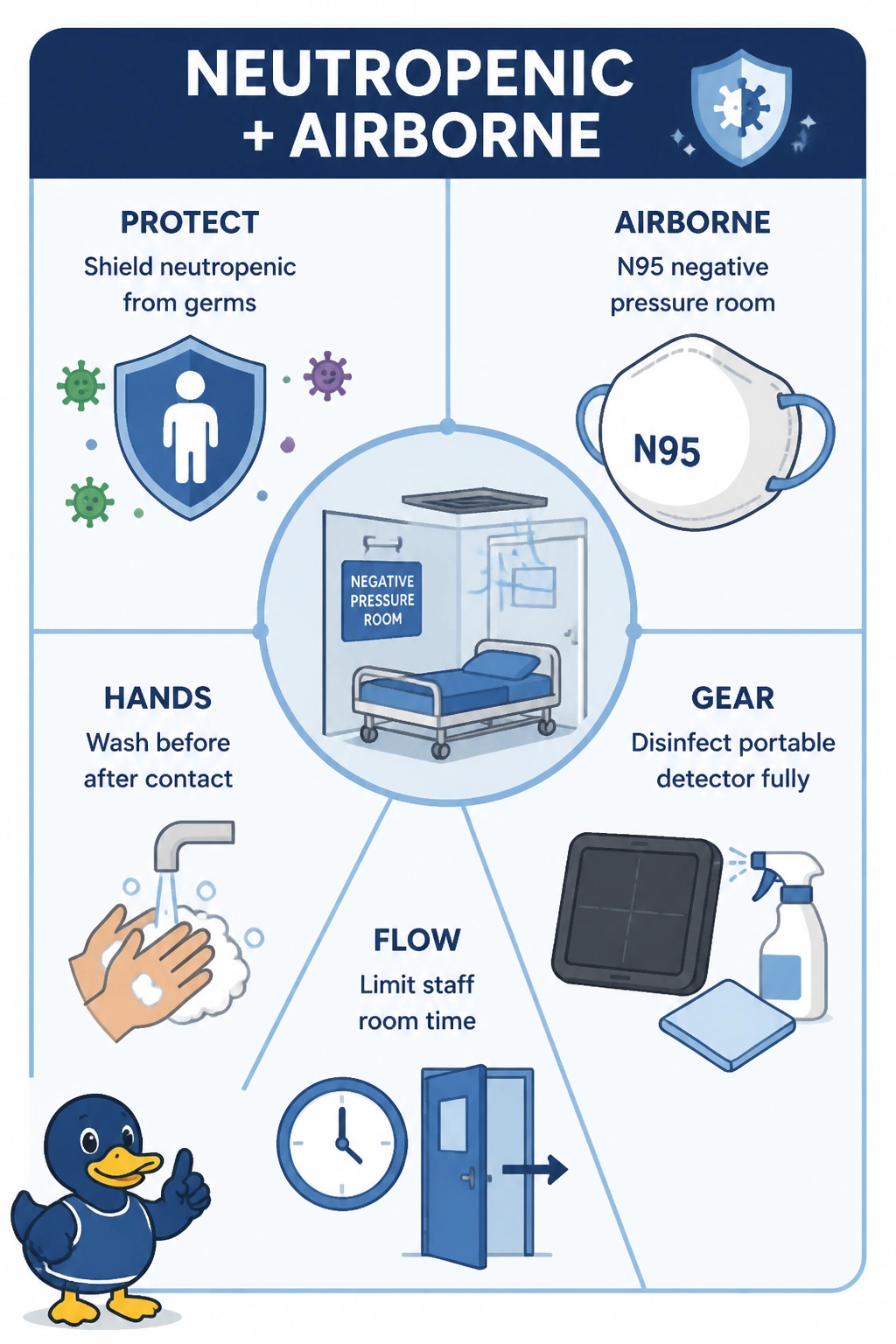
The correct pairing addresses bidirectional risk because neutropenic precautions protect the severely immunocompromised oncology patient from organisms introduced by staff, air, and portable equipment through hand hygiene, masking of contacts, limiting ill visitors, and detector barrier draping, while airborne precautions address persistence of Mycobacterium tuberculosis from the prior occupant through fit-tested N95 respirator, restricted entry, and appropriate room air clearance. A neutropenic plus droplet pairing preserves protective isolation but fails by airborne concept because droplet controls and surgical masks manage large short-range particles and do not prevent inhalation of small suspended nuclei that can remain airborne for hours. A standard plus airborne pairing preserves tuberculosis control but fails by protective concept because standard precautions alone lack enhanced exclusion, masking, and equipment barriers required when fever in neutropenia demands minimal exogenous exposure during portable work. A neutropenic plus airborne pairing using a surgical mask names both risks correctly but fails by respirator concept because a surgical mask does not seal or filter airborne nuclei and cannot substitute for a fit-tested N95 when tuberculosis contamination is possible. Exam caveat is that prior-room tuberculosis history still triggers airborne thinking even when the current patient does not have tuberculosis, and portability never downgrades precautions. Practical check is to verify N95 seal, perform hand hygiene before and after contact, use single-use detector cover, limit time and personnel in the room, and confirm clearance time and unit policy before entering after a tuberculosis case.