
A clinic compares two flat-panel detectors for extremity imaging, one with smaller detector elements and matrix with more pixels and one with larger elements and fewer pixels. The supervisor asks how element size affects resolution limits. Which detector relationship correctly links pixel pitch, Nyquist frequency, matrix, and MTF for this resolution comparison?
Select an answer to reveal the explanation.
Short Explanation
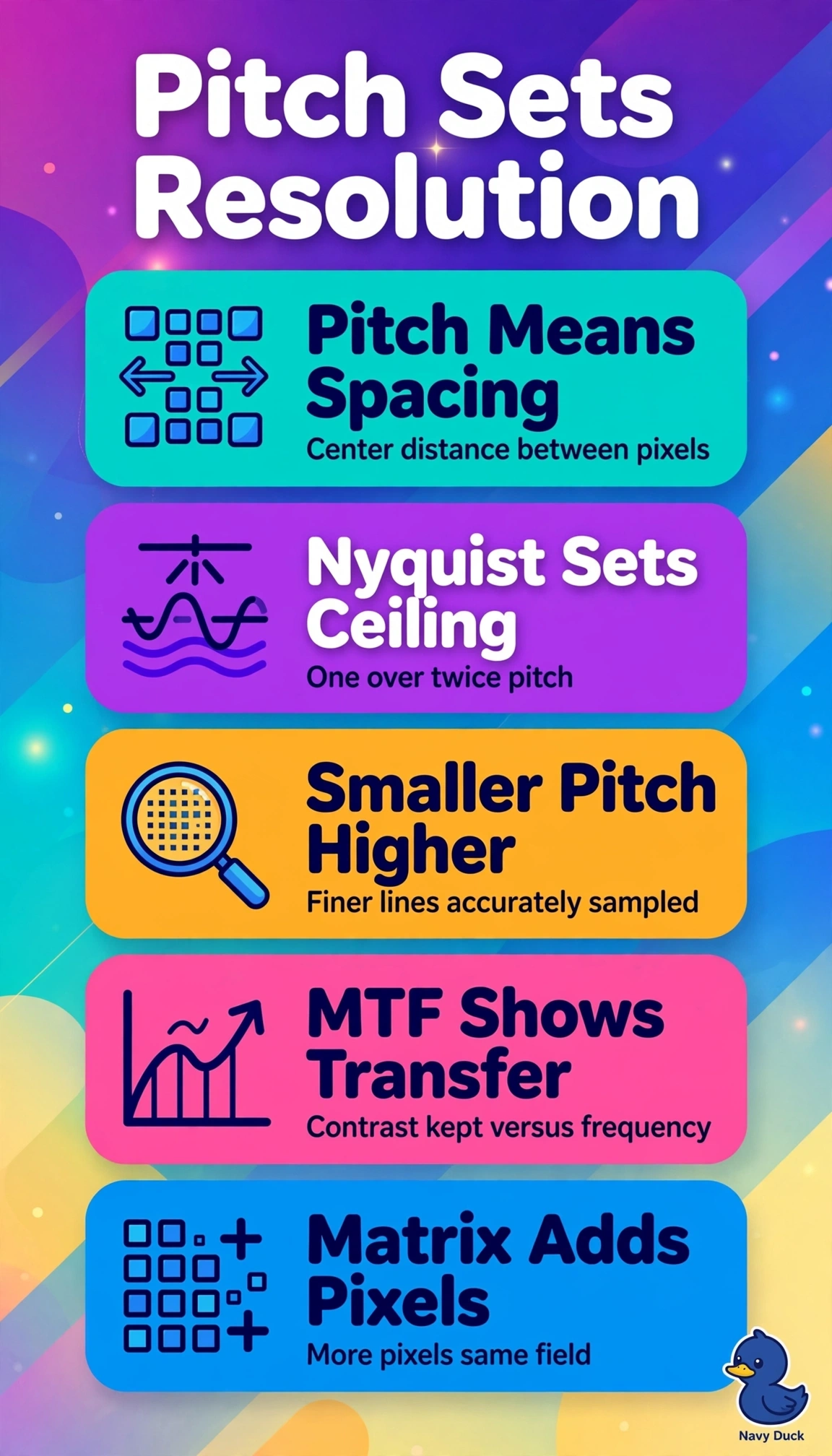
Tighter pixels sample finer lines, just as smaller tiles draw sharper mosaics. Shrinking pitch pushes the sampling ceiling higher, and sampling is what sets your resolution limit.
Full Explanation
For fixed coverage, smaller pitch means more pixels and higher Nyquist frequency from 1/(2xpitch), raising the sampling ceiling so higher frequencies can be recorded without aliasing and generally supporting higher limiting resolution seen as extended high-frequency MTF when other blurs are controlled. The statement that larger matrix typically ensures higher MTF across all frequencies is incorrect because Nyquist sets only the cutoff while magnitude depends on aperture averaging, fill factor, scintillator spread and focal-spot blur, so measured MTF can be similar or lower despite higher Nyquist. The statement linking sharper cutoff to higher detective quantum efficiency confuses efficiency with sharpness because DQE measures SNR transfer and smaller elements often lower DQE at matched exposure from higher noise, allowing better sampling with poorer efficiency. The statement making low-frequency MTF determine limiting resolution inverts the curve because low frequencies describe large-area contrast while limiting resolution is set near cutoff where high-frequency MTF falls to threshold. For exams, separate detector sampling limits from system limits including geometry, motion, scatter and display, since Nyquist by itself does not predict clinical detail. Practically, verify with slanted-edge MTF and matched-dose bar images before crediting smaller pitch for sharpness.