
A general radiographic room fails annual inspection for excessive field size and inadequate beam quality, with staff reporting loose collimator knobs and a missing filter indicator on a unit used for adult extremities and spine work. The physicist asks the technologists to state the corrective requirements before returning the unit to service. Which beam restriction and filtration requirement best meets safety standards?
Select an answer to reveal the explanation.
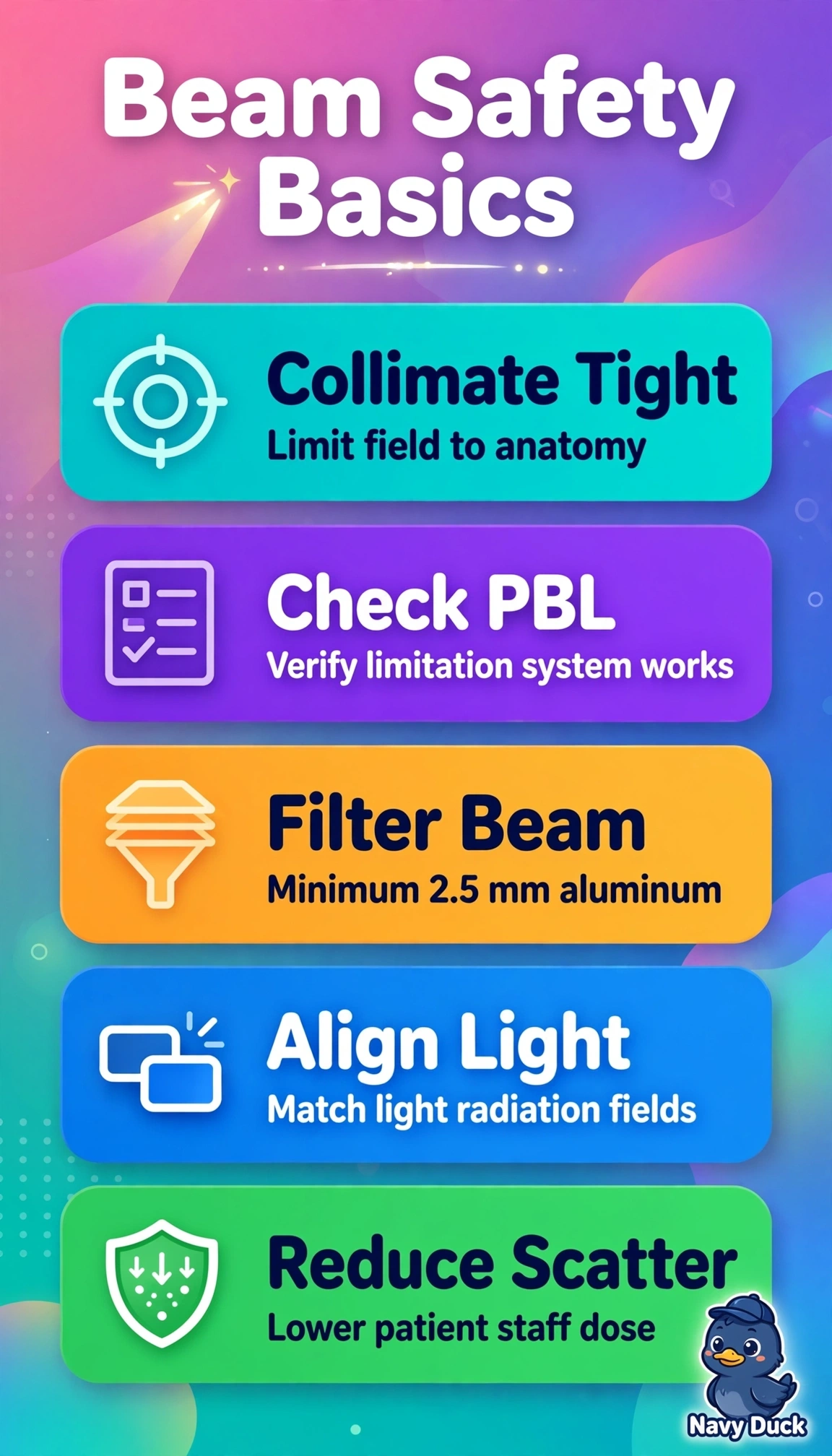
Short Explanation
You're trimming the beam to only what you need while keeping it clean and safe. Proper collimation works like window blinds that block stray sunlight. Filtration then removes the soft rays that only add skin dose.
Full Explanation
The correct requirement pairs restriction with beam quality for adult general radiography, limiting the useful beam to the anatomy and receptor size with verified positive beam limitation that automatically prevents exposure when field and receptor mismatch, plus at least 2.5 mm Al equivalent total filtration that hardens the beam by removing low-energy photons that increase entrance skin dose without reaching the receptor, correcting excessive field size, inadequate quality, loose knobs and missing indicator on a unit operated above 70 kVp for extremities and spine. The manually collimated light-field congruence approach fits mobile or non-PBL tubes and states correct filtration but fails automation because visual congruence and manual shutters cannot substitute for verified positive beam limitation when required and suspected faulty. The 1.5 mm Al equivalent approach preserves restriction and limitation but fails beam quality because that minimum applies to low-kVp, dental or dedicated low-energy use, not general adult techniques requiring 2.5 mm Al equivalent. The fixed 14x17 receptor approach preserves limitation and filtration but fails restriction by equating receptor size with clinical field, oversizing small extremity fields and adding scatter and integral dose despite Bucky use. Exam caveat is added filtration does not sharpen bone detail or increase brightness; it raises average energy and may require technique adjustment while reducing dose, and the practical check is to test shutter response with different cassettes, verify light-radiation alignment and interlock function, and confirm filtration from housing labeling with half-value layer measurement when the indicator is missing.