
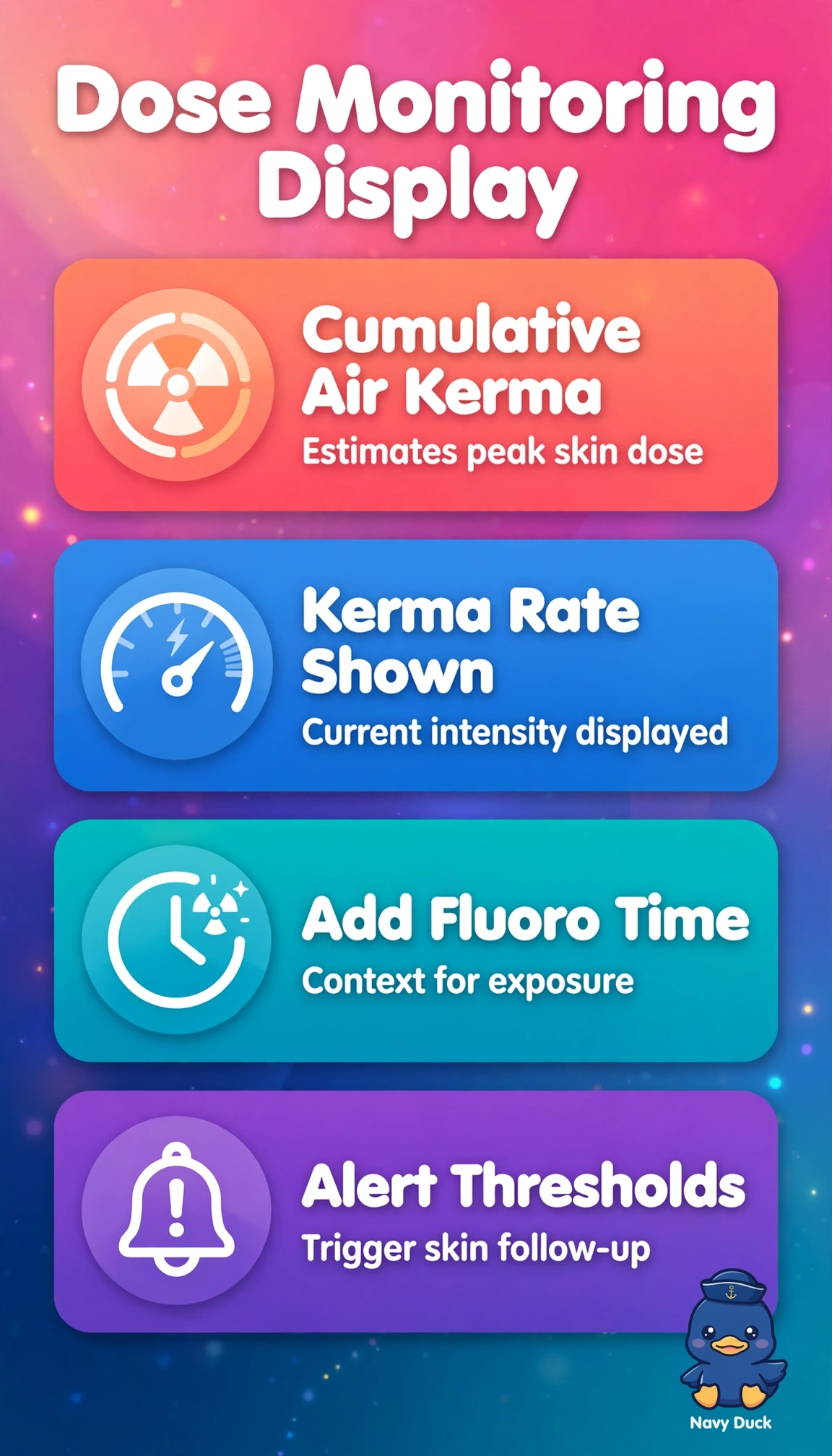
A 68-year-old patient undergoing prolonged mesenteric embolization has been under fluoroscopy for 45 minutes, and the interventional team asks the radiographer for current dose status before continuing. The room displays cumulative air kerma, kerma rate, DAP and fluoroscopy time. Which dose indicator should the radiographer report to assess deterministic skin injury risk?
Select an answer to reveal the explanation.
Short Explanation
You're watching a sunburn meter, not the whole beach. Cumulative air kerma tracks concentrated skin dose where injury starts.
Full Explanation
Deterministic effects such as erythema depend on peak skin dose, which is best approximated intra-procedurally by cumulative air kerma at the interventional reference point combined with beam-on time and gantry positioning, triggering notifications and follow-up when thresholds are approached. Dose-area product integrates dose over beam area and reflects stochastic risk and total energy delivered, but the same DAP can represent wide low-dose fields or a small intense field, so it cannot alone predict focal skin injury. Detector input or scatter readings characterize image receptor exposure or occupational scatter rather than patient entrance skin dose and are not the regulated patient metric. Last-image-hold frame count reflects stored images without beam-on quantification and has no calibrated dose units, so it cannot substitute for kerma-based monitoring.