
A 19-year-old volleyball player has bilateral anterior knee pain and crepitus when climbing stairs, without trauma, effusion, or suspected fracture. The orthopedist suspects patellofemoral tracking disorder and wants both patellae compared for subluxation with the knees flexed and the beam tangent to the joint. Which tangential patella method best meets the bilateral comparison need?
Select an answer to reveal the explanation.
Short Explanation
You're lining up both kneecaps side-by-side in the same groove shot. Merchant gives you that fair bilateral skyline view without favoring one sore knee.
Full Explanation
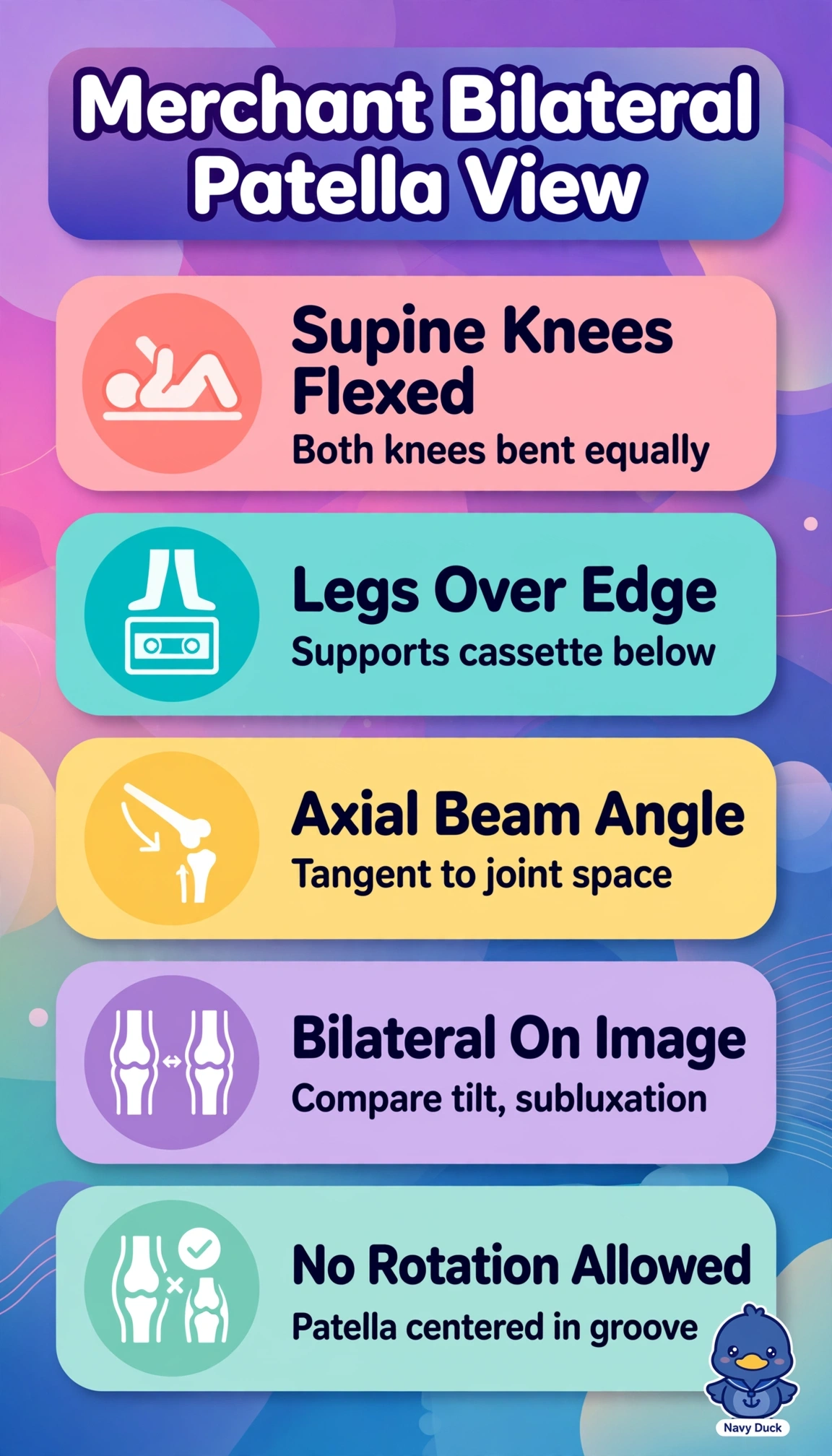
The Merchant method obtains bilateral tangential patellofemoral projections with the patient supine and knees flexed about 40 degrees over the table end, cassette supported distally and beam angled axially to project the patellae free of femur for comparison of tilt, subluxation and joint space in tracking disorders. The unilateral Settegast method fails by concept because prone flexion with a single axial view profiles one patellofemoral joint well but does not provide simultaneous bilateral comparison under identical flexion and beam angles requested for tracking assessment. Bilateral AP weight-bearing knees in extension fails by concept because the AP projection demonstrates tibiofemoral joint spaces and alignment but superimposes the patella on the distal femur rather than providing the tangential skyline needed for patellar position. The tunnel intercondylar method fails by concept because flexion with an angled posteroanterior beam opens the intercondylar notch for loose bodies and condylar lesions rather than profiling the anterior patellofemoral articulation. Exam caveat: ARRT contrasts Merchant as bilateral supine, Settegast as unilateral prone or seated, and tunnel as intercondylar notch view, and practical check is to match flexion, keep legs relaxed without rotation, and confirm both patellae are centered free in the trochlear grooves.