
A pregnant technologist at eight weeks gestation worries after assisting with portable exams without a lead apron. The RSO counsels on deterministic versus stochastic fetal risks during organogenesis. Which radiosensitivity principle best guides counseling for first-trimester exposure?
Select an answer to reveal the explanation.
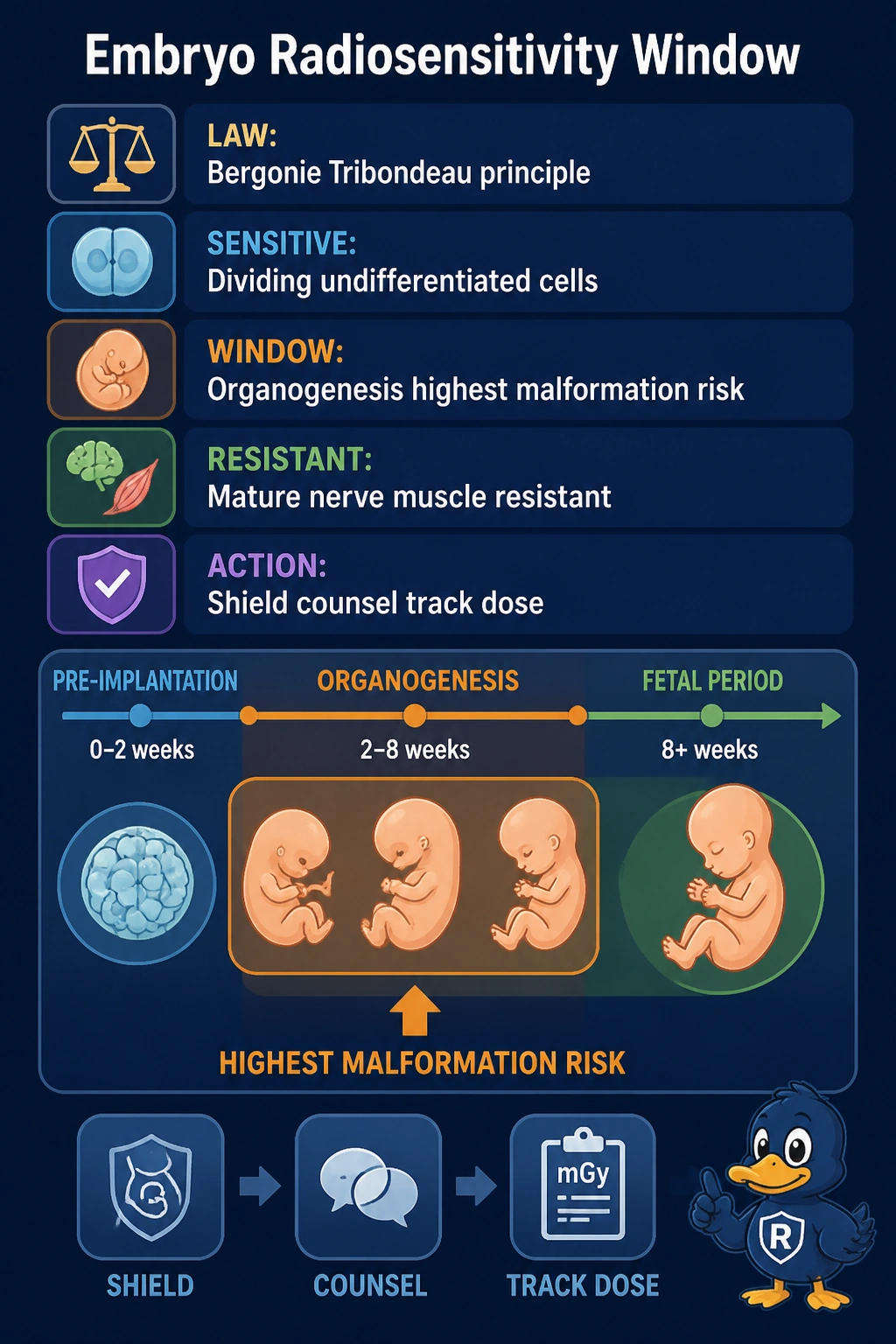
Short Explanation
You are protecting cells at their busiest building stage. Rapidly dividing builders suffer most, which is why early organogenesis needs extra care.
Full Explanation
The correct principle reflects Bergonie-Tribondeau sensitivity, where rapidly proliferating undifferentiated cells with high mitotic rate are most radiosensitive, explaining why the eight-week embryo in organogenesis faces heightened deterministic risk of malformation or loss above threshold plus stochastic risk, so counseling emphasizes that brief portable scatter is usually far below deterministic thresholds while ALARA and monitoring remain required. The marrow-sparing concept fails by application because fractionation recovery describes therapeutic tolerance built over weeks, not vulnerability in a single first-trimester developmental window. The differentiated-skin concept fails by biology because mature differentiated slowly dividing cells are relatively resistant, the opposite of embryonic tissue, and cannot account for increased fetal sensitivity. The oxygenation concept fails by target because oxygen enhancement and reoxygenation govern tumor cell kill in oncology, not normal fetal developmental injury. An exam caveat is to separate deterministic threshold effects with dose-dependent severity from stochastic probabilistic effects, since organogenesis malformation is classically tested as deterministic. A practical check is to verify declared pregnancy, place a fetal dosimeter at waist under apron, maximize distance and minimize time during portables, and compare estimated fetal dose to the 5 mSv gestational guidance for reassurance.