
A physics instructor compares two exposures on the same tungsten target: one at 45 kVp showing faint low-energy output and one at 95 kVp showing much higher output and higher average energy. The student asks why output rises steeply with kVp. Which target interaction best explains the added x-ray production at higher kVp?
Select an answer to reveal the explanation.
Short Explanation
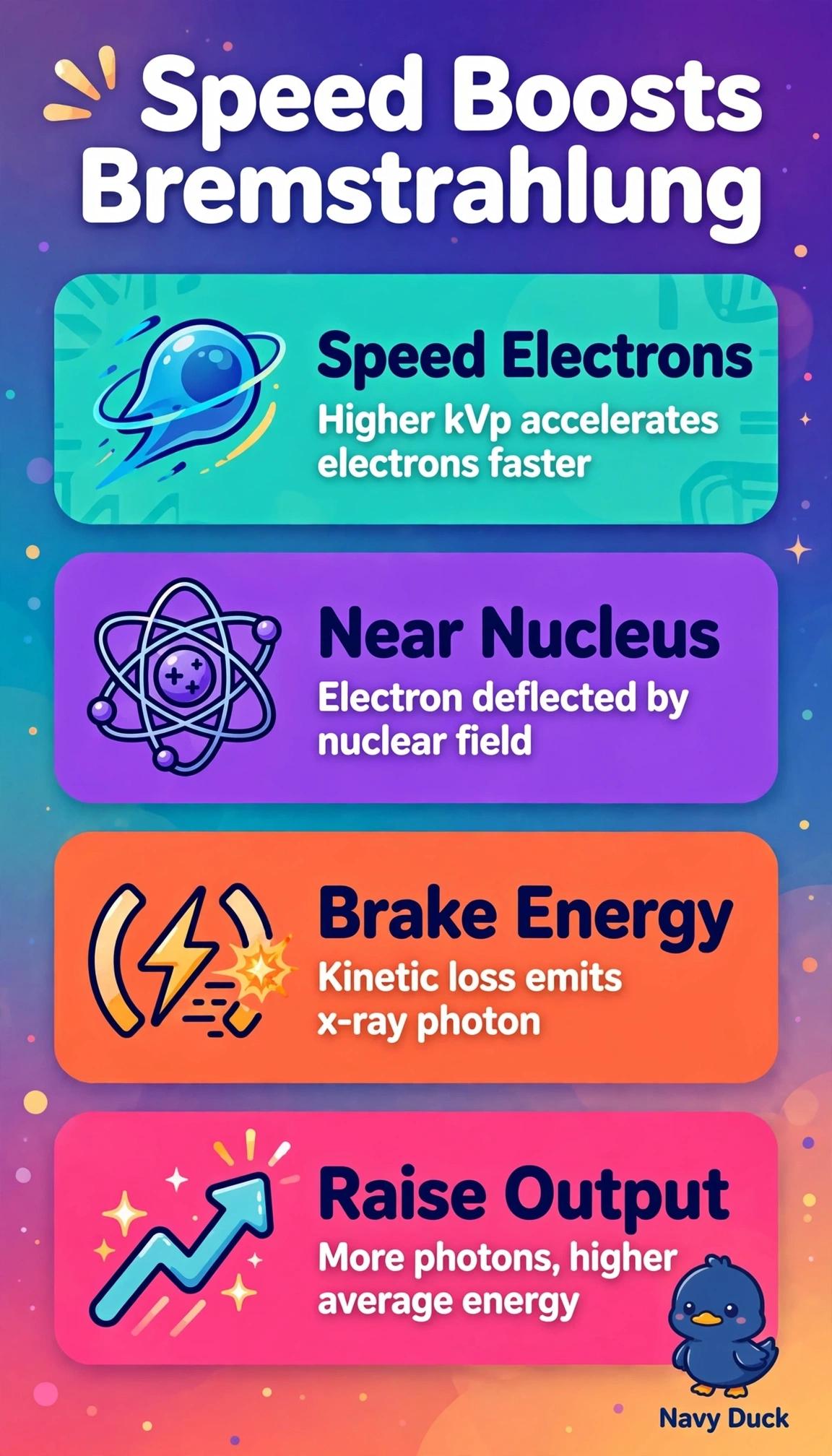
You are seeing speed turn into spectrum. Faster electrons braking near nuclei boost bremsstrahlung, lifting both quantity and quality.
Full Explanation
Bremsstrahlung, or braking radiation, occurs when incident electrons are slowed and deflected by the positive nuclear field, with kinetic energy converted to x-ray photons forming a continuous spectrum; raising kVp increases both electron number striking the target efficiently and electron energy, so bremsstrahlung output rises approximately with kVp squared and average energy rises. Characteristic radiation requires incident energy above the K-edge to eject an inner-shell electron followed by outer-shell fill with a discrete photon, and while higher kVp exceeds the edge more often, it produces line emission rather than the dominant steep continuous increase in total output. Thermionic emission governs electron supply at the filament and responds to filament current and mA, not to kVp-driven electron speed, so that approach confuses quantity control with beam quality. Photoelectric absorption is an x-ray photon interaction in the patient or detector, not an electron-target production mechanism, so it cannot explain creation of photons at the anode; exam caveat is that tungsten K-characteristic photons are about 69 keV and need kVp above that threshold, and practical check is to correlate kVp changes with exposure indicator and half-value layer.