
A radiologist cannot see subtle lung nodules and rib detail on the same portable chest image, with correct exposure confirmed and no repeat desired. Which postprocessing display adjustment using window level, width, and LUT best reveals both soft tissue and bone without re-exposure?
Select an answer to reveal the explanation.
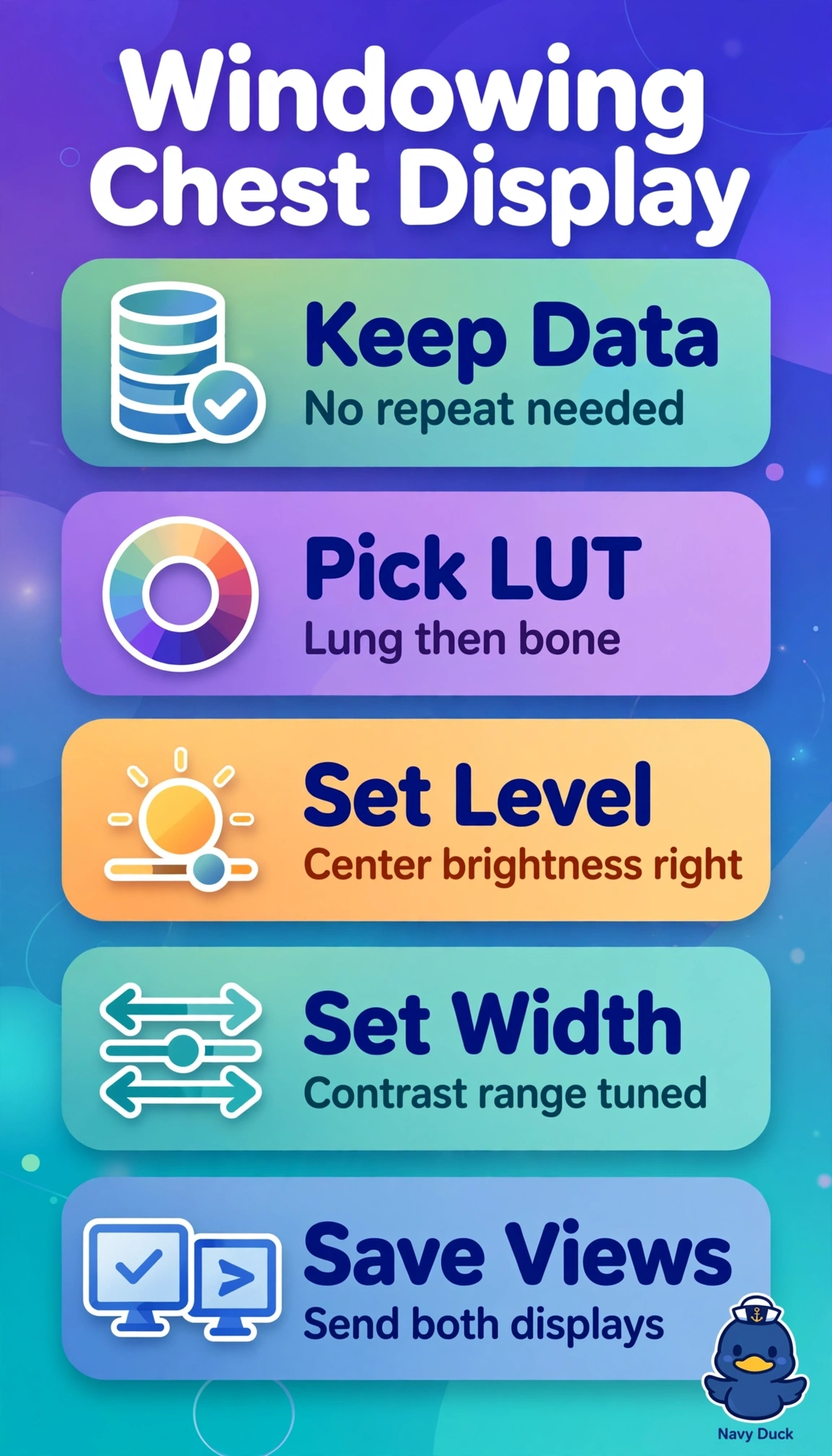
Short Explanation
You're tuning the image like stage lights for each act. Smart windowing with preset LUTs lets lungs glow soft while bones stay crisp, all from one exposure.
Full Explanation
The correct display solution works because a portable chest contains very low attenuation aerated lung and very high attenuation ribs in one high dynamic range acquisition, so no single brightness setting can show both; preset VOI LUTs provide calibrated mappings for lung parenchyma and for bone while separate adjustment of window level selects the center attenuation and window width controls the displayed contrast range, rendering subtle nodules conspicuous without washing out cortical detail and without altering stored values or dose. Adjusting a single global window with sigmoid LUT fails by concept because windowing is a display tradeoff and one center and width must compromise, either flattening low contrast nodules or clipping rib whites, which is why dual presentation is standard. Increasing exposure factors and repeating with higher kVp fails by concept because it confuses acquisition with postprocessing and violates correct exposure confirmed with no repeat desired, adding dose when data already exist. Applying magnification zoom with edge enhancement fails by concept because it changes scale and sharpness rather than the grayscale transfer function, so it cannot recover contrast hidden by an inappropriate window and may accentuate noise. Exam caveat is windowing never creates information or fixes true saturation, it only redistributes gray levels, so questions hinge on display versus reacquisition. Practical check is to toggle lung and bone presets, fine tune level and width, and confirm nodules and cortex remain visible before dictating.