
A 71-year-old postoperative patient on 2 L nasal oxygen with a left forearm IV infusion, indwelling urinary catheter and recent tracheostomy needs a portable chest radiograph in a semi-private room. The nurse asks the radiographer to move the patient upright without disrupting support devices. Which patient-assistance sequence should the radiographer follow for this multi-device transfer?
Select an answer to reveal the explanation.
Short Explanation
You're dancing with several partners at once. Secure tubing first keeps every lifeline slack and kink-free while you move.
Full Explanation
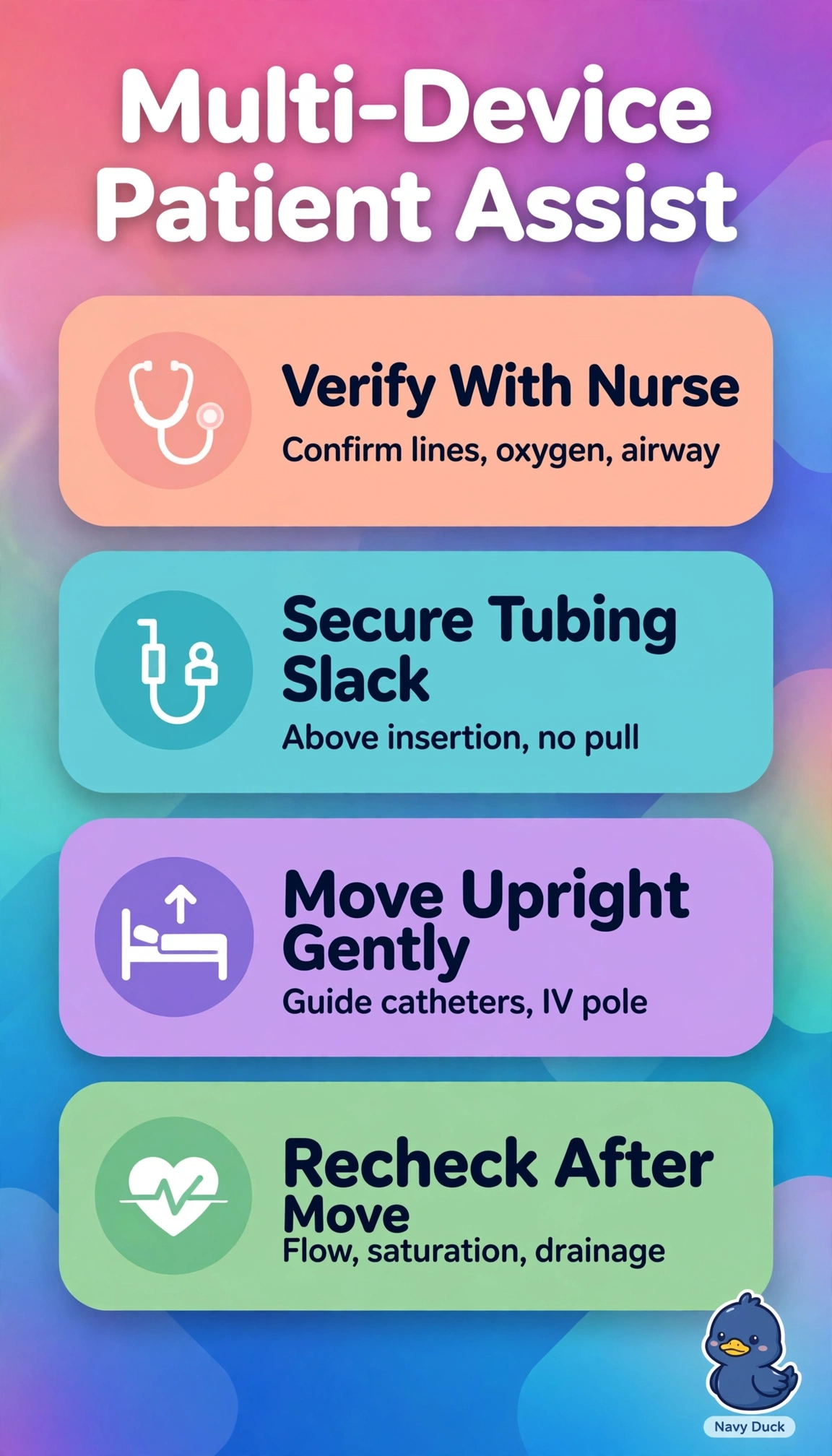
The correct sequence reflects safe multi-device transfer for a postoperative patient with concurrent nasal oxygen, forearm IV infusion, urinary drainage and recent tracheostomy needing an upright portable chest image, where joint verification with the nurse establishes line identity, patency and slack, securing tubing above insertion sites prevents traction, dislodgement and reflux during movement, and post-positioning recheck confirms unchanged oxygen delivery, infusion flow, tracheostomy patency and urinary drainage before exposure. An incorrect sequence that secures tubing and rechecks devices but omits joint verification fails by shared accountability, because independent handling risks misidentified lines, inadequate slack or unrecognized order changes despite otherwise good technique. An incorrect sequence that verifies beforehand and rechecks afterward but leaves tubing below insertion level during movement fails by gravity-dependent safety, because dependent loops invite traction on the IV and airway interface, backflow in drainage tubing and snagging on bedding during the upright assist. An incorrect sequence that verifies and secures correctly but exposes immediately without post-positioning rechecks fails by transfer reassessment, because even careful movement can kink cannula tubing, disturb flowmeters, tense catheter tubing or alter IV flow, so function must be reconfirmed after position change. An exam caveat is that upright technique and privacy in a semi-private room never supersede life-support continuity, so speed or image clarity alone does not justify skipping verification or recheck. A practical check is to trace each line from patient to source before and after moving, confirm 2 L flow with patent cannula and tracheostomy, observe IV drip and insertion site, confirm free urine flow without tension, and only then expose.