
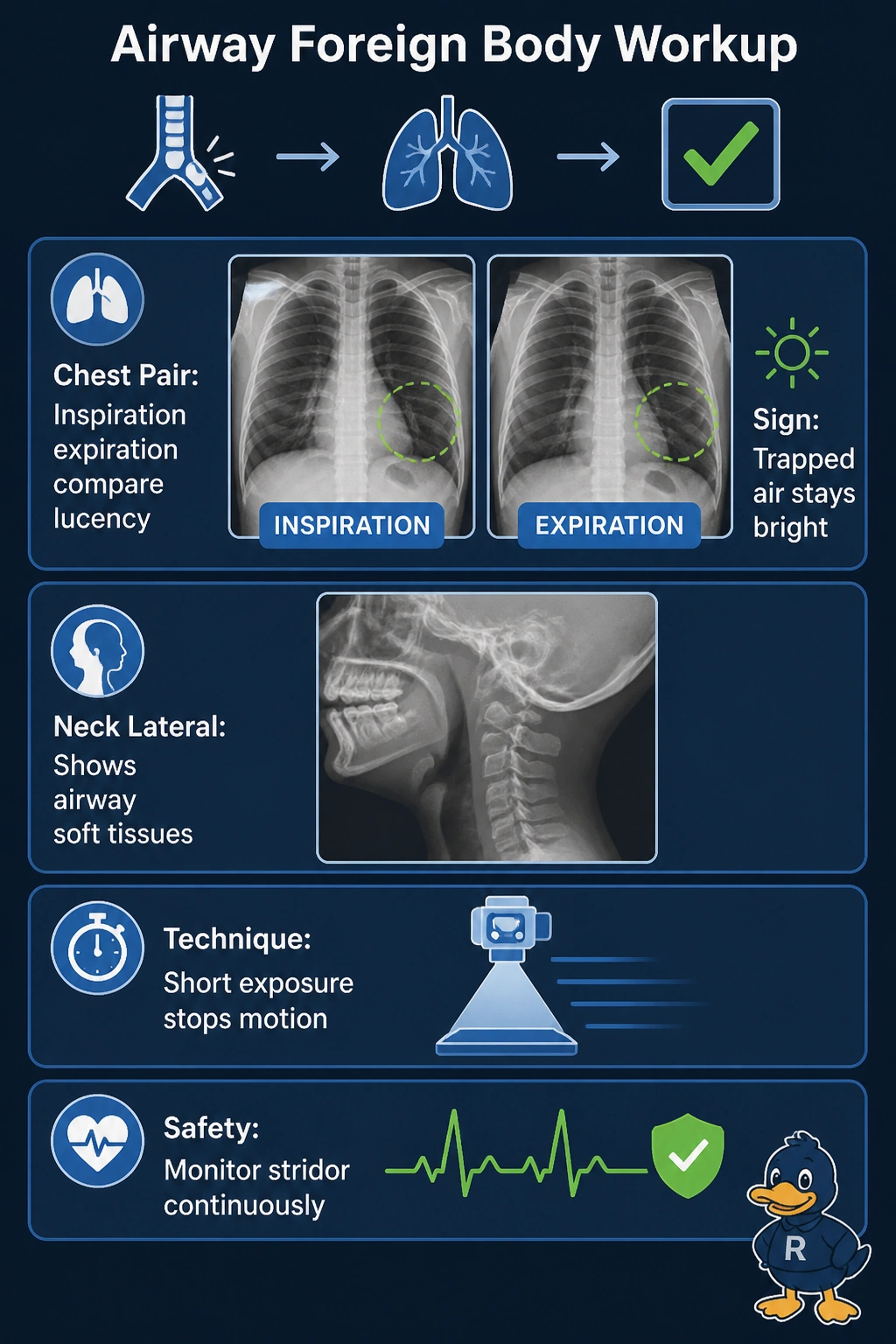
A toddler arrives at urgent care with stridor after suspected peanut aspiration. The radiologist requests inspiratory and expiratory chest films and a soft-tissue neck series. The child is crying and moving. Which imaging strategy best evaluates airway foreign body and soft-tissue neck?
Select an answer to reveal the explanation.
Short Explanation
You are hunting trapped air that will not leave. That breath-pair plus neck lateral gives you the air-trapping clue even with a wiggly toddler.
Full Explanation
Paired inspiratory-expiratory chest with lateral neck is correct because peanut aspiration causes ball-valve obstruction with unilateral air trapping best seen as persistent lucency and lack of volume loss on expiration compared with inspiration, while the lateral soft-tissue neck profiles the epiglottis, subglottic airway, retropharyngeal space and level of edema or radiolucent impaction causing stridor. An inspiratory chest with lateral neck is routine for airway narrowing and shows upper airway anatomy well, but it fails physiologically because without expiratory comparison subtle trapping cannot be confirmed and a normal inspiratory film may hide obstruction. A paired inspiratory-expiratory chest with AP neck satisfies lung dynamics and screens the pharynx, but it fails anatomically because frontal projection superimposes laryngeal structures and cannot reliably show epiglottic thickening, subglottic contour, retropharyngeal swelling or anterior displacement that define lateral assessment. A single expiratory chest with lateral neck highlights hyperlucency and lateral anatomy, but it fails comparatively because isolated expiratory lucency in a crying moving toddler may reflect effort, timing or rotation rather than true trapping without an inspiratory baseline for symmetry. Exam caveat is that crying mimics expiration and poor inspiration mimics disease, so phase labeling, nonrotation and neutral extension matter more than speed. Practical check is upright parent-assisted immobilization, correct markers, arms clear of apices, quiet inspiratory lateral neck and immediate review for repeat.