
A radiation safety in-service compares radon alpha particles in a basement exposure to diagnostic x-rays for chest imaging, noting differences in ionization density, hypoxic tumor response, and lethal dose estimates. Which radiobiologic explanation correctly links LET, RBE, oxygen effect, and LD50 for this alpha-versus-x-ray comparison?
Select an answer to reveal the explanation.
Short Explanation
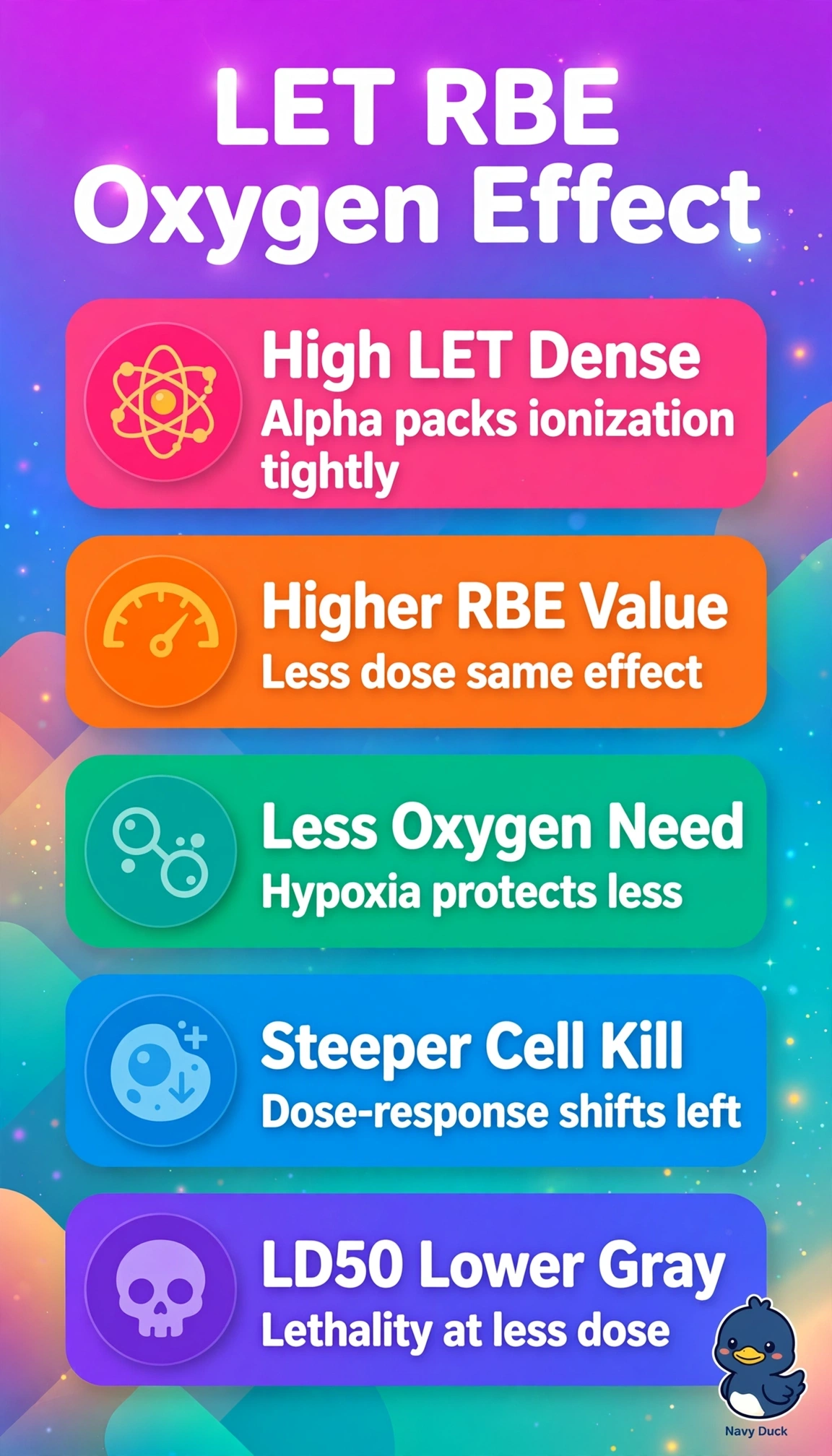
You've got alpha particles landing like power punches that don't need much oxygen to damage cells. That's why your RBE runs higher than x-rays and you'll see less hypoxia protection with a lower lethal dose.
Full Explanation
Linear energy transfer describes ionization density along a particle track, relative biological effectiveness compares the dose of a test radiation to reference x-rays for the same effect, the oxygen effect shows that hypoxia protects mainly against low-LET damage that relies on free radicals while high-LET damage is less oxygen dependent, and LD50 reflects whole-body lethality on a sigmoid dose-response curve where high-RBE radiation achieves the effect at lower absorbed dose. The low-LET higher-RBE with independence approach fails by concept because it inverts the LET-RBE relationship and misattributes oxygen independence to sparse ionization. The high-LET lower-RBE with greater dependence approach fails by concept because it reverses both effectiveness and the well-established reduction in oxygen enhancement ratio with dense ionization. The identical-RBE with identical-enhancement approach fails by concept because it denies track-structure differences that fundamentally separate dose-response slopes for alpha versus x-ray exposures. For the exam, associate high LET with high RBE, reduced oxygen effect, and lower LD50 dose in gray, then practically check that risk discussions specify radiation type rather than absorbed dose alone.