
A 64-year-old patient arrives in the ED after a steering-wheel impact with midline sternal tenderness and dyspnea. She can stand briefly but cannot lie prone because of pain. The physician orders a sternum series to evaluate for fracture. Which projection selection best visualizes the sternum while respecting this positioning limit?
Select an answer to reveal the explanation.
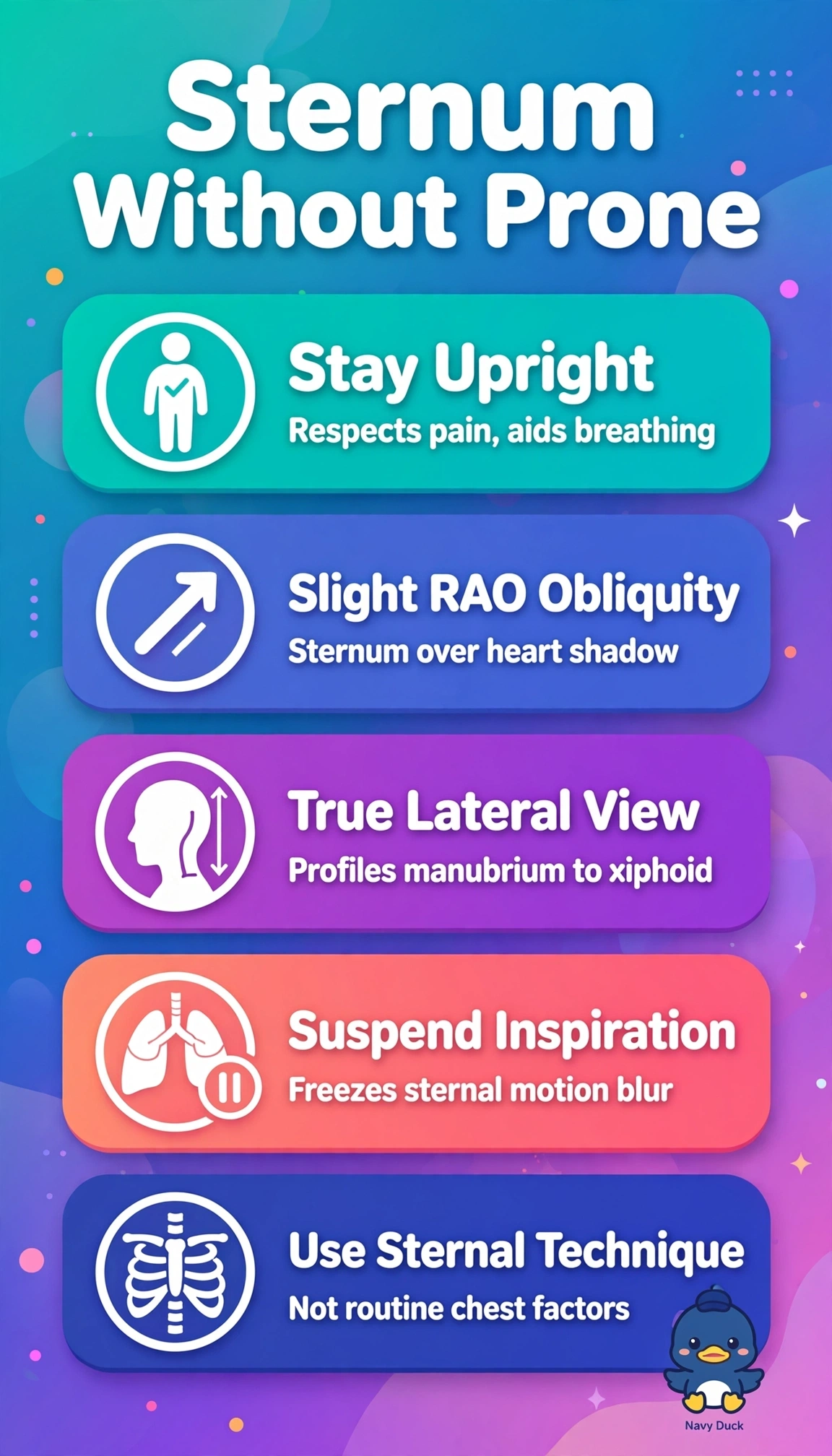
Short Explanation
You're hunting a sternal fracture without the prone option, so obliquity is your workaround. A slight RAO throws the sternum beside the spine using offset like stepping sideways to see around a post.
Full Explanation
The correct selection succeeds because upright positioning accommodates dyspnea and brief standing tolerance while avoiding prone pressure on an acutely tender sternum, slight 15- to 20-degree RAO obliquity projects the sternal body lateral to the thoracic spine onto the homogeneous cardiac shadow for optimal contrast without excessive rotation, and a true lateral profile obtained with respiration suspended after inspiration freezes rib and lung motion to sharply delineate cortical margins and displacement. The prone RAO combination fails by positioning concept despite ideal image quality, since direct sternal compression against the table is intolerable with acute fracture tenderness and contraindicated by the stated inability to lie prone. The upright LAO variant fails by projection geometry, since left anterior obliquity rotates the sternum over the thoracic spine and heterogeneous lung rather than the heart, reducing visibility and mimicking a non-sternum oblique. The upright RAO with lateral taken during continued deep breathing fails by motion-control concept, since failure to suspend respiration blurs fine fracture lines through overlying ribs and pulmonary markings. A common exam caveat is confusing sternal RAO with anterior ribs or sternoclavicular obliques that use steeper angulation and different centering, so verify slight obliquity, sternal centering, and suspended inspiration rather than full aeration technique. A practical check is to confirm an undeformed lateral sternum superimposed over soft tissues anterior to the heart without rotation, assess the RAO for sternum clear of spine, and reassess breathing instructions and pain-limited upright tolerance before exposure.