
A radiographer assists with a 25-minute mobile C-arm case in the OR, with staff close to the table, a removable grid slot on the unit, and concern about unnoticed beam-on time. Which personnel protection combination using drapes, slot cover, and timer best limits staff dose during this fluoroscopy case?
Select an answer to reveal the explanation.
Short Explanation
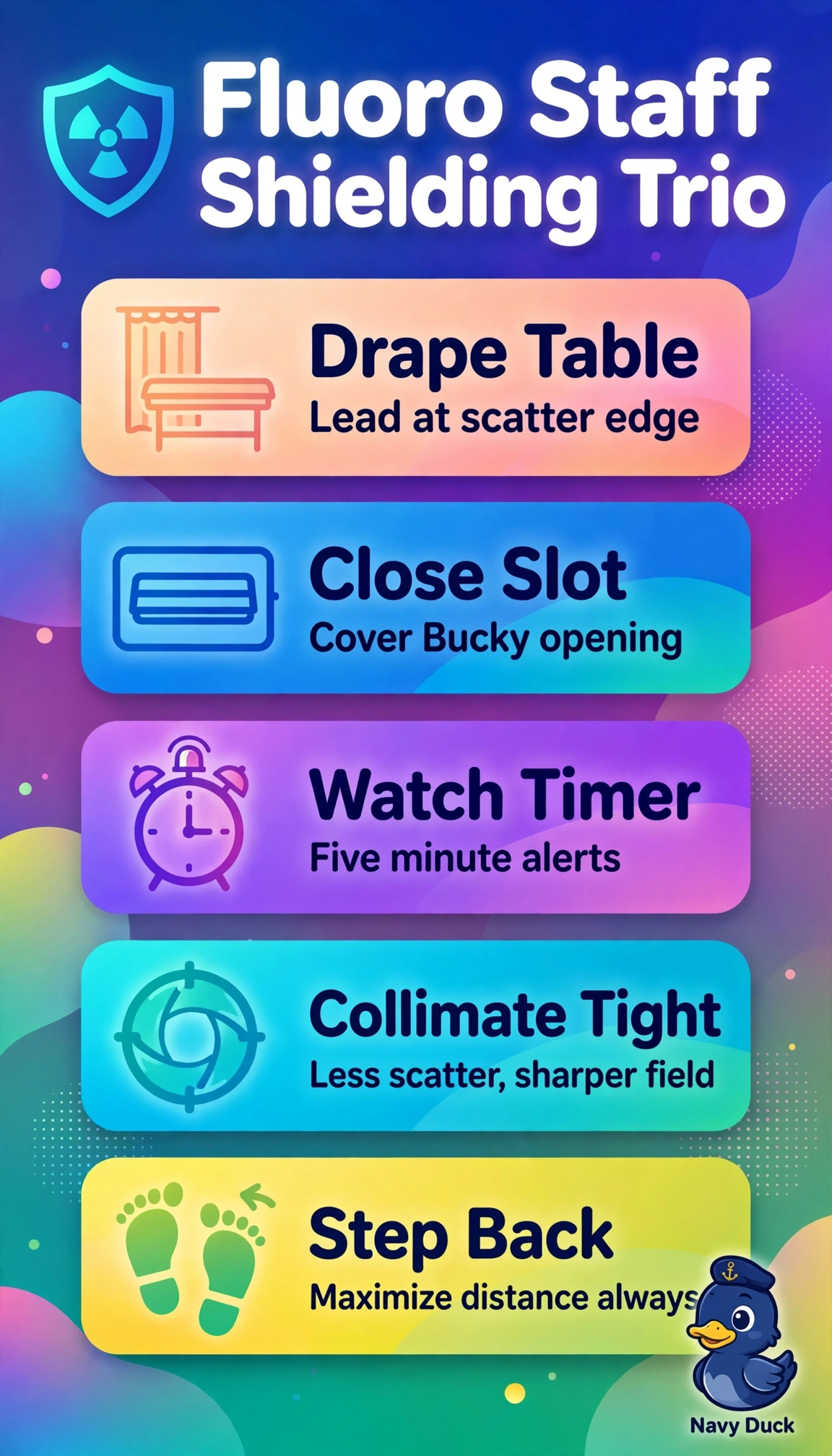
You’re creating a strong barrier against scatter while keeping track of exposure over the whole case. Table-edge drapes, a secured Bucky slot cover, and a cumulative timer with dose alerts help protect nearby staff and catch unnoticed beam-on time.
Full Explanation
For a 25-minute C-arm case with staff close to the table, table-edge lead drapes, a secured Bucky slot cover, and a 5-minute cumulative timer with dose alerts address the main sources of staff exposure. The drapes attenuate patient and tabletop scatter at the height of nearby staff; the cover blocks leakage and stray radiation through the unused Bucky opening; and cumulative timing tracks total beam-on time so exposure does not quietly accumulate. Table-edge drapes and a secured cover paired only with a single-exposure timer fall short because that timer limits each individual exposure but does not sum fluoroscopy time. Drapes around the image intensifier tower are poorly placed: they intercept exit beam above the patient rather than the intense table-edge scatter that exposes the trunk and legs of nearby staff. Leaving the Bucky slot open with the grid in place fails to provide the lead-lined closure needed to limit leakage and backscatter. An exam caveat is to distinguish worker scatter protection from patient dose reduction: collimation and pulsed fluoroscopy can help the patient but do not replace staff drapes, slot closure, and time tracking. Practically, confirm the drapes hang without gaps, the cover latches, and the cumulative timer is reset, audible, and monitored.