
A 58-year-old inpatient with incomplete colonoscopy due to tortuosity is ordered for a fluoroscopic contrast enema to evaluate the sigmoid colon for stricture, with no biliary symptoms or recent surgery. The radiologist wants mucosal relief with safe pressure control. Which enema setup should the radiographer prepare for this single-contrast evaluation?
Select an answer to reveal the explanation.
Short Explanation
You're backfilling a winding road gently. Gravity enema fills the colon evenly without forcing pressure like a squeezed hose.
Full Explanation
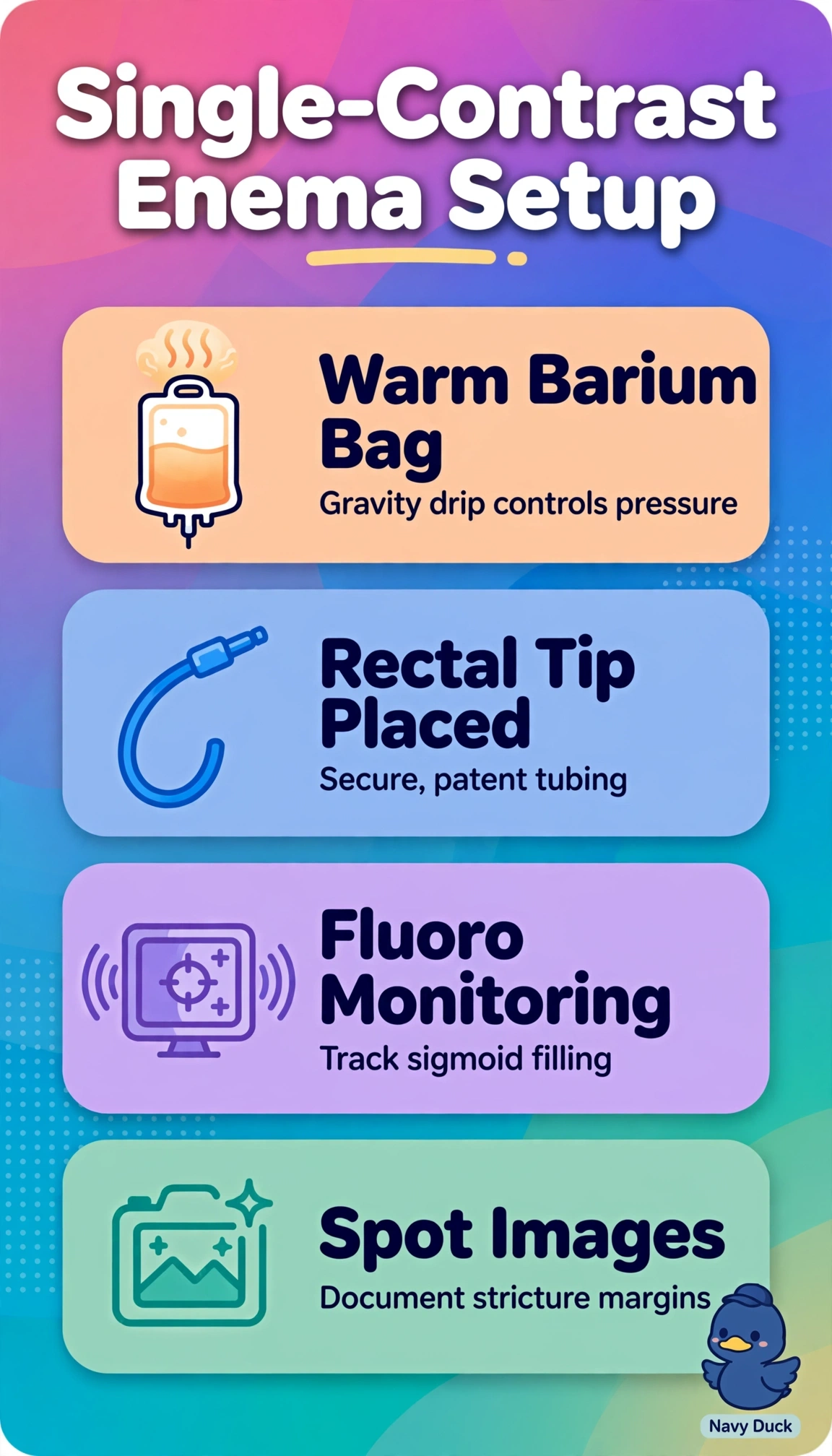
The ordered study is fluoroscopic single-contrast evaluation of sigmoid stricture after incomplete colonoscopy due to tortuosity, so warm isotonic barium by gravity drip via rectal tip with fluoroscopic spot images is correct because barium coats intact mucosa for mucosal relief, warmth reduces spasm to aid filling of the tortuous segment, and open gravity flow inherently limits hydrostatic pressure by bag height while allowing real-time fluoroscopic control and spot documentation. A dense-barium double-contrast technique with controlled air insufflation is ideal for polyp screening and fine mucosal detail but violates the prescribed single-contrast method and adds unnecessary distension and complexity for stricture assessment. A water-soluble iodinated enema by gravity drip is indicated for suspected perforation, leak, or postoperative anastomotic evaluation but is inappropriate here with no peritoneal signs or recent surgery, and iodine provides inferior coating and relief in intact colon. A powered pump injection of warm isotonic barium can opacify colon but violates safe pressure control because mechanized delivery can rapidly exceed physiologic intraluminal pressure whereas gravity height predictably regulates pressure. An exam caveat is to match indication to contrast and technique rather than assuming denser contrast or added air is always better, remembering perforation favors water-soluble agents and polyp detection favors double contrast while uncomplicated stricture favors single-contrast barium. A practical check is to confirm the single-contrast order, warm the suspension, hang the bag no more than about 60 cm (24 inches) above the table with vented gravity set and rectal tip only, monitor filling continuously under fluoroscopy, and obtain sigmoid spots in multiple obliquities.