
A high-school soccer player with a suspected lateral malleolar fracture needs an ankle series in a small ED room with a wall Bucky. The physician wants the tibiofibular joint open without overlap to assess stability. Which ankle positioning action best demonstrates the mortise joint space on this injured athlete?
Select an answer to reveal the explanation.
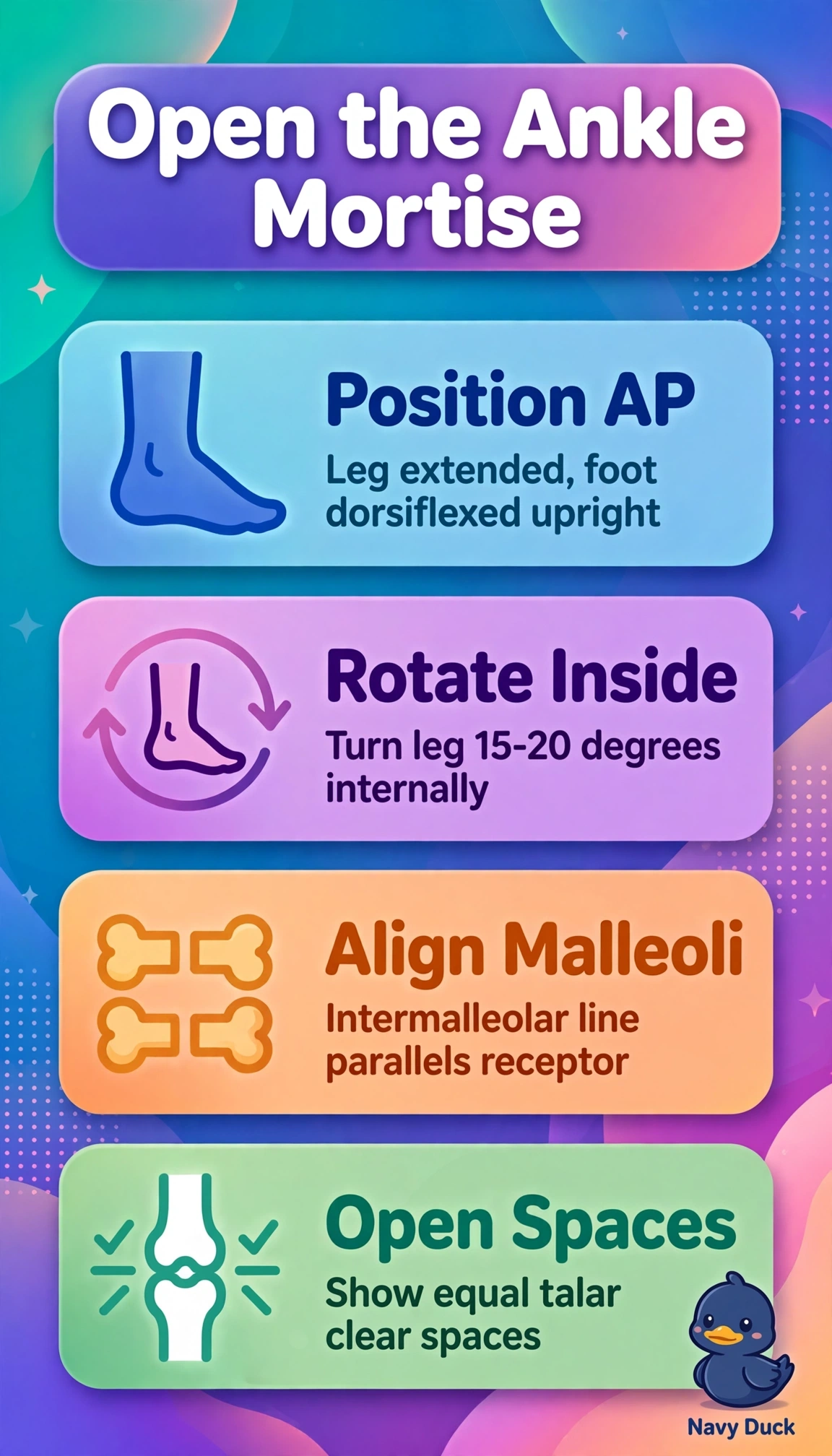
Short Explanation
You have got the joint-opening trick down. That slight inward turn gives you a true mortise with even joint spaces.
Full Explanation
The AP mortise is an AP ankle with 15 to 20 degrees internal rotation that places the intermalleolar line parallel to the image receptor, opening the lateral mortise and tibiofibular articulation with roughly equal 3 to 4 mm clear spaces around the talus while the medial mortise remains open. A 45-degree external oblique exaggerates overlap differently and is useful for the distal tibiofibula and posterior malleolus but closes the mortise rather than profiling it symmetrically. Dorsiflexing to 90 degrees for a lateral ankle profiles tibiotalar alignment, joint effusion, and malleoli in profile but superimposes the joint spaces instead of opening the mortise en face. A 40-degree cephalad axial through the plantar surface describes a plantodorsal calcaneal projection that evaluates the calcaneus and subtalar region, not the ankle mortise; exam caveat is to keep the leg rotated as a unit without just turning the foot, and practical check is to see open lateral clear space with the fibula slightly separated from the tibia.