
A radiation safety in-service compares alpha particles from radon with x-rays for lung tissue. Staff ask why equal absorbed doses cause different biologic harm. Which radiobiology concept best explains the difference in biologic effectiveness per unit dose?
Select an answer to reveal the explanation.
Short Explanation
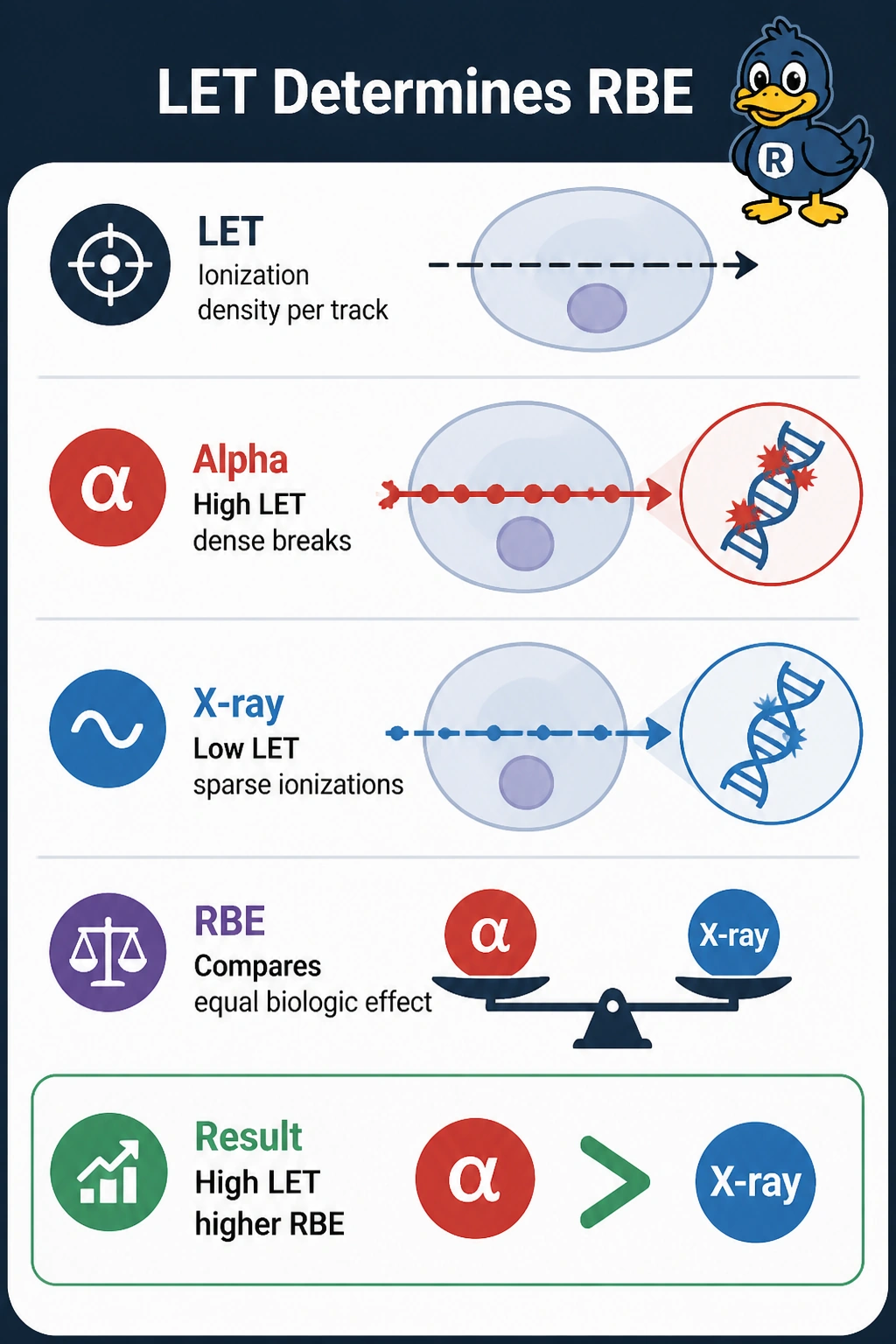
You are tracking energy crowding, not just total dose. Dense ionizations make high-LET hits far harder for cells to repair.
Full Explanation
The stem asks why identical absorbed dose produces different lung harm, which is the definition of radiation quality and relative biological effectiveness driven by linear energy transfer. High-LET radon alphas deposit energy densely along short tracks, causing clustered complex DNA breaks that repair poorly compared with sparse low-LET x-ray ionizations, so less alpha dose is needed for the same effect and RBE exceeds one for relevant endpoints. The oxygen idea is clinically important because oxygen fixes radical damage and increases x-ray cell killing, but it describes a chemical sensitizer mainly for low-LET radiation rather than intrinsic track density, and high-LET lethality is notably less oxygen dependent, so it cannot explain alpha versus x-ray quality. The fractionation idea is clinically important because protraction and intervals allow sublethal damage repair and spare late lung tissue, but it explains tolerance versus timing and total dose rather than effectiveness per gray when quality differs. The half-life idea is important for internal dosimetry because inhaled radon lung dose depends on decay, deposition and biological clearance, but it predicts how much gray accrues rather than why equal gray differs in consequence. Exam caveat is to separate RBE for different qualities producing the same endpoint from oxygen enhancement or time-dose factors and recall RBE changes with dose, endpoint and reference radiation. Practical check is to rephrase as same gray, different damage, different track structure, then choose the quality factor and cross-check with radiation weighting for alpha risk estimates.