
A fluoroscopy suite is upgrading from an image-intensifier tower to a flat-panel dynamic detector for barium studies. The radiologist notes dose creep during long swallows and asks how exposure control differs. Which statement best describes fluoroscopic automatic exposure control in the new flat-panel system?
Select an answer to reveal the explanation.
Short Explanation
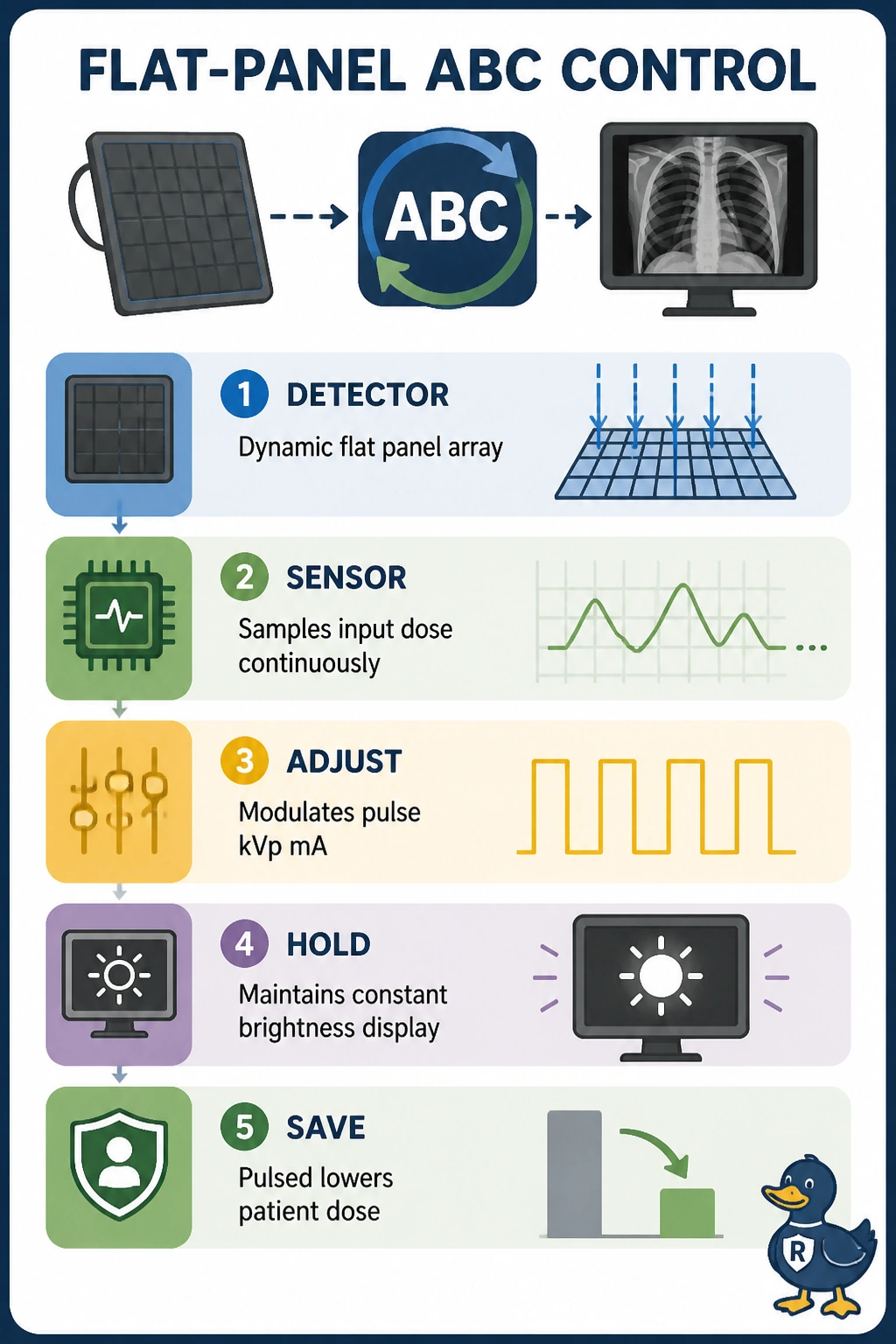
You have got the upgrade logic — flat panels ditch the glow tube. Modern ABC is your smart dimmer, pulsing output to keep brightness steady.
Full Explanation
The correct description holds because flat-panel dynamic fluoroscopy uses automatic brightness control as a closed feedback loop sampling detector entrance signal over a region of interest and continuously adjusting kVp, mA, pulse width, added filtration and pulsed frame rate to maintain target brightness and signal-to-noise despite changing barium thickness and attenuation, countering dose creep by lowering output when attenuation is low and raising it only as needed. The gain-alone claim fails as image-intensifier video-chain autogain, which maintained brightness electronically after detection, whereas flat-panel wide dynamic range requires modulating actual technique to control quantum noise and dose rather than amplifying noise. The end-spot-at-set-dose claim fails as radiographic automatic exposure control for single acquisition, which terminates exposure at a threshold, not continuous regulation sustaining brightness over minutes without terminating the run. The lock-pulse-rate-to-fix-entrance-dose claim fails by inverting goal and method, since fluoroscopy holds brightness constant by varying output and pulse rate while entrance dose rises with thick barium, not fixing technique and letting brightness fall. Exam caveat: vendors blur ABC, automatic dose rate control and AEC, but tests reserve AEC termination for spot/radiographic images and ABC pulsing for live fluoroscopy. Practical check: watch generator kVp, mA, ms and pulses per second rise behind dense barium and fall over aerated neck while monitor brightness stays constant and dose-area product accrues slower at lower pulse rates.