
A 45-year-old patient needs a 10-minute upper GI fluoroscopy evaluation, and the radiologist asks the radiographer to keep dose as low as reasonably achievable without losing diagnostic motion detail. The tower has pulsed mode, last-image-hold, variable magnification and an adjustable spot-film rate. Which fluoroscopy dose strategy should the radiographer apply during this prolonged guidance?
Select an answer to reveal the explanation.
Short Explanation
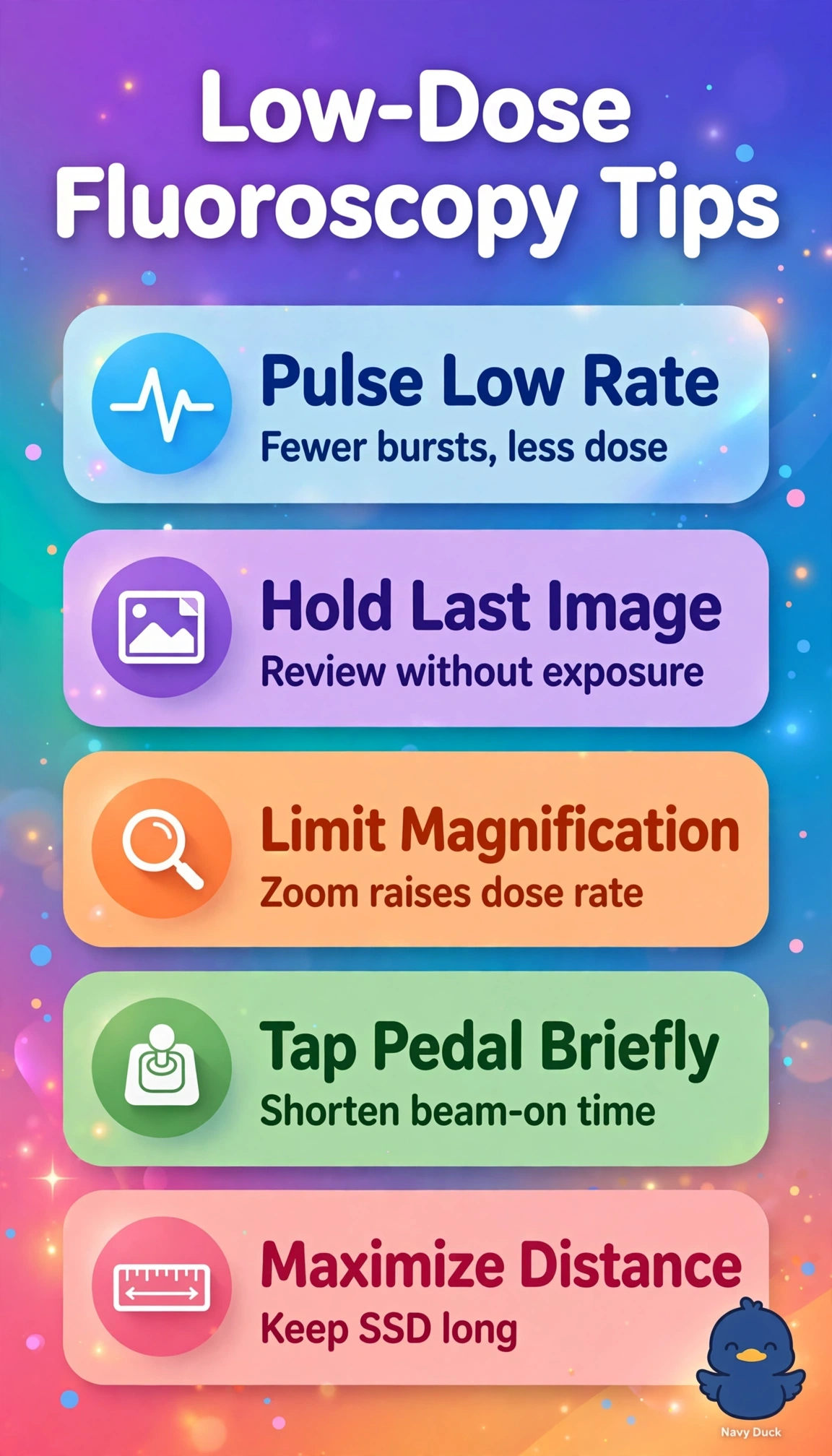
You're filming a long movie, so you shoot fewer frames. Pulsed fluoroscopy plus hold cuts beam-on time like pausing instead of rewinding.
Full Explanation
The correct strategy balances ALARA with diagnostic motility because low-rate pulsed fluoroscopy delivers X-ray in brief pulses rather than continuously, cutting beam-on time and total mAs over a 10-minute upper GI study while frame rate remains sufficient for swallowing and peristalsis, last-image-hold allows review and discussion without additional exposure, minimal field magnification keeps input dose rate low and noise acceptable, and short intermittent taps further limit scatter and skin dose. The strategy using continuous pedal pressure despite pulsed mode and last-image-hold fails by time concept because total exposure time dominates cumulative dose in prolonged guidance and continuous activation negates pulsing benefits. The strategy adding routine high-detail spot-film sequences fails by dose-distribution concept because spot acquisitions use substantially higher exposure per frame than fluoroscopy or hold images and should be selective rather than routine when motion review suffices. The strategy keeping steady electronic magnification fails by geometry concept because magnified modes use a smaller image-intensifier input field requiring higher entrance exposure rate to maintain brightness and signal-to-noise, which compounds significantly over ten minutes. Exam caveat: do not confuse improved contrast resolution from magnification with acceptable routine use, as boards test that magnification always increases patient dose rate. Practical check: confirm low pulse rate, zero magnification, last-image-hold displayed, and use tap-and-review technique with time, kerma, and image count monitored.