
In a busy outpatient center, a restless toddler needs a voiding study and keeps sliding off the table, and the resulting image shows the caregiver's fingers over the bladder edge. The technologist considers soft wrist ties and cropping out the fingers with postprocessing. Which combined restraint and electronic image-data action meets ethical and legal standards for this pediatric case?
Select an answer to reveal the explanation.
Short Explanation
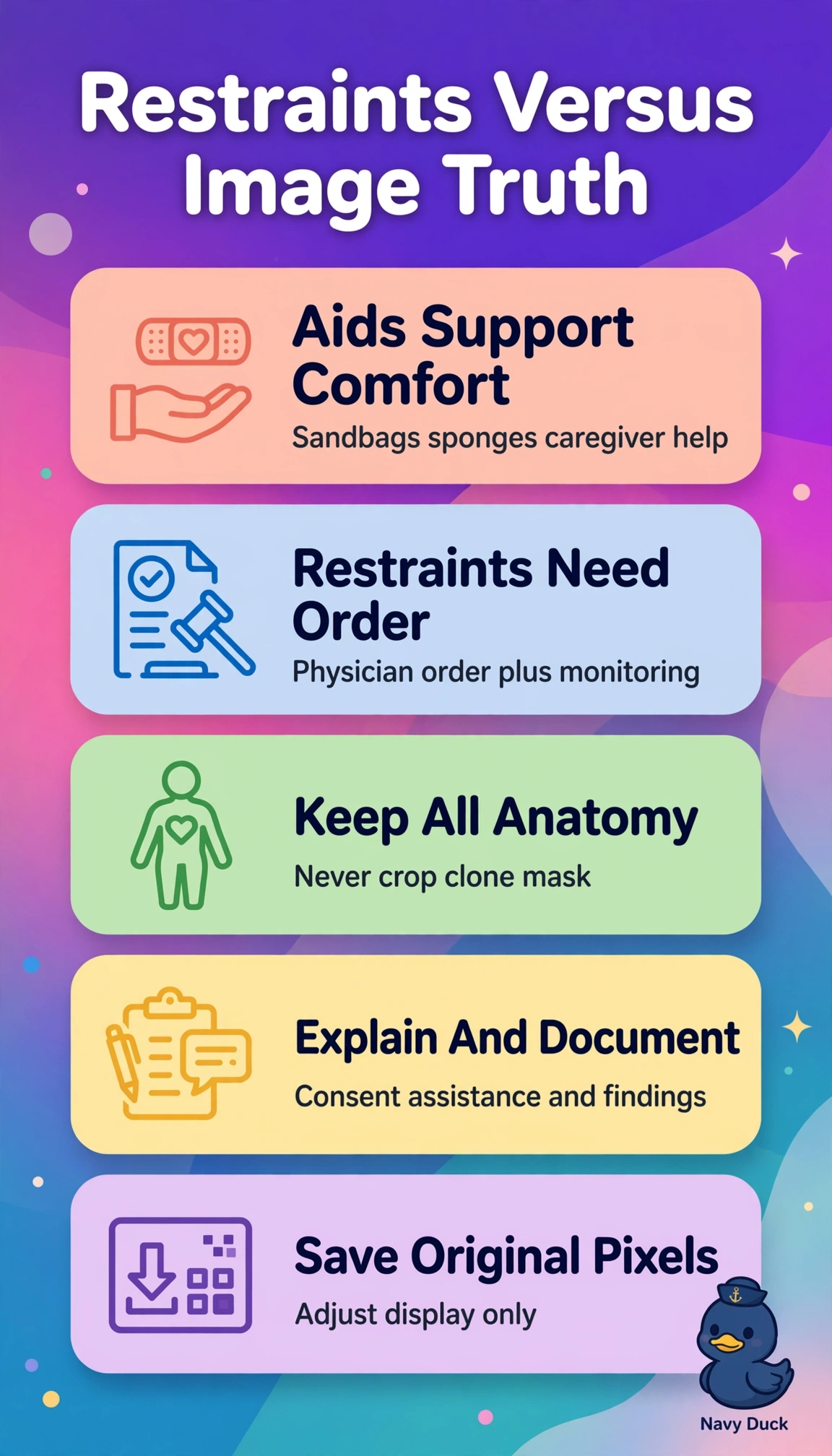
You protect little patients by supporting, not tying, and by showing everything you captured. Sandbags and a caregiver steady the child while untouched pixels keep the record honest, like leaving a receipt unedited; fidelity is your safeguard.
Full Explanation
Sandbags with caregiver assistance provide least-restrictive, non-mechanical support for a toddler who is sliding, with consent discussion and comfort measures; retaining all original data without masking, cropping, or cloning preserves legal integrity and diagnostic truth when fingers overlie the bladder edge. Keep the caregiver’s hands clear of the field and, if the anatomy remains obscured, reposition and repeat rather than edit. A papoose board fails on proportionality: even with a valid order, parental consent, and full retention, full-body mechanical immobilization is excessive for simple sliding when minimal support suffices and needlessly increases distress and oversight. Sandbags with caregiver assistance plus an electronically collimated display copy fail on diagnostic integrity: retaining the original meets retention rules, but the copy excludes the finger-covered bladder edge, risking hidden pathology and misrepresentation of collimation. A secure swaddle with caregiver help fails on physiologic compatibility: although it offers familiar support and preserves the original, tight wrapping to prevent sliding restricts pelvic motion and inhibits voiding, defeating the study’s purpose. Exam caveat: distinguish permitted display optimization away from pathology, with the original retained, from excluding anatomy over the diagnostic region; editing cannot fix that. Practical check: confirm consent, use minimal support, keep caregiver hands outside the field with protection, retain unaltered originals in PACS with documentation, and reposition and repeat if anatomy remains obscured.