
A new flat-panel detector shows fixed grainy shading across all images despite correct exposure, and service asks about calibration that corrects pixel gain differences before clinical use. Which raw data preprocessing correction should the team verify first to restore uniform detector response?
Select an answer to reveal the explanation.
Short Explanation
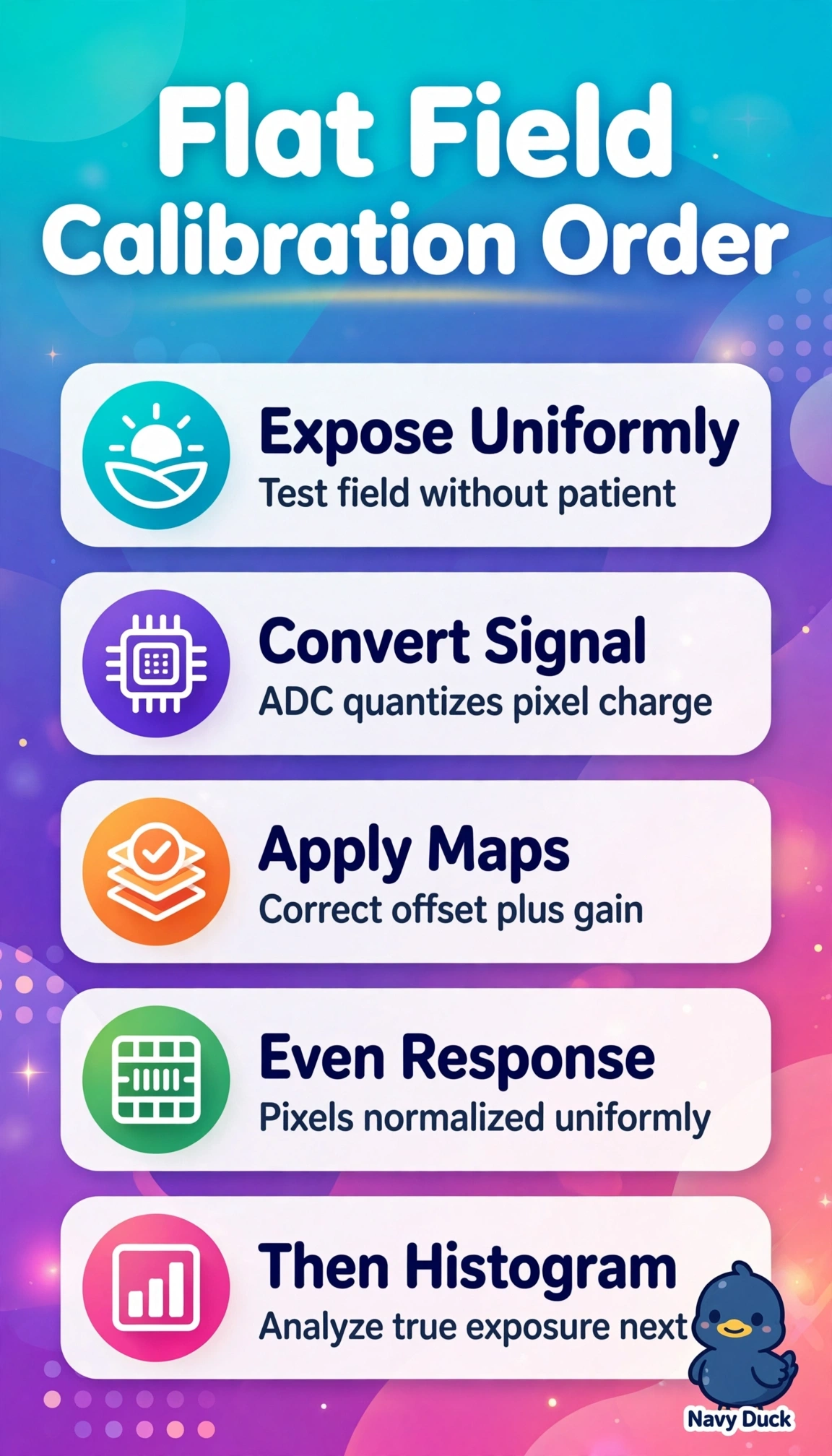
Your detector needs an even canvas before painting anatomy, and you're setting it right. Proper flat-fielding evens out each pixel's quirks so shading vanishes and the histogram sees true exposure.
Full Explanation
Fixed grainy shading stable across all images despite correct exposure points to variable pixel sensitivity, and flat-field gain correction is the raw preprocessing calibration that multiplies raw data by a stored uniformity map to normalize individual detector element response before histogram analysis and clinical display. Dark-current offset calibration is a valid raw preprocessing step but it subtracts baseline electronic signal measured without radiation, so it corrects zero-level drift rather than exposure-dependent gain variation and cannot remove fixed mottling that scales with dose. Defective-pixel interpolation is routine raw preprocessing that detects permanently nonresponsive elements and replaces them from neighboring values, but it corrects isolated points or lines rather than global sensitivity inhomogeneity and therefore leaves diffuse shading intact. Image lag correction is also standard preprocessing that estimates and subtracts retained charge from prior exposures, but it targets history-dependent ghosting that changes with sequence timing rather than a stable gain pattern present even on first exposure. An exam caveat is that all four calibrations are grouped as detector calibration, so distinguish exposure-independent uniform offset versus exposure-proportional global nonuniformity versus isolated defects versus temporal carryover. As a practical check, expose a uniform phantom, review the unprocessed raw image and uniformity metrics, and reacquire the gain map if mottling persists after offset correction.