
A busy fluoroscopy suite replaces an old image-intensifier tower with a flat-panel dynamic system for barium and joint injections. The radiologist notices steadier brightness during panning, dose-rate changes with patient thickness, and cine clips stored directly to PACS. Which fluoroscopic equipment function best explains automatic brightness and dose control during this upgrade?
Select an answer to reveal the explanation.
Short Explanation
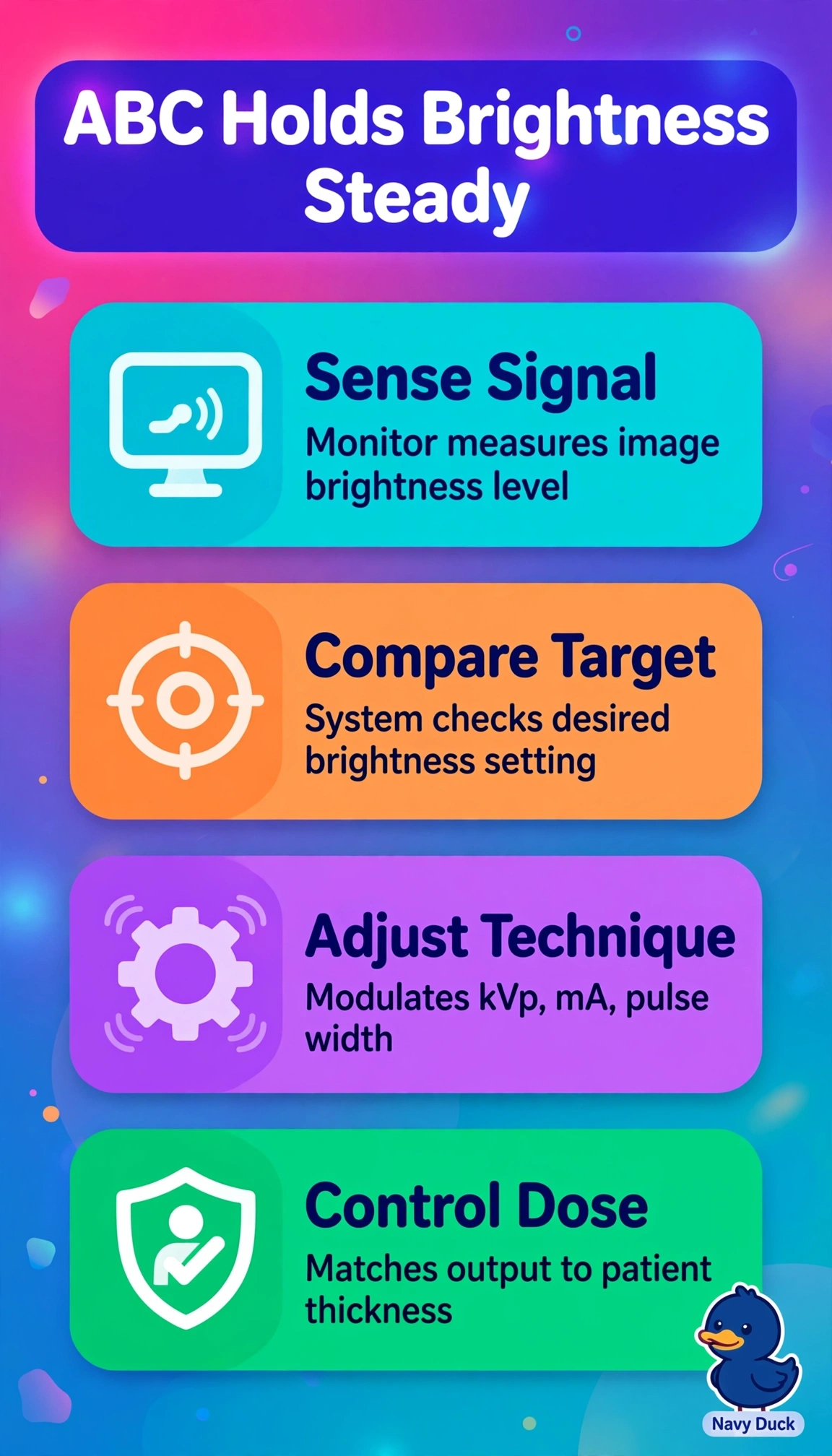
You are watching feedback do its job in real time. Steady images during panning come from automatic brightness control constantly retuning technique for you.
Full Explanation
The upgrade retains closed-loop feedback where the measured detector input dose drives continuous adjustment of kVp, mA, and filtration to hold display brightness constant as anatomy thickness, magnification, and panning change, which is exactly the definition of automatic brightness control and in flat-panel systems is often termed automatic dose-rate control; it explains both steadier brightness and thickness-dependent dose rate while remaining distinct from archival functions. Automatic exposure control is valid for terminating discrete barium spot radiographs at preset detector dose but it does not continuously modulate technique during live fluoroscopy, so it cannot explain panning stability. Pulsed fluoroscopy is valid for reducing temporal dose by using brief exposures at selected pulse rates, yet it governs frame timing rather than the brightness-feedback loop that upregulates output for thicker parts. Flat-panel gain and offset calibration is essential for uniform, artifact-free images by correcting individual pixel sensitivity, but it is a periodic uniformity correction, not a real-time kVp-mA controller. Exam caveat is to distinguish control loop purpose from dose-saving or image-uniformity tools when stems emphasize constant brightness across changing thickness. Practical check is to pan across an abdomen-to-lung interface or add attenuation and watch technique readouts change while brightness stays stable, confirming the feedback loop is active.