
A small urgent-care site reports lower output and a slightly cooler anode track on its aging radiographic tube. The filament current was recently reduced to extend tube life, but kVp and mA station settings are unchanged. Which stage of x-ray production explains the reduced electron supply for acceleration and focusing?
Select an answer to reveal the explanation.
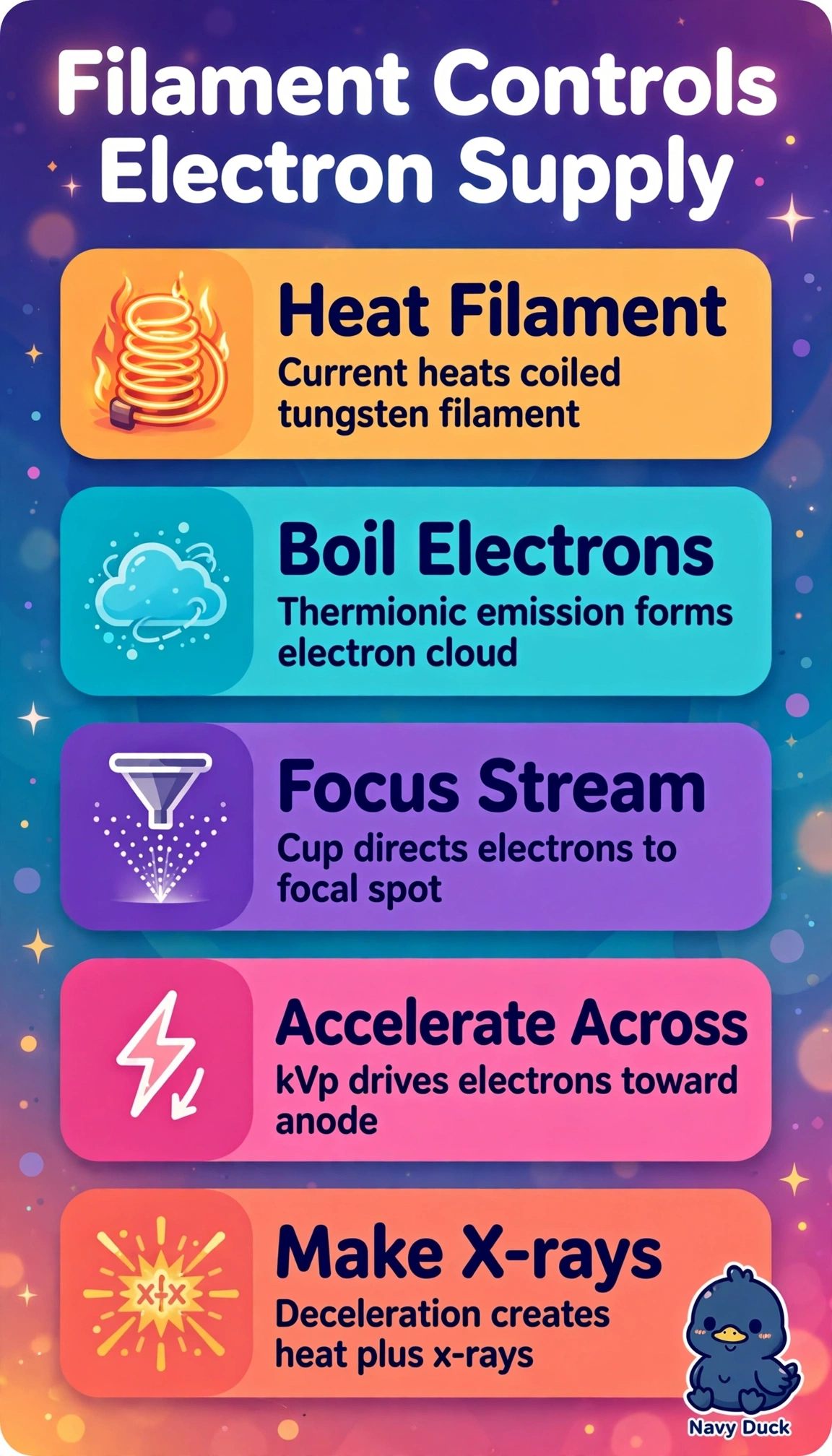
Short Explanation
You nailed the cause when you track the cloud first. A cooler filament means weaker thermionic emission, so fewer electrons are ever available to accelerate.
Full Explanation
Thermionic emission describes electrons boiled off the heated filament to form the space charge, and filament current directly controls that cloud size; acceleration by kVp, focusing by the focusing cup, and deceleration in the anode then act only on electrons already available, so reducing filament heating lowers mA and output even when console selections look unchanged. Acceleration using kVp controls electron speed and penetration but does not create the supply, so invoking kVp fails because the scenario states kVp is unchanged and the root change was filament current. Focusing with the negatively charged cup shapes the electron stream toward the focal spot but does not determine total electron number, so that approach misses the stated cooler filament and reduced cloud. Deceleration in the target converts kinetic energy to heat and x-rays, and a cooler track is the result of fewer incoming electrons rather than the cause, so that approach reverses cause and effect; exam caveat is to separate mA-related quantity from kVp-related quality, and practical check is to verify filament current, space-charge behavior, and exposure linearity before blaming kVp or anode condition.