
A 62-year-old outpatient with progressive dysphagia is scheduled for an esophagram to evaluate a mid-esophageal lesion. The radiologist wants live swallowing dynamics plus distended mucosal detail, with no gastric or small-bowel follow-through. Which contrast administration sequence should the radiographer prepare for this esophagram swallowing study?
Select an answer to reveal the explanation.
Short Explanation
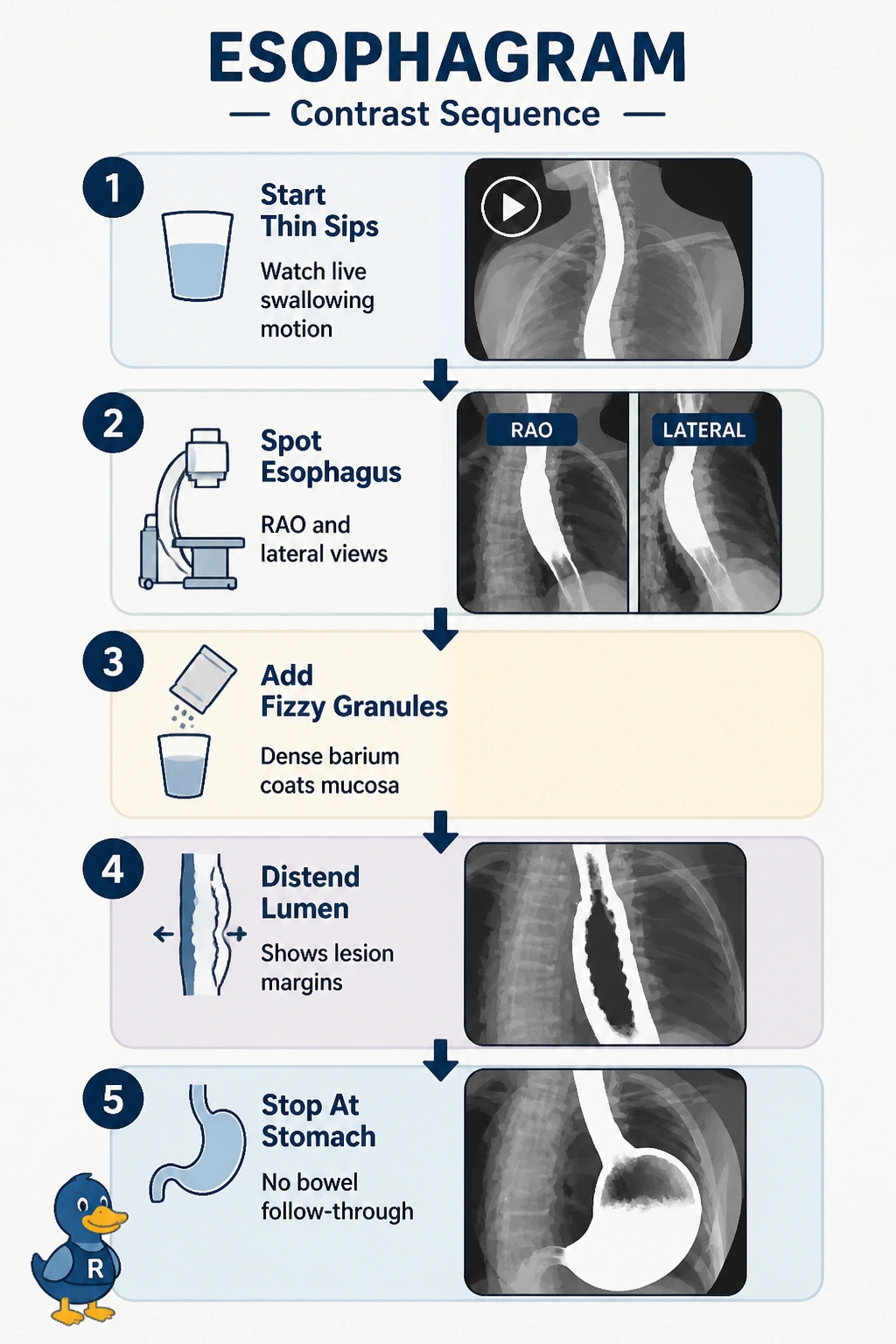
You’re evaluating swallowing motion and then the distended esophageal lining, so keep the study focused on the esophagus. Thin barium shows motion live; afterward, effervescent granules and high-density barium coat the stretched lining like syrup on pancakes.
Full Explanation
Thin barium sips under fluoroscopy with spot images, followed by effervescent granules and a high-density barium bolus, provide the requested functional and mucosal assessment while keeping the examination limited to the esophagus. The live phase shows swallowing dynamics, peristalsis, stricture transit and aspiration; the subsequent distension and coating help reveal plaques, ulceration or mass detail. Continuous thin barium sips with spot images assess motility, but without a distended mucosal phase, the liquid washes away quickly and does not provide the adherence and distension needed to characterize mucosal lesions. A barium paste bolus with effervescent granules can provide distended mucosal coating, but without live fluoroscopy it omits real-time peristalsis and transit assessment central to dysphagia. Water-soluble contrast sips with spot images followed by effervescent granules are not the preferred sequence when the esophagus is presumed intact: water-soluble agents are reserved for suspected leak, perforation or postoperative states and provide inferior mucosal definition compared with barium. Exam caveat: choose water-soluble contrast when perforation is suspected, rather than assuming it is interchangeable with barium. Practically, confirm the esophagus-only order, verify NPO status and aspiration precautions, preset pulsed fluoroscopy and spot imaging, and have the effervescent granules and high-density barium ready after the motility runs while the patient remains positioned.