
A department audit reviews fetal exposure estimates, occupational reports, and equipment output logs after installing new fluoroscopy units. Readings include absorbed dose, shielding equivalence, and whole-body risk estimates. Which unit assignment correctly distinguishes air kerma, absorbed dose, and effective dose?
Select an answer to reveal the explanation.
Short Explanation
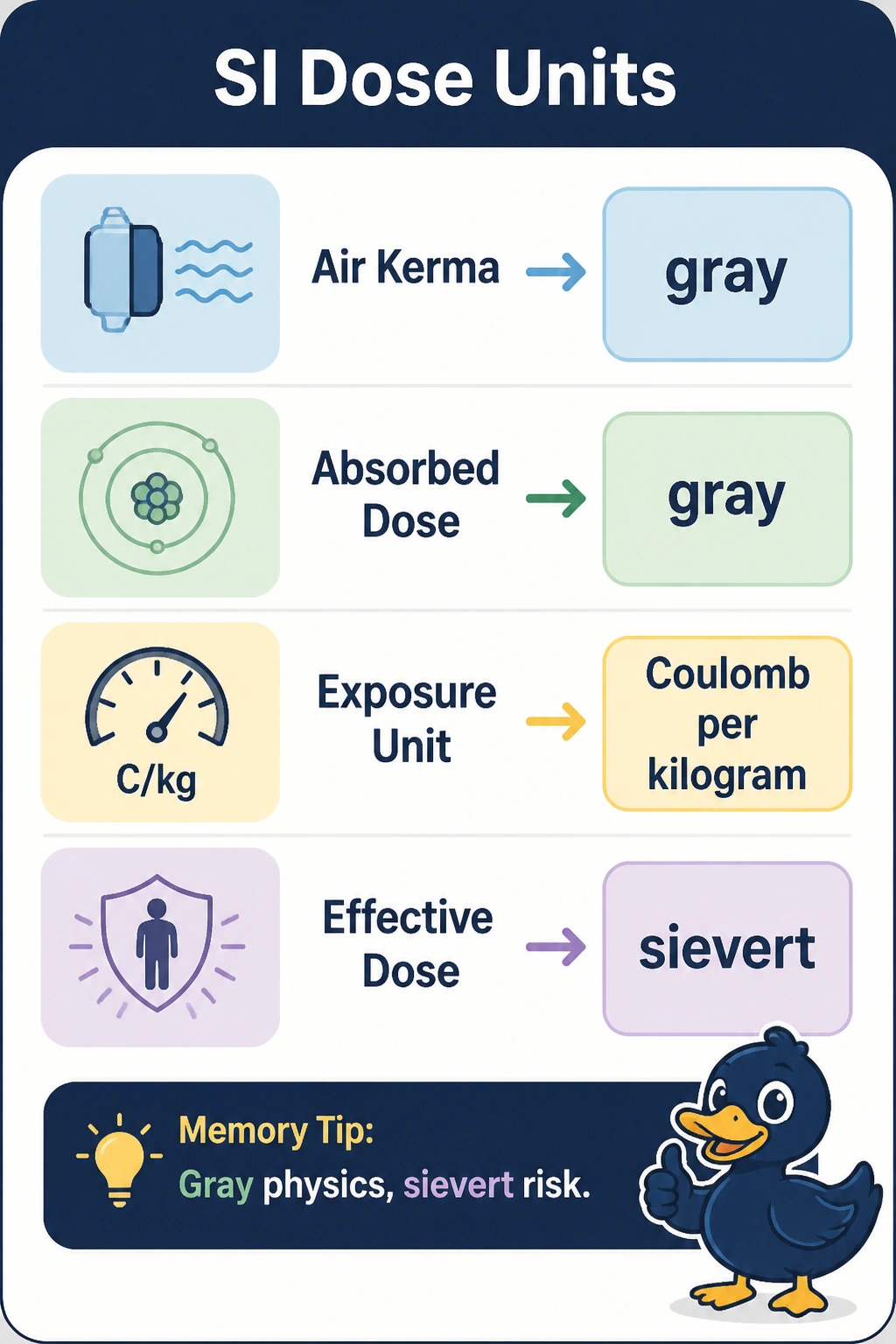
You’re sorting dose labels so risk talk stays honest. Energy absorbed stays in gray, while weighted whole-body risk earns sievert units every time.
Full Explanation
Air kerma quantifies kinetic energy released in air and absorbed dose quantifies energy deposited in tissue, both expressed in gray, exposure is charge in air expressed in coulombs per kilogram, equivalent and effective dose incorporate radiation weighting and tissue weighting to reflect biologic risk and are expressed in sievert per NCRP Report 184 and SI conventions. Correctly assigning gray to machine output and tissue absorption and sievert to risk-weighted whole-body estimates prevents audit confusion between physical deposition and stochastic risk. Reporting air kerma in sievert confuses physical energy with weighted risk, and coulombs per kilogram measures exposure rather than absorbed dose. Reporting effective dose in gray reverses weighting concepts, and sievert per minute is not a standard cumulative dose unit. Reporting absorbed dose in becquerel confuses activity of radioactive material with deposited energy, and gray-equivalent is not the SI unit for effective dose. Exam caveat is that older units rad and rem convert as 1 gray equals 100 rad and 1 sievert equals 100 rem, and practical check is to confirm dosimeter reports in sievert and ion chamber logs in gray or coulombs per kilogram.