
A 34-year-old construction worker arrives in the ED after a fall with severe left groin pain and suspected femoral neck fracture. The patient remains supine, cannot abduct or internally rotate the injured leg, and tolerates only stretcher transfer. The unaffected leg is elevated out of the beam path while the injured leg stays extended in neutral. Which hip projection best visualizes the femoral neck without moving the injured leg for this trauma presentation?
Select an answer to reveal the explanation.
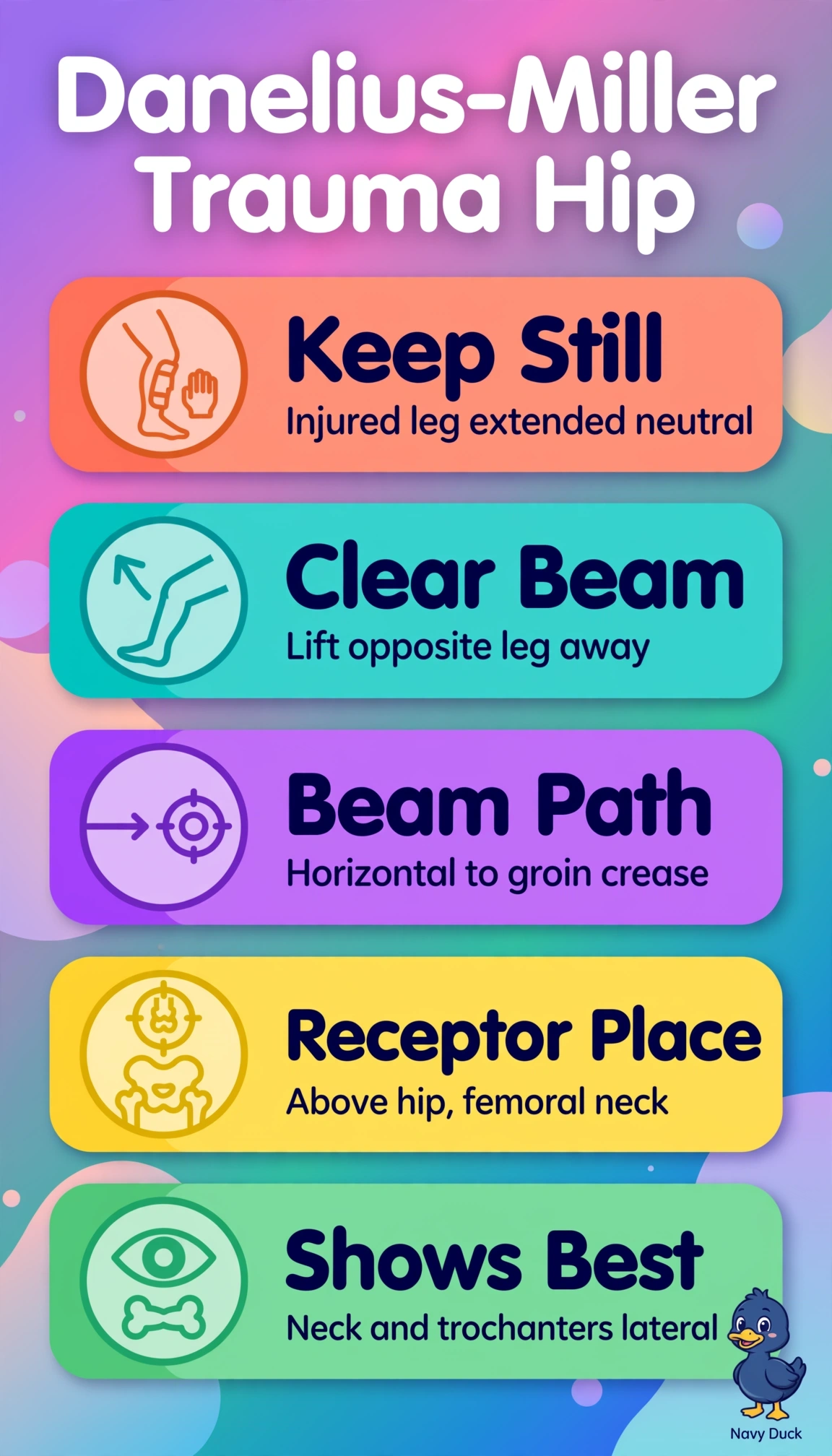
Short Explanation
You’re protecting a painful hip when you bring the beam to the patient, not the injured leg to the beam. The Danelius-Miller approach uses a horizontal beam while the injured leg stays still—like photographing under a parked car without moving it.
Full Explanation
The Danelius-Miller inferosuperior axiolateral is correct for acute hip trauma when the injured leg cannot be moved. The patient remains supine with the injured leg in neutral extension, while the unaffected leg is flexed and elevated clear of the beam; a horizontal central ray then provides a lateral view of the femoral neck to assess fracture, impaction, angulation or shortening. A supine anteroposterior pelvis with both legs neutral provides a frontal comparison but not the orthogonal lateral detail needed to show the neck, and the opposite limb is not elevated from the ray path. A 45-degree posterior oblique Judet projection is used to profile the acetabulum, but rotating the body moves the painful hemipelvis and does not provide the required lateral view of the femoral neck. A horizontal-beam axiolateral with the unaffected leg flat keeps the injured leg neutral, but the opposite thigh remains in the inferosuperior beam path, causing superimposition, attenuation and scatter over the neck. Exam caveat: distinguish the Danelius-Miller setup by its elevated unaffected leg and horizontal beam; the injured leg remains untouched. Practical check: lock the stretcher, support the unaffected knee upright, align the horizontal ray perpendicular to the neck, and place the grid and detector against the lateral hip above the iliac crest. Apply shielding only according to facility policy, never over the anatomy of interest.