
A radiographer must perform a mobile chest in a busy ICU bay with visitors nearby, limited space to move, and only one rolling lead barrier plus wraparound aprons available. Which personnel protection combination best applies time, distance, and shielding with correct lead equivalence for this exposure?
Select an answer to reveal the explanation.
Short Explanation
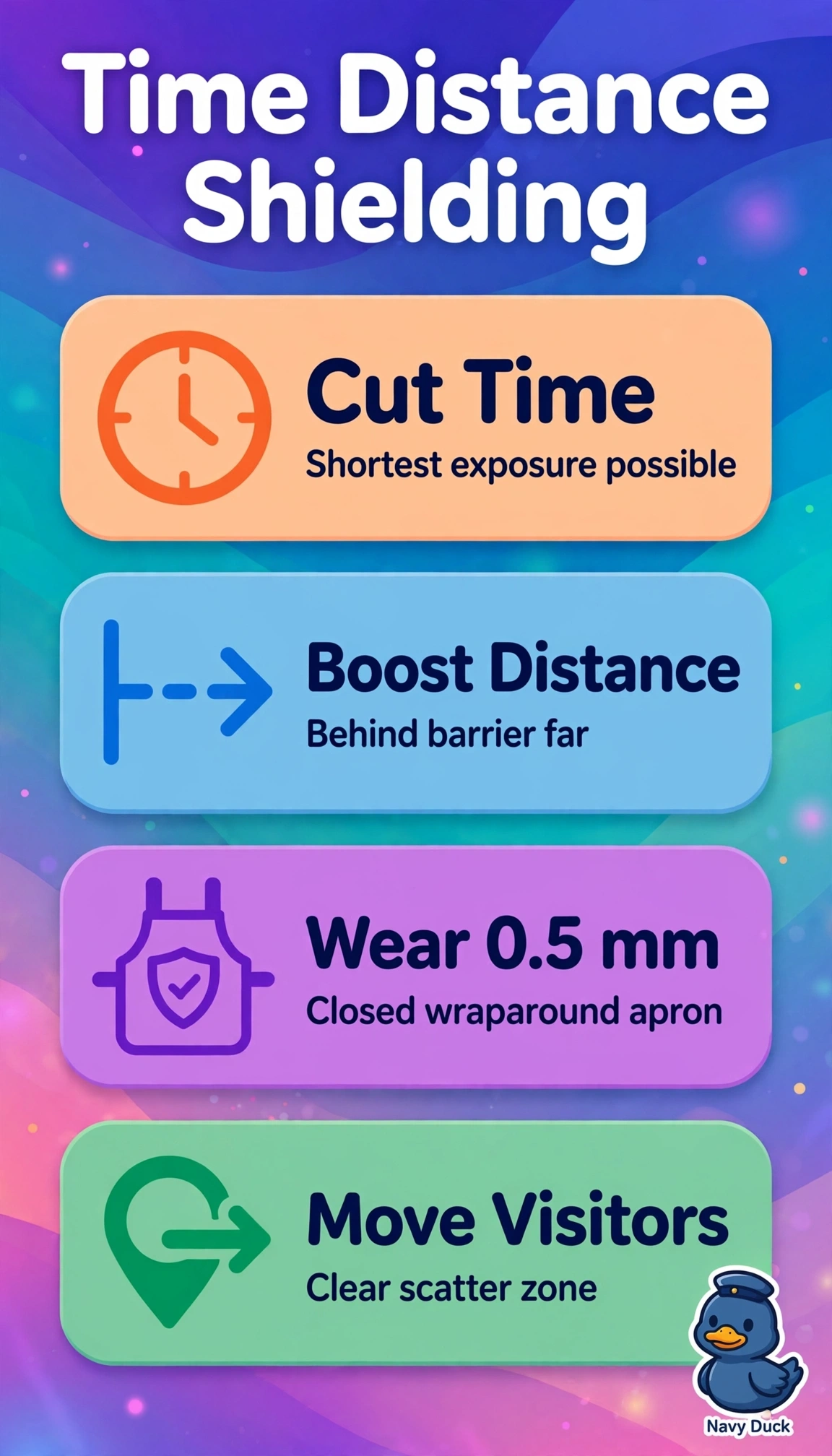
You're juggling all three shields at once, so quick, far, and covered wins. 0.5-mm lead all around is your trusty raincoat for scatter in tight spaces.
Full Explanation
The correct combination succeeds because it integrates all three cardinal principles under the stated ICU constraints: minimizing beam-on time reduces total scatter production, maximizing distance leverages inverse-square falloff while taking refuge behind the single available rolling barrier, and wearing a 0.5-mm lead equivalent wraparound apron provides accepted diagnostic attenuation for mobile scatter. The 0.25-mm variant fails on shielding despite correct time and distance, because that thickness is below the accepted 0.5-mm lead equivalent standard for occupational aprons at diagnostic kVp and transmits substantially more scatter even behind a barrier. The apron-alone combination fails on shielding optimization by omitting the rolling barrier, since the stem explicitly provides one barrier and best practice requires using the most attenuating available shielding in addition to personal apparel rather than relying on an apron alone in a crowded bay with visitors. The routine-time combination fails on time by accepting routine beam-on time instead of actively shortening exposure through optimized technique and efficient positioning, which unnecessarily increases scatter to staff and bystanders without imaging benefit. An exam caveat is that lead equivalence items often test the 0.25-mm versus 0.5-mm threshold and barrier versus apron hierarchy, so confirm what shielding the stem supplies and what equivalence is specified. As a practical check, announce the exposure, move visitors as far as feasible, verify full apron closure and integrity, stand fully behind the barrier at maximal feasible distance, and select the shortest appropriate factors.