
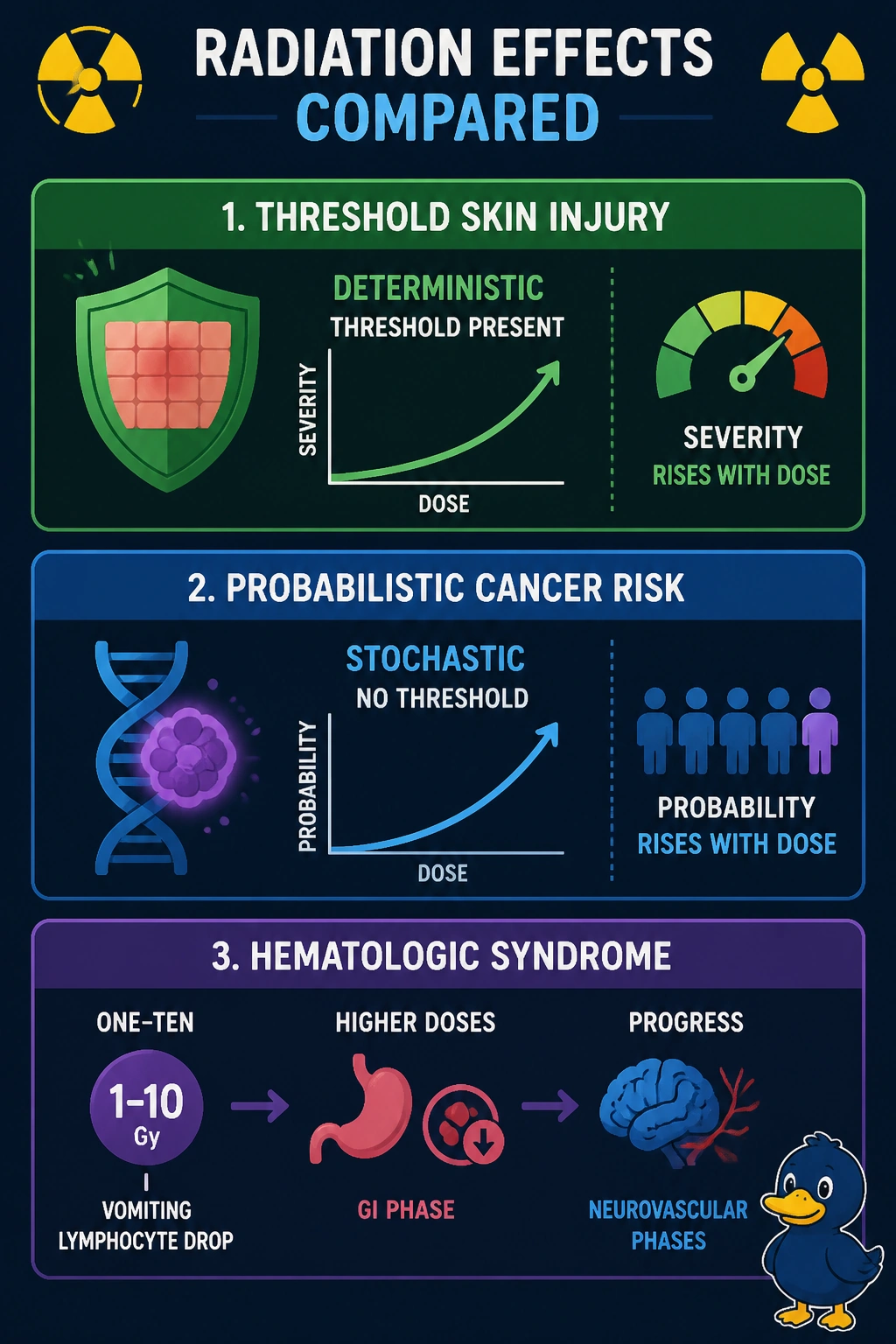
Two workers receive accidental exposure: one develops transient erythema and epilation after a high hand dose, the other faces future cancer risk after a low whole-body dose. A third presents with vomiting and lymphopenia after 3.5 Gy. Which framework best distinguishes deterministic, stochastic, and acute syndrome effects?
Select an answer to reveal the explanation.
Short Explanation
You are separating certainty from chance so clearly. Deterministic effects are your burn analogy — pass the threshold and severity climbs.
Full Explanation
The correct framework treats transient erythema and epilation after high localized dose as deterministic injury with a threshold and dose-dependent severity, future cancer after low whole-body dose as stochastic risk with no threshold where probability rises but severity does not, and vomiting with lymphopenia after 3.5 Gy as hematopoietic acute syndrome with prodromal upset followed by marrow suppression. The distractor invoking gastrointestinal syndrome at 3.5 Gy fails on dose-syndrome correlation because hematopoietic failure dominates at about 2 to 6 Gy while gastrointestinal syndrome with crypt loss and severe fluid shifts generally requires about 6 to 10 Gy. The distractor calling cancer risk deterministic fails on effect modeling because carcinogenesis is the prototype stochastic effect where population incidence is probabilistic and individual severity is independent of dose. The distractor calling skin erythema non-threshold fails on threshold biology because erythema and epilation are classic deterministic skin effects requiring several gray to skin before appearing and worsening thereafter. An exam caveat is that early vomiting is a shared prodrome and cannot alone separate syndromes without dose estimate, timing, and lymphocyte depletion kinetics. A practical check is to confirm localized versus whole-body dosimetry, obtain serial blood counts, map skin dose, manage deterministic injury by threshold-based care, and counsel on stochastic risk with long-term surveillance.