
A 34-year-old warehouse worker fell on an outstretched hand, now with ulnar-sided wrist pain when gripping a hammer and thumb pain at the thenar area. The physician suspects a hook of hamate fracture and a thumb sesamoid injury and requests dedicated wrist and thumb views beyond routine PA and lateral. Which supplementary projection pair best demonstrates those suspected injuries?
Select an answer to reveal the explanation.
Short Explanation
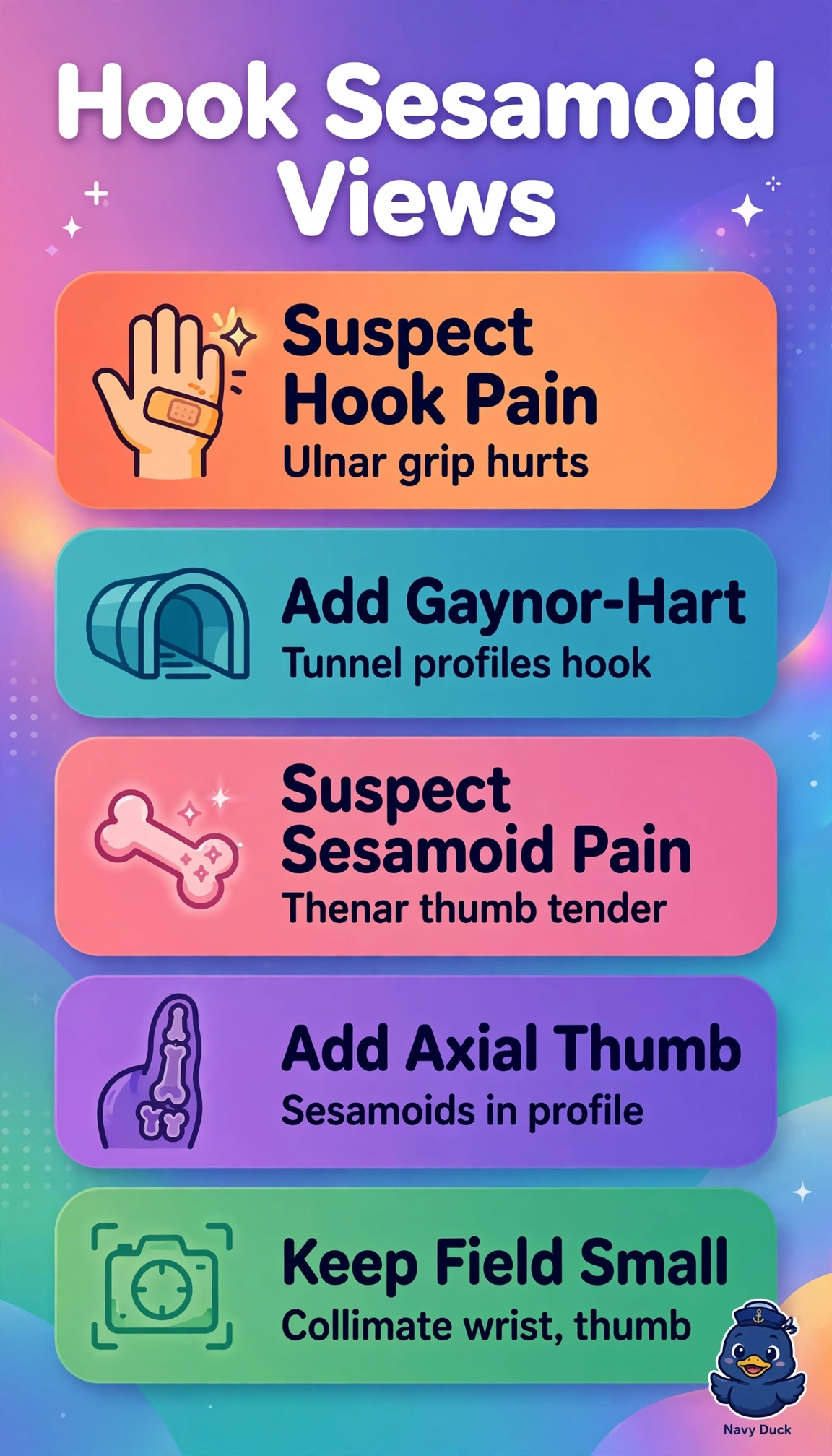
You matched the view to the bone. The tunnel view pops the hook off the hamate and the axial thumb rolls the sesamoids into profile for you.
Full Explanation
The Gaynor-Hart method uses wrist dorsiflexion with tangential beam through carpal tunnel to project hook of hamate in profile clear of hamate body and pisiform, which routine PA and lateral obscure, explaining its value for ulnar-sided grip pain after fall on outstretched hand, while AP axial thumb dorsiflexes thumb to project sesamoids at metacarpophalangeal joint free of metacarpal head for fracture or displacement evaluation. The pairing retaining tunnel view but using Roberts AP thumb fails by thumb concept because Roberts unfolds first carpometacarpal joint for Bennett injury, not sesamoid tangential detail. The pairing retaining axial thumb but using semisupinated oblique wrist fails by wrist concept because oblique surveys dorsal carpus and scaphoid but leaves volar hook superimposed and occult. The pairing of clenched-fist PA with ulnar deviation plus lateral thumb fails by pathology concept because that valid survey shows dynamic scapholunate widening and collateral ligament laxity, not volar hook cortex or sesamoid profile. An exam caveat is treating any tunnel, oblique, or scaphoid view as interchangeable for hook detection when only tangential projection isolates it. A practical check is confirm hyperextension and thumb dorsiflexion tolerance, set exact tube angle, palpate hook and sesamoid points, and repeat for overlap rather than accept nondiagnostic superimposition.