
A clinic replaces computed radiography with flat-panel DR for upright chests and supine abdomens, debating direct versus indirect conversion and whether to keep a stationary grid versus a virtual grid. Which detector and scatter-control choice best matches dose and workflow needs?
Select an answer to reveal the explanation.
Short Explanation
You’re pairing sharp sensors with smart scatter cleanup. Cesium iodide sips light efficiently, so indirect-conversion panels plus the right grid keep dose lean.
Full Explanation
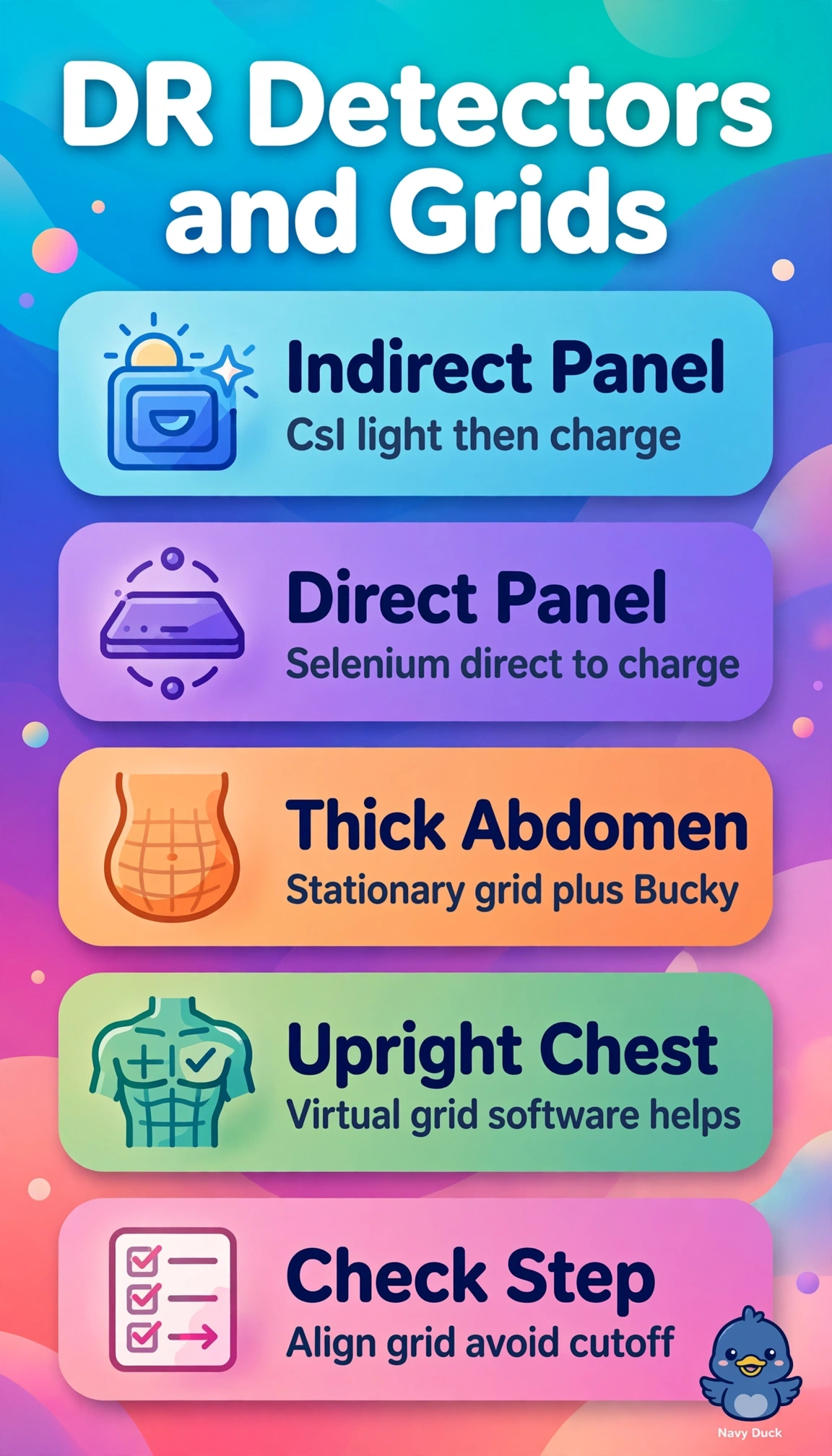
Indirect flat-panel detectors use a cesium iodide scintillator to convert x-rays to light then to charge via photodiodes, offering high absorption and dose efficiency, while direct detectors use amorphous selenium to convert x-rays directly to charge, often favored for high detail; stationary grids with focused lead strips in a Bucky remove scatter for thick parts like abdomens, and virtual grid software estimates and subtracts scatter for upright chests where a physical grid is impractical. Combining indirect CsI with a physical grid for abdomens controls heavy scatter, and virtual grid processing for chests preserves contrast without grid alignment artifacts. Using selenium for all abdomens without grid or Bucky invites scatter fog and motion issues and misapplies direct conversion strengths. Omitting scatter control for thick abdomens and simply raising kVp increases scatter and dose while degrading contrast. Retaining film-screen cassettes misunderstands DR workflow and virtual grids require digital data to function. Exam caveat is to match grid focal range and orientation to SID and center precisely to avoid cutoff, and practical check is to select grid in versus virtual grid on the console and confirm exposure index stability.