
A 48-year-old outpatient arrives for fluoroscopic lumbar myelography for stenosis, reports shellfish allergy and takes apixaban, with orders for prone oblique spot images and post-procedure CT. Consent, labs, and allergy review are pending. Which pre-procedure and positioning coordination best supports safe myelography?
Select an answer to reveal the explanation.
Short Explanation
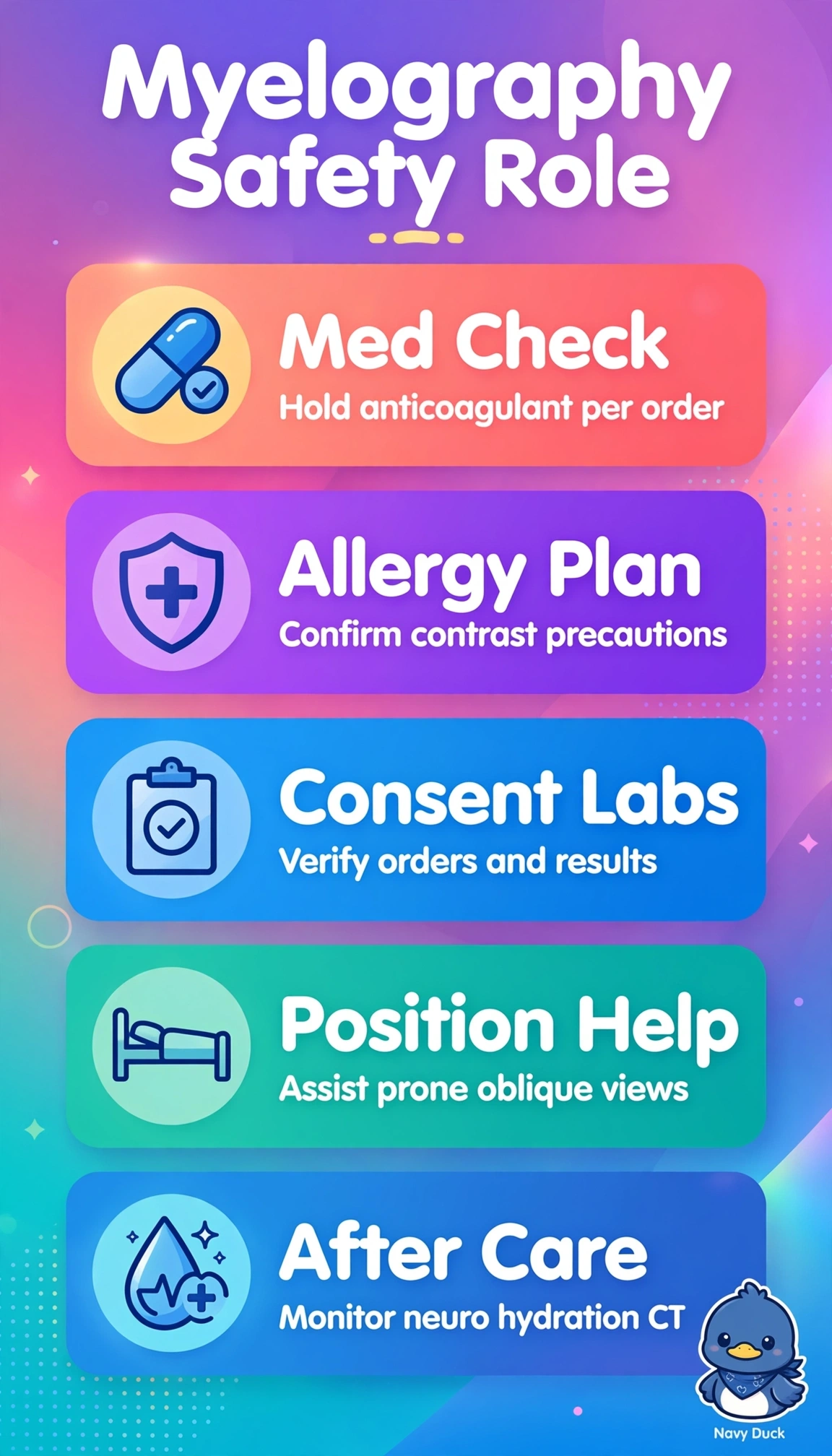
You’re the safety bridge between ordering and table. Pausing blood thinners and flagging allergies keeps the spinal canal calm, so lumbar-puncture prep stays on track.
Full Explanation
The correct response aligns three linked safety requirements for fluoroscopic lumbar myelography: intrathecal needle placement creates spinal hematoma risk so apixaban must be held per physician and pharmacy orders with labs and consent verified, reported shellfish allergy triggers formal contrast allergy review and premedication planning rather than assumption, and prone oblique spot images require assisting and maintaining prone positioning for diagnostic quality. The renal-focused alternative fails by substitution concept because assessing hydration and kidney function is routine contrast care but does not replace allergy planning when an allergic history is explicitly pending review, leaving anaphylaxis risk unaddressed. The continuation alternative fails by bleeding-risk concept because uninterrupted apixaban may be appropriate for low-bleed-risk or high thrombotic-risk settings but is unsafe when dural puncture is planned and orders direct holding. The supine-for-comfort alternative fails by order-fidelity concept because supine positioning is comfortable and common for other imaging but does not satisfy the explicit prone oblique order needed to demonstrate stenosis. Exam caveat: do not equate shellfish allergy automatically with iodinated contrast allergy, yet never dismiss it; the test expects active review and documented plan. Practical check: reconcile hold instructions, allergy band and premedication, consent and labs, and prone positioning aids with time-out before transfer to post-procedure CT.