
During a double-contrast upper GI series on an older flat-panel fluoroscopy system, brightness fluctuates as barium moves, the image lags slightly, and the radiologist wants stable density with pulsed exposure and last-image-hold review. Which fluoroscopic subsystem function should the radiographer evaluate to maintain consistent brightness automatically?
Select an answer to reveal the explanation.
Short Explanation
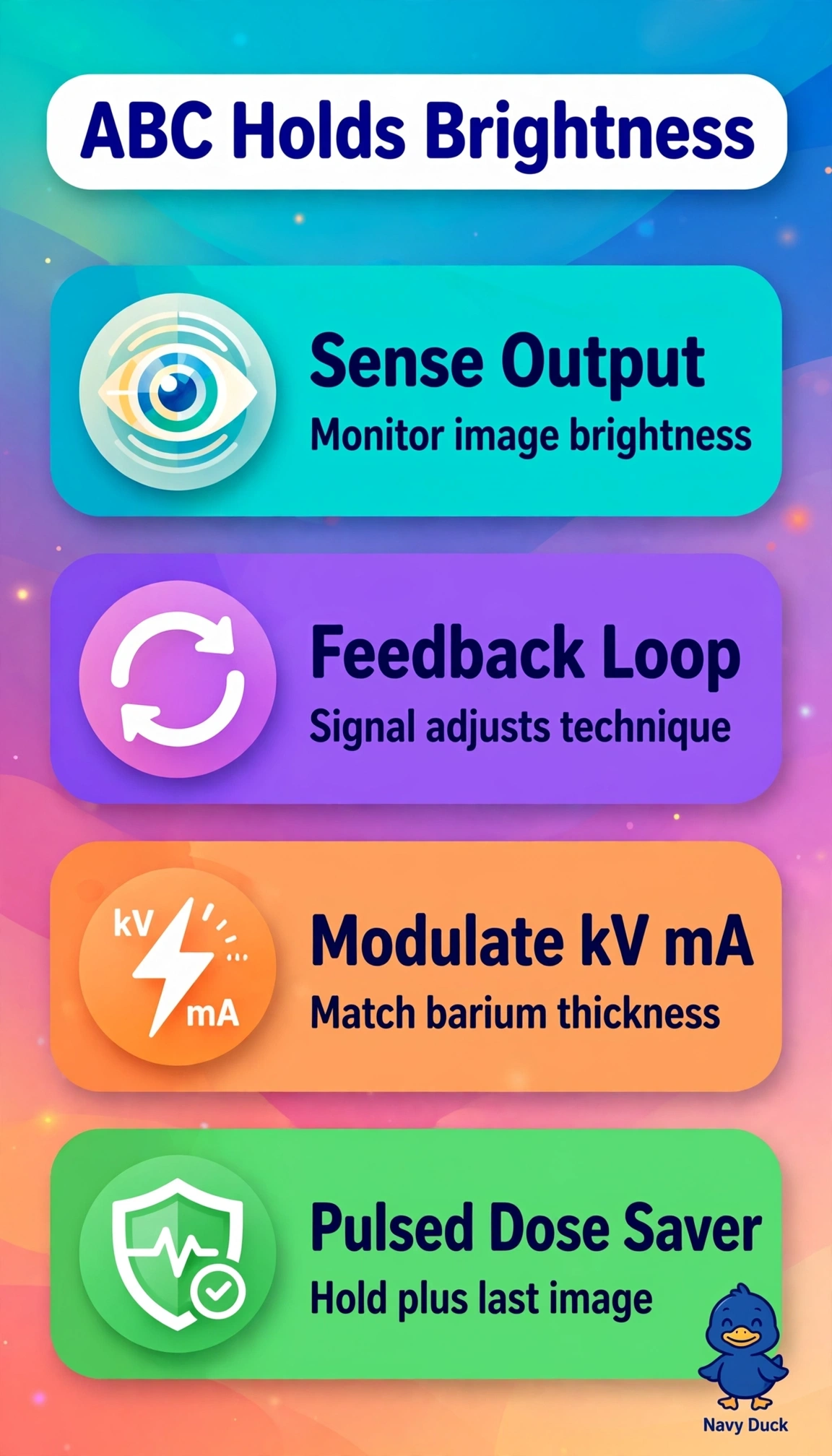
You're letting smart cruise control handle hills of thick barium. Automatic brightness control senses output and tweaks technique to hold density steady.
Full Explanation
The correct evaluation addresses the closed-loop servo that samples detector dose or video signal and modulates tube output to hold displayed brightness constant despite changing attenuation as barium enters the field, which is automatic brightness control linked to automatic exposure rate control through real-time kV and mA adjustment during fluoroscopy. Checking pulsed grid control with last-image-hold memory supports pulsed exposure and review without continuous beam-on and helps dose management, but it controls pulse width, frame rate, and frozen display rather than driving output to compensate for contrast changes, so density would still fluctuate. Checking temporal frame averaging with detector lag correction reduces noise and smooths persistence and motion blur from peristalsis by blending successive frames, yet this processing occurs downstream of exposure and cannot command the generator to stabilize brightness. Checking a preset anatomic chart with manual kV-mA technique can produce consistent density for static projections, but it relies on operator selection and cannot automatically track swallow-to-swallow variation in a dynamic double-contrast study. An exam caveat is that legacy intensifier terminology persists in questions about flat-panel systems, so focus on functional description rather than expecting modern dose-rate wording. A practical check is to pan slowly across the barium-filled stomach while observing stable monitor brightness with smooth inverse changes on the generator kV-mA readout, then test pulse rate and hold display as separate functions.