
A 68-year-old floor patient with a right-arm IV infusion, nasal cannula oxygen at 2 L, indwelling Foley catheter, and nasogastric tube to suction needs transfer to radiology for a chest x-ray via wheelchair. Which assistance approach correctly manages the infusion lines, oxygen, NG tube and catheter during movement?
Select an answer to reveal the explanation.
Short Explanation
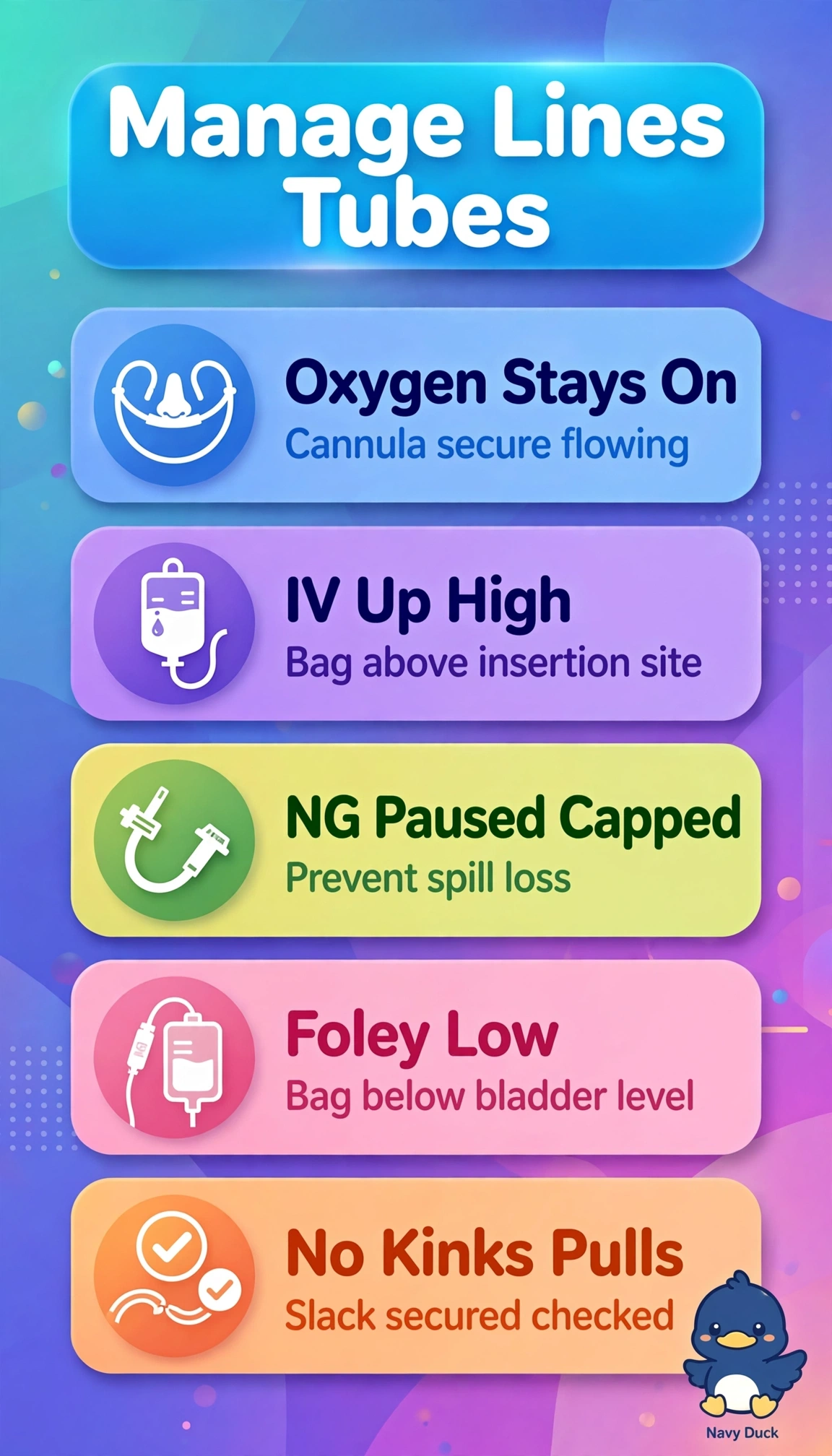
You're playing traffic cop for tubes, keeping flow where gravity wants it. Below bladder drainage plus raised IV keeps everything running without backflow or tugs.
Full Explanation
Maintaining oxygen delivery, IV height, capped NG, and dependent Foley drainage is correct because continuous oxygen prevents desaturation, gravity head above the venous site maintains infusion pressure and patency, temporarily pausing and capping suction prevents spillage and loss of decompression while allowing safe movement, and keeping the closed urinary bag below bladder level unkinked uses gravity to prevent reflux and infection. The waist-level IV with lap-high Foley approach fails because lowering the IV reduces hydrostatic pressure risking backflow and pump alarms, while placing the Foley above bladder promotes retrograde urine flow and bacteriuria. The disconnect and clamp approach fails because interrupting oxygen and clamping infusions without orders risks hypoxia, clotting, and suction loss with unsafe high carrying that encourages reflux. The low IV and chest-high Foley approach fails because it reverses correct gravity relationships, creates tension and pull injury risk on NG and IV sites, and tight coiling compromises oxygen flow. Exam caveat is to never disconnect, raise drainage bags, or kink lines for convenience. Practical check is to coil slack, secure tubing to gown, confirm drip, oxygen flow, and bag levels before and after moving.