
A 54-year-old emergency patient has acute abdominal pain with suspected free intraperitoneal air, can sit upright briefly but cannot stand, and has no trauma. The surgeon needs to see both free air and air-fluid levels with the least discomfort. Which abdomen series best demonstrates free air and levels in this patient?
Select an answer to reveal the explanation.
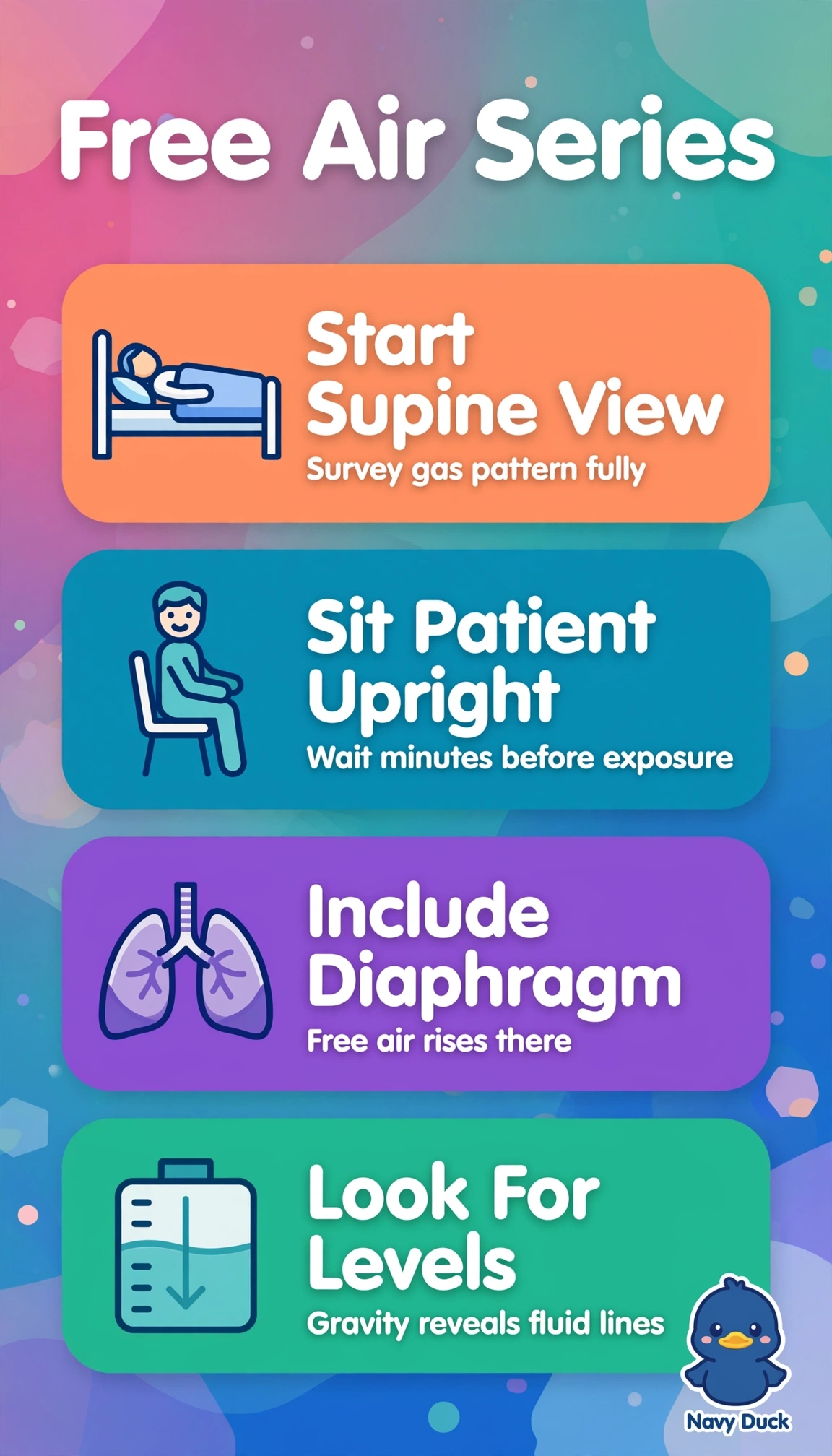
Short Explanation
You've got air rising and fluid settling in one pair. Upright positioning lets free air float up like bubbles in soda.
Full Explanation
Abdomen series for suspected perforation pairs a supine view for overall gas pattern, calcifications, and masses with an upright view including the diaphragm to demonstrate subdiaphragmatic free air and air-fluid levels that require gravity and at least five minutes upright for small bubbles to rise; centering and exposure must include the hemidiaphragms without excessive dose. A prone addition compresses anterior structures and redistributes gas dependently, obscuring free air that rises anteriorly and failing to create the vertical gradient needed for levels. A supine-only study, even with higher technique, cannot separate free from intraluminal air because without gravity separation, small pneumoperitoneum remains hidden among bowel gas and diaphragmatic detail stays superimposed. An upright-only view centered low excludes the diaphragm where free air collects and misses the supine baseline for comparison of dilated loops, extraluminal gas, and soft tissue outlines.