
A 4-year-old outpatient drools and refuses to swallow after reportedly swallowing a coin, is breathing comfortably, can sit upright, and the physician needs to locate a radiopaque esophageal foreign body and exclude airway involvement. Which soft-tissue neck and thorax protocol best localizes the ingested foreign body?
Select an answer to reveal the explanation.
Short Explanation
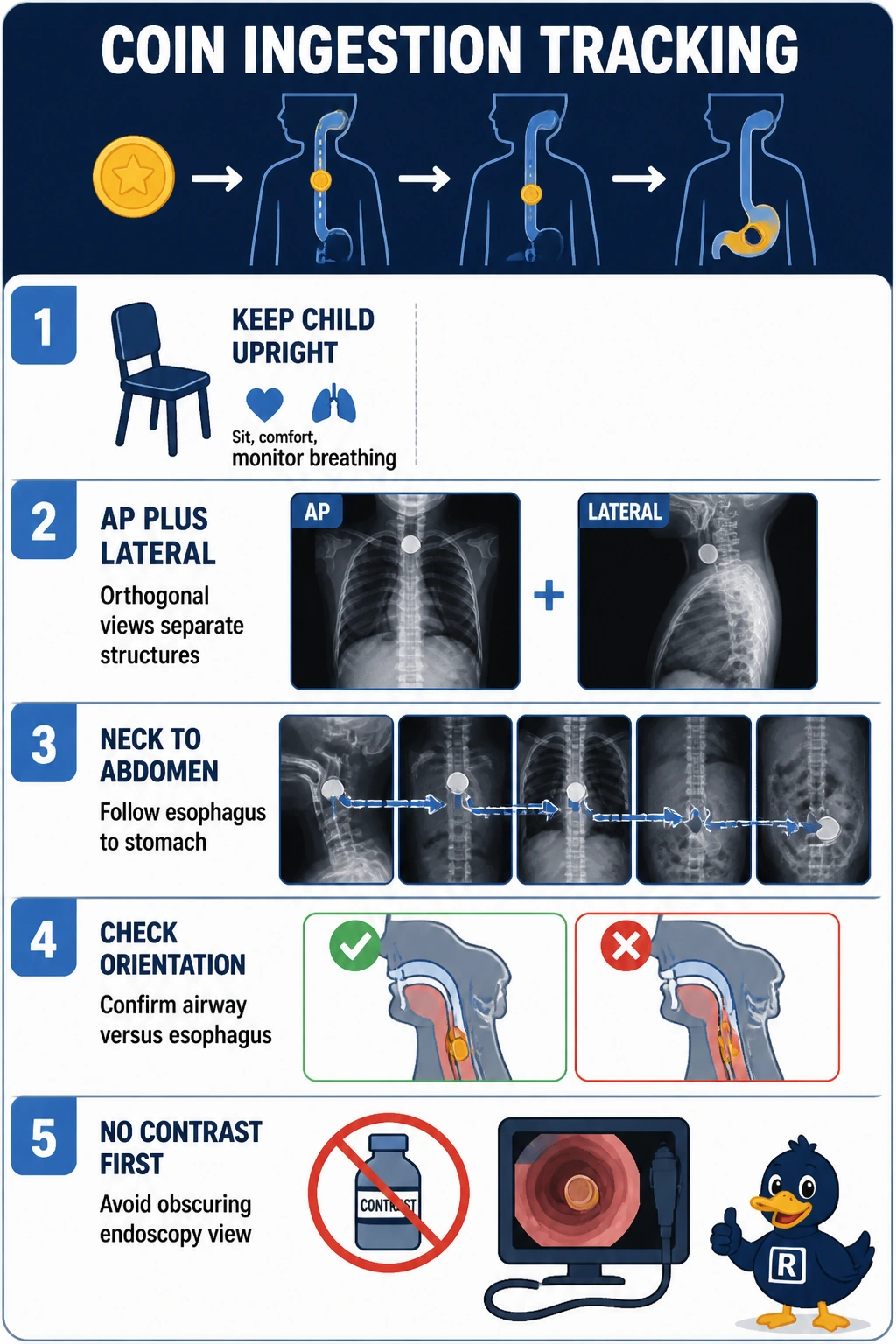
You'll follow the coin's whole journey, not just one stop. Continuous AP and lateral coverage maps the path with trail-tracking clarity like marking breadcrumbs from throat to belly.
Full Explanation
The correct protocol is appropriate because drooling with refusal to swallow suggests high-grade esophageal obstruction often at the thoracic inlet, and orthogonal frontal plus lateral coverage from nasopharynx through abdomen tracks a radiopaque coin that may lodge superiorly, migrate distally or pass into stomach while simultaneously separating posterior esophageal position from anterior airway position, with frontal orientation helping since esophageal coins usually appear coronally and tracheal coins sagittally and the lateral view directly confirms depth and screens lungs for aspiration. A chest study confined from apices to costophrenic angles fails by coverage concept because it excludes the cervical esophagus where coins commonly impact and excludes the abdomen needed to confirm passage, so a negative chest could falsely reassure despite retained foreign body. A frontal-only neck to abdomen study fails by projection concept because without the orthogonal lateral view the anterior trachea and posterior esophagus superimpose and airway involvement cannot be excluded, which matters because precise level and depth guide endoscopic management. A fluoroscopic barium swallow fails by indication and safety concept because it requires voluntary swallowing and airway protection, both impaired when the child drools and refuses to swallow, creating aspiration risk while adding no value for an already radiopaque object and delaying definitive care. For exams remember stable breathing does not exclude esophageal impaction with airway compression, so airway assessment remains required. Practically verify upright positioning without rotation, remove necklaces and snaps, and confirm skull base to stomach inclusion on both projections before assessing coin orientation and soft-tissue swelling.