
An ED patient with a fall has a painful right hip, cannot abduct the leg, and needs acetabular assessment without further rotation. The physician orders AP pelvis, unilateral frog-leg, and acetabular views. Which projection set correctly applies Judet and inlet-outlet concepts while respecting the mobility limit?
Select an answer to reveal the explanation.
Short Explanation
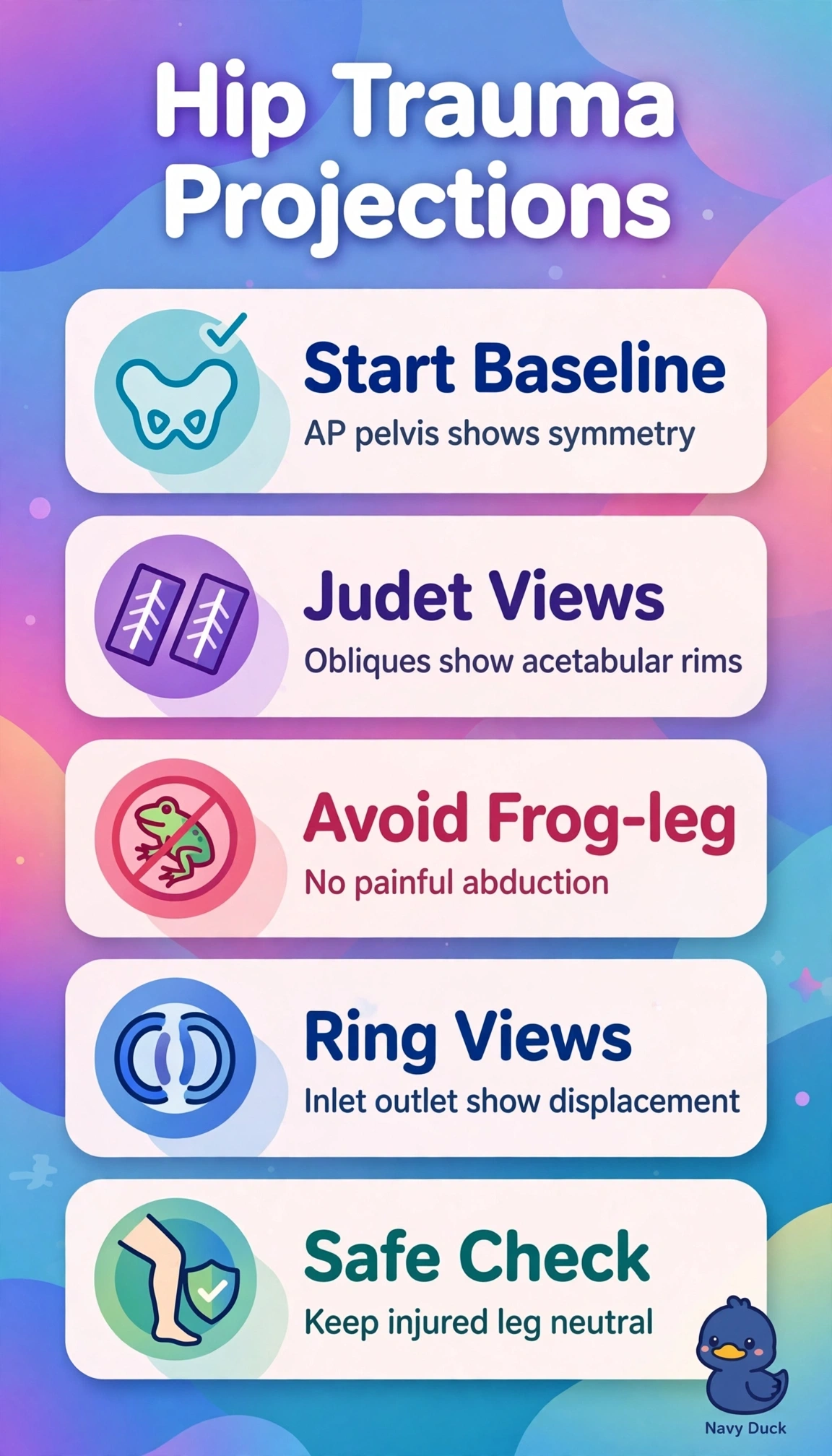
You’re protecting a hurt hip while still showing the socket. Judet obliques reveal the rims without twisting the leg, so acetabular detail stays clear and safe.
Full Explanation
The correct set respects both anatomy and mobility by retaining the AP pelvis for overview and adding Judet obliques for acetabular detail while deferring the unilateral frog-leg because abduction is impossible and painful. Judet anterior and posterior 45-degree obliques centered to the affected acetabulum use body rotation rather than hip rotation to separate anterior and posterior columns and walls that overlap on AP, directly meeting the need for assessment without further hip motion. The inlet and outlet approach is standard for pelvic ring trauma, with inlet showing anterior-posterior displacement and outlet showing vertical displacement, but it does not profile acetabular columns, so using it for acetabular fracture lines provides appropriate pelvic evaluation yet misses the specific acetabular requirement. Including a gentle frog-leg as ordered reflects routine complete hip practice and follows the written order, but even careful abduction violates the explicit cannot-abduct limit and risks harm, so the technologist must hold that projection and notify the physician. Using a cross-table lateral hip is a sound trauma adaptation that avoids abduction and rotation and shows femoral neck and joint relationships, but it cannot replace Judet detail for column fractures. An exam caveat is that questions deliberately swap Judet with inlet-outlet, so associate Judet with acetabulum and inlet-outlet with pelvic ring. A practical check is to assess pain and range of motion, avoid forcing abduction or rotation, confirm Judet positioning and centering, and document any deferred projection with communication.