
An imaging department has two add-on cases: an older adult with productive cough and confirmed pulmonary tuberculosis needing a portable chest, and a chemotherapy patient with severe neutropenia needing a KUB in radiography. Supplies are limited and rooms must turn over quickly. Which infection control plan correctly applies transmission-based and neutropenic precautions to limit healthcare-associated infections?
Select an answer to reveal the explanation.
Short Explanation
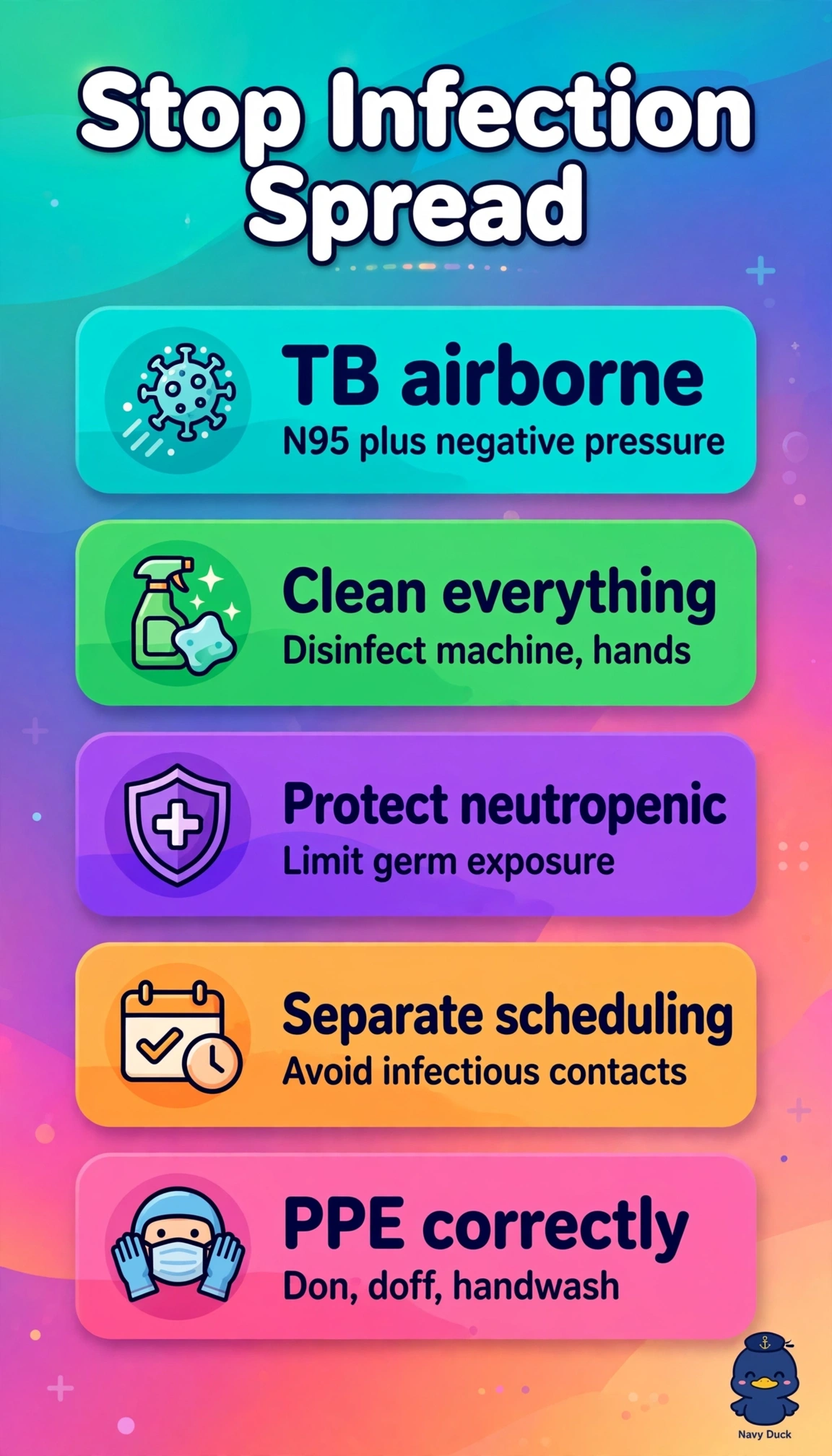
You're guarding two fragile ends of the spectrum at once. Airborne control contains TB spread while protective environment habits shield low counts, and strict hand and equipment cleaning links both.
Full Explanation
The correct plan matches pathogen transmission to host vulnerability: productive pulmonary tuberculosis demands airborne precautions with N95 respirators, negative-pressure handling and terminal cleaning, ideally with portable imaging to avoid transport through shared areas, while severe chemotherapy-related neutropenia demands protective measures centered on meticulous hand hygiene, minimizing exposures, contacts and environmental reservoirs during KUB imaging. The surgical-mask droplet approach fails on transmission concept because tuberculosis nuclei persist airborne and require respirator filtration and airborne engineering, so negative pressure plus terminal cleaning cannot compensate for inadequate respiratory protection. The standard-precautions-only approach for neutropenia fails on host-susceptibility concept because routine hand hygiene without added protective strategies leaves profound immunosuppression unaddressed during positioning, transfers and waiting. The rapid-turnover approach that skips terminal cleaning fails on environmental persistence concept because quick reuse without proper air clearance and surface disinfection risks nosocomial spread to subsequent patients, especially the neutropenic patient. Exam caveat is to distinguish required mask and room pairing by organism rather than by symptoms alone, since cough appears in both droplet and airborne diseases. Practical check is to verify N95 fit, room pressure, cleaning completion, and separation of scheduling and equipment between the infectious and immunocompromised cases.