
During a 12-minute mobile fluoroscopy case in the OR, the radiographer stands 1 meter from the patient wearing an apron, the primary beam is directed at the surgical site, and leakage from the housing is minimal. Which exposure source contributes most to this radiographer's occupational dose during beam-on time?
Select an answer to reveal the explanation.
Short Explanation
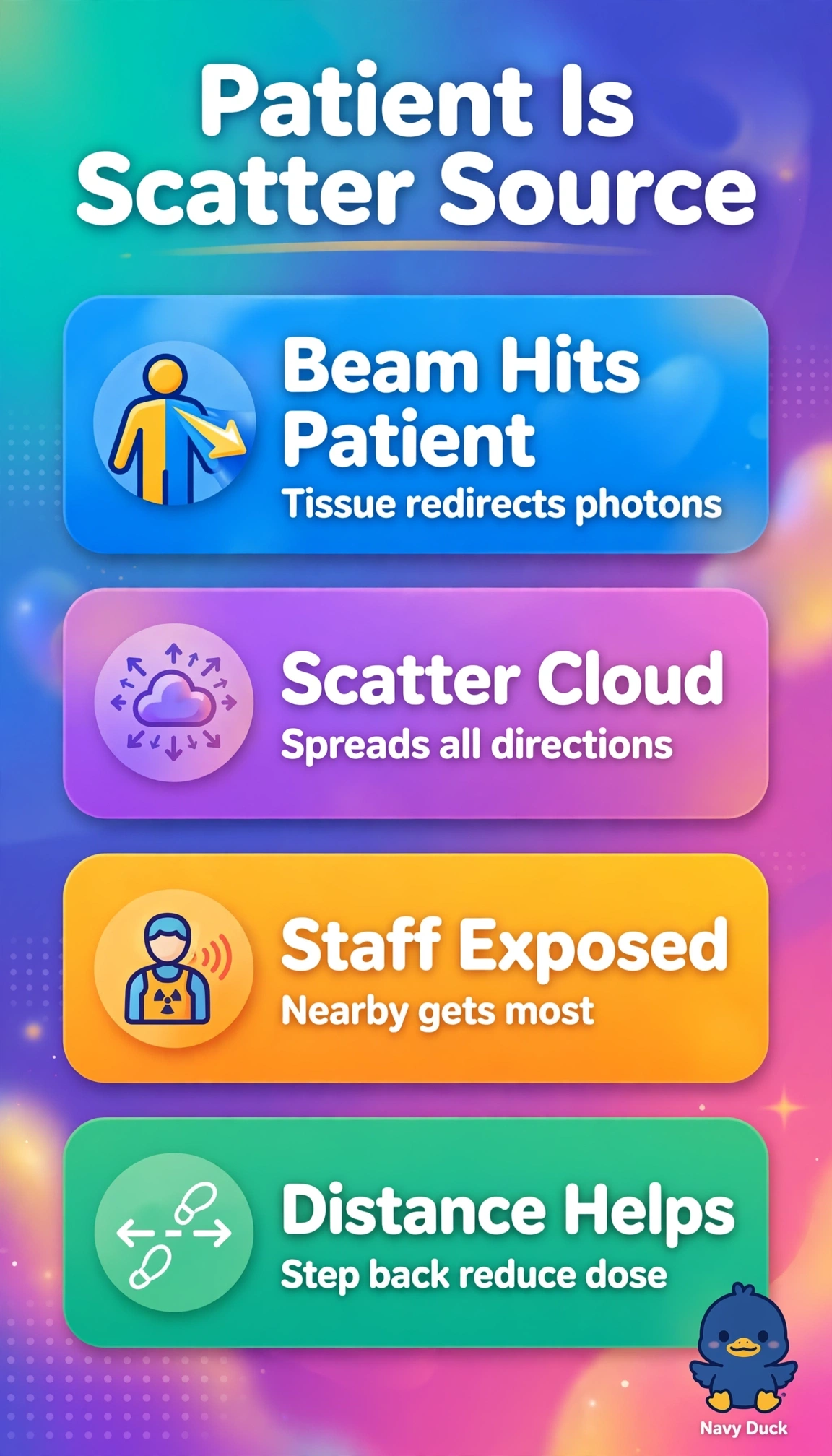
You're not in the direct beam, but the patient glows with bounce-off. Patient scatter becomes like a sprinkler soaking everyone nearby during fluoro.
Full Explanation
The correct answer is patient scatter because the irradiated tissue volume acts as an extended secondary source during beam-on time, with Compton interactions redirecting intense fluence in all directions, and at one meter this first-order scatter dominates occupational dose by inverse-square geometry despite apron attenuation of the torso. Transmitted primary fails by concept because photons traversing the patient remain highly directional along the useful-beam axis toward the receptor, so an operator standing one meter lateral with the beam centered on the surgical site does not intercept that beam and off-axis intensity is negligible after tissue attenuation. Leakage fails by concept because tube-housing emission is isotropic, low-level radiation constrained by design limits and testing, and the stem states it is minimal, so even integrated over twelve minutes it cannot rival continuous patient scatter near the field. Wall and floor scatter fails by concept because return to the operator requires a second scatter event plus longer path length, markedly reducing fluence and energy compared with direct first-order patient scatter at short distance. An exam caveat is that prolonged beam-on time multiplies all sources equally and does not make leakage or room return dominant, so prioritize geometry and stated conditions over duration. A practical check is to verify with tight collimation, stepping back when possible, and personal dosimetry showing rapid falloff with distance from the patient.