
A 38-year-old with chronic neck stiffness and arm tingling needs routine cervical spine views plus motion assessment, with no trauma and full cooperation. The order asks for disc mobility without MRI. Which cervical spine projection set best evaluates alignment, foramina, and flexion-extension motion?
Select an answer to reveal the explanation.
Short Explanation
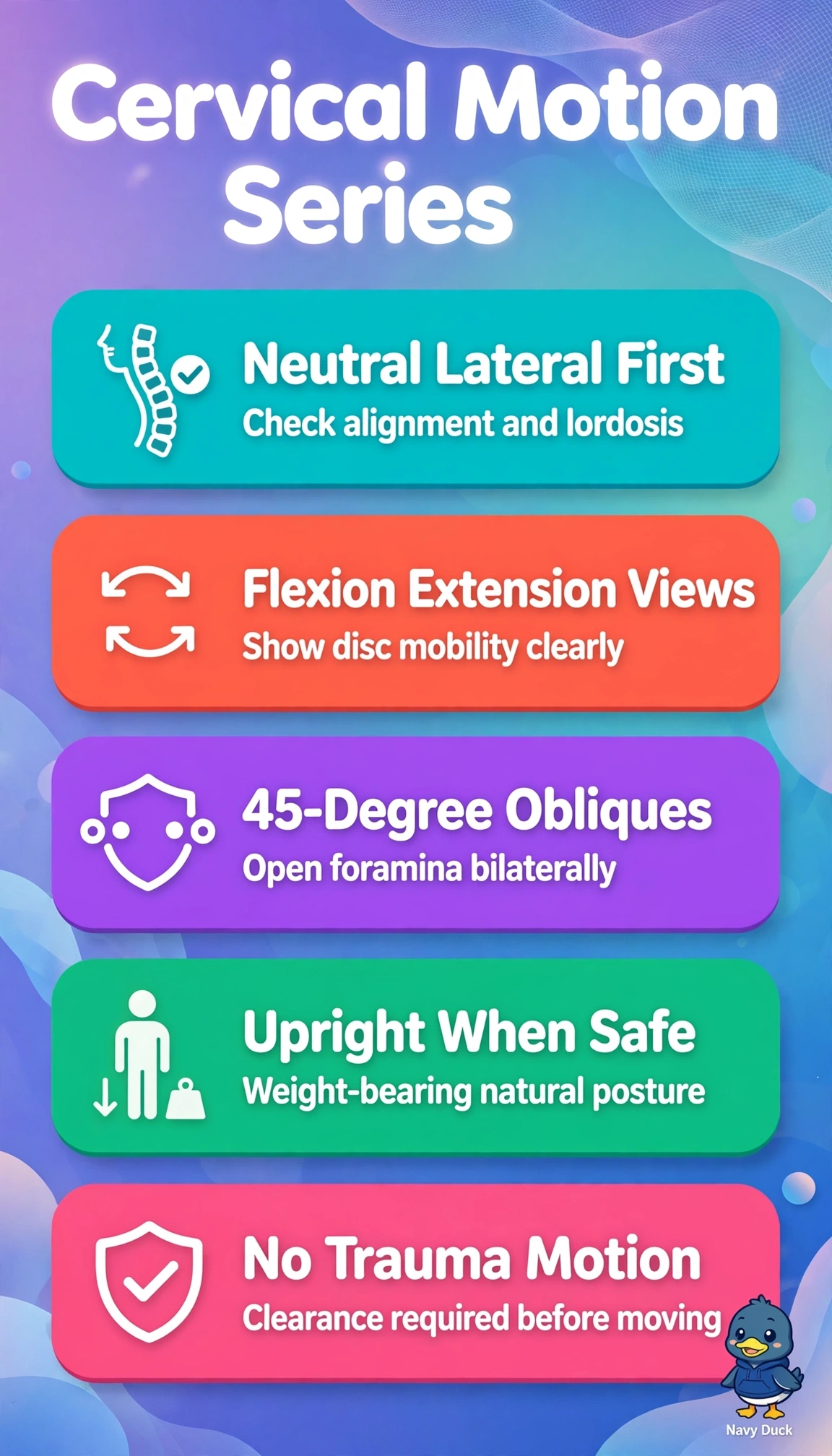
You need alignment, openings, and movement all in one set. Neutral plus flexion-extension laterals with well-rotated obliques covers discs and foramina without missing instability.
Full Explanation
The correct set succeeds because upright neutral lateral displays weight-bearing lordosis and alignment, active flexion-extension laterals reveal disc mobility and dynamic instability without MRI, and bilateral 45-degree posterior obliques with accurate rotation optimally open the lower cervical foramina to correlate with arm tingling. The upright routine with anteroposterior, odontoid, neutral lateral and well-rotated posterior obliques offers strong bone and foraminal detail but fails by motion concept since static views cannot demonstrate functional excursion or instability. The upright neutral plus flexion-extension, odontoid and anteroposterior set captures alignment and stability but fails by foraminal concept because without oblique projections the foramina stay overlapped and radiculopathy cannot be assessed. The supine neutral plus flexion-extension with posterior obliques preserves motion and foraminal visualization but fails by loading concept because recumbency unloads the column and obscures standing alignment in a cooperative nontrauma patient. Exam caveat is to separate degenerative dynamic workup from trauma clearance where active motion is contraindicated until stability is proven. Practical check is to verify erect posture, superimposed articular pillars, voluntary pain-limited motion, 45-degree rotation, and visualization of C7-T1 on every lateral.