
A 17-year-old in outpatient orthopedics needs a single AP femur for length assessment, thick proximal thigh tapering to thin knee, prior image showed cortical blur and darker knee with pale hip, and the teen can hold still briefly. Which tube and positioning setup best controls focal-spot blur, anode heel effect, motion, and angulation distortion?
Select an answer to reveal the explanation.
Short Explanation
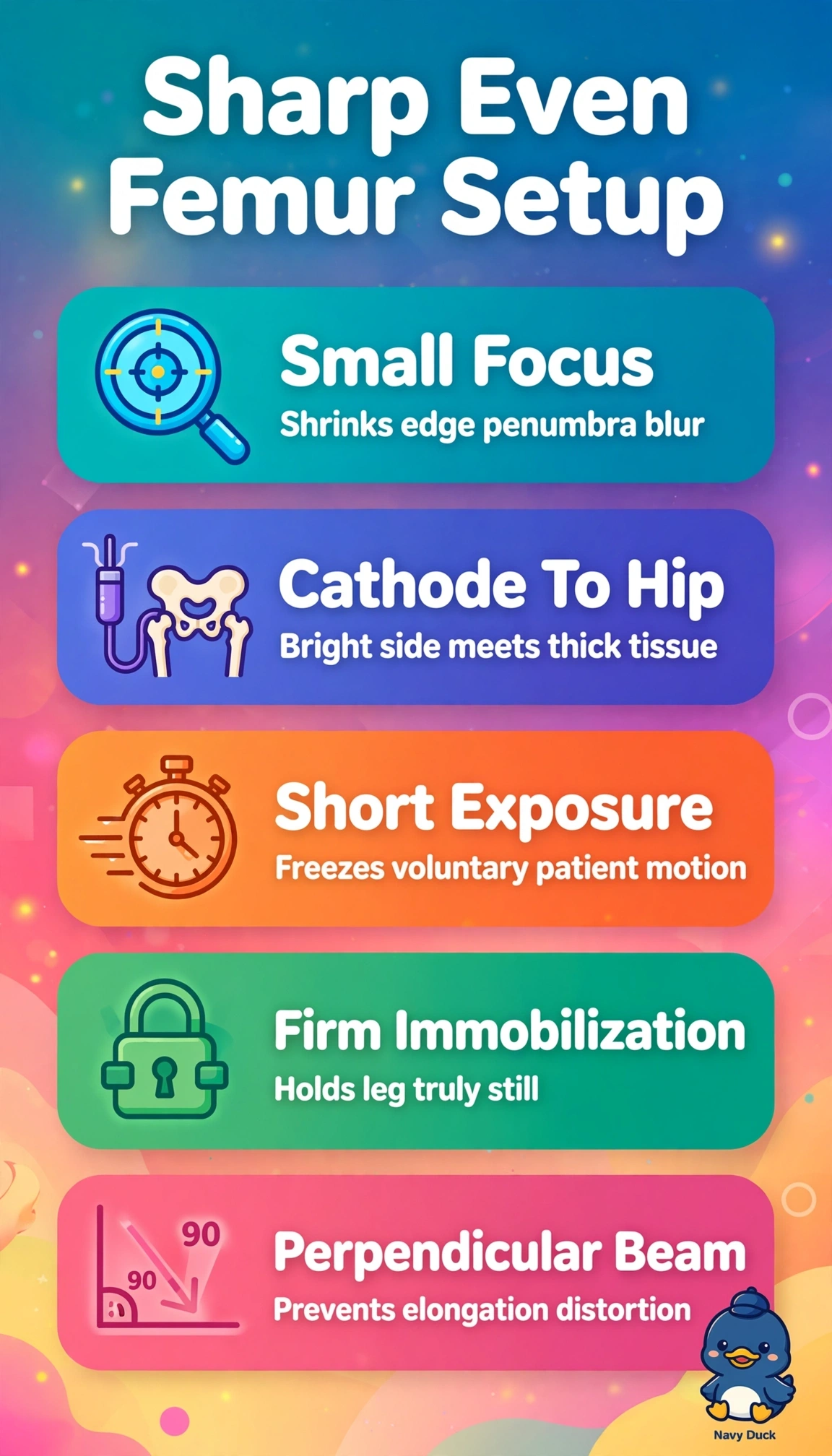
You're balancing a thick-to-thin bone that needs even density plus tack-sharp cortex. Cathode toward the thick hip uses the heel-effect wisely while a small spot and short time freeze detail, like aiming a flashlight's bright end uphill.
Full Explanation
Small focal spot reduces geometric unsharpness by shrinking the penumbra at cortical edges, which is critical for a length measurement where edge definition matters. Anode heel effect makes intensity higher on the cathode side, so placing the cathode toward the thicker hip compensates for greater attenuation and evens receptor exposure from hip to knee. Short exposure time with firm immobilization controls motion unsharpness that otherwise blurs trabeculae despite correct focal spot, and keeping the central ray perpendicular to the midshaft and receptor avoids elongation or foreshortening from tube-part-receptor angulation. Placing the anode toward the hip fails by heel-effect concept because the weaker beam meets the thickest tissue, worsening pale-hip and dark-knee imbalance despite sharpness. Large focal spot with long exposure fails by resolution and motion concepts because penumbra increases and voluntary motion blurs during the exposure despite correct heel-effect orientation. Angling the beam 15 degrees toward the hip fails by angulation distortion because the projected femur elongates and joint spaces skew despite correct focal spot, heel effect, and motion control. Exam caveat is that heel effect reverses if the tube is mounted opposite, so confirm cathode location rather than assuming. Practical check is to announce cathode end, verify perpendicularity with angle finder, and test immobilization before exposure.