
An educator compares a barium-filled colon at 80 kVp with a chest at 110 kVp to explain contrast and scatter control for junior students. Which interaction and attenuation description best explains why barium shows high contrast while lung shows lower contrast with more scatter?
Select an answer to reveal the explanation.
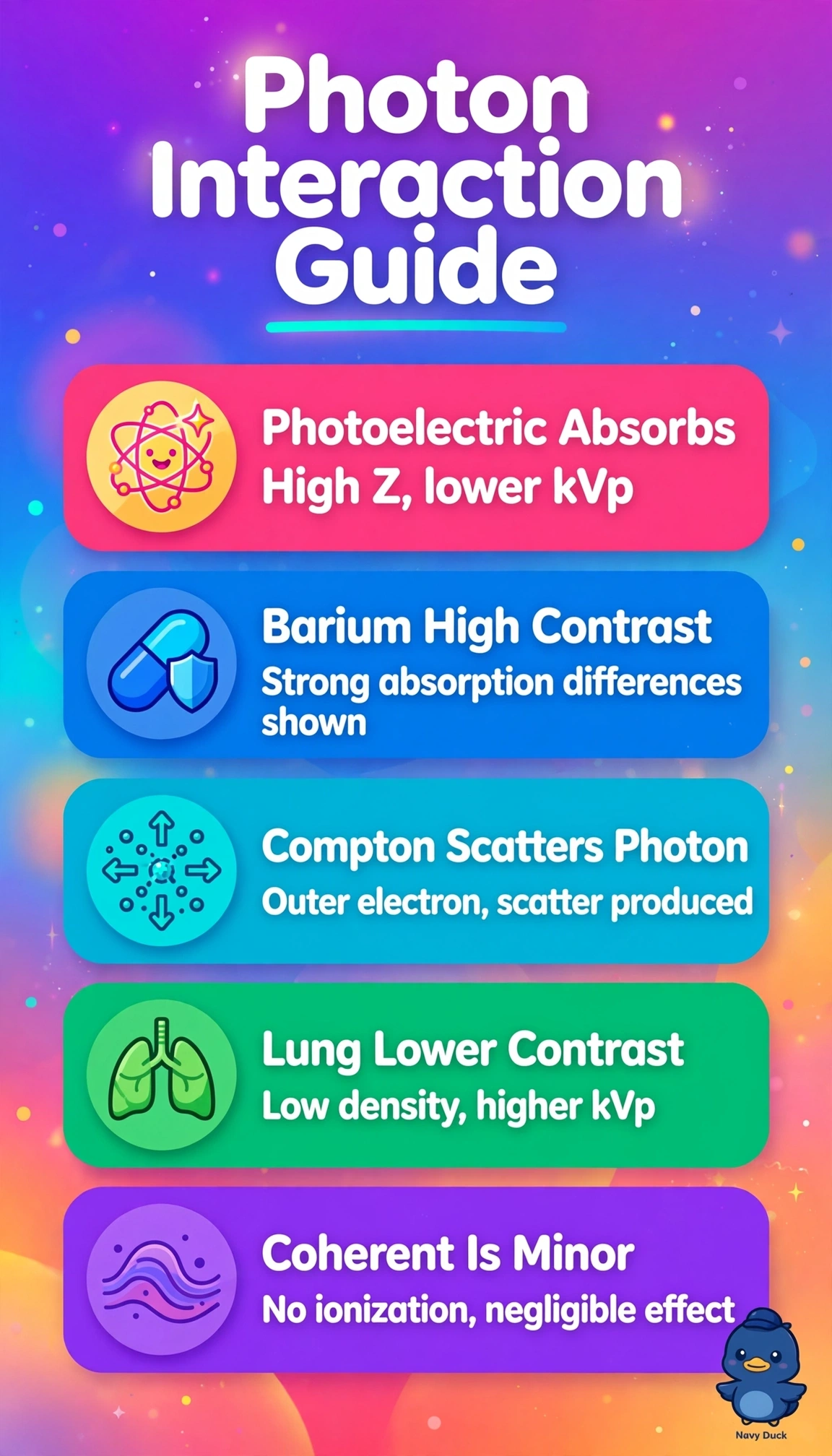
Short Explanation
You'll see barium light up because its high atomic number soaks up low-energy photons through photoelectric absorption, like a sponge soaking up spills. Your lung tissue is airy and low-density, so higher-energy photons just glance off and scatter, leaving softer grays.
Full Explanation
The photoelectric effect involves complete absorption of the incident photon with ejection of an inner-shell electron, probability increasing with higher atomic number and lower photon energy, so barium with high Z at moderate kVp yields strong differential attenuation and high subject contrast; Compton interaction involves a photon striking an outer-shell electron, producing a scattered photon and recoil electron, probability increasing with tissue electron density and higher kVp range, so aerated lung with low density at high kVp transmits more photons with relatively more scatter and lower contrast. Coherent or Thomson scattering involves low-energy photons changing direction without ionization and contributes negligible image formation or contrast in diagnostic ranges, not dominant barium contrast. Reversing the interactions misattributes absorption to Compton, which by definition produces scatter, and scatter to photoelectric, which by definition removes photons from the beam. Claiming photoelectric produces fog or Compton creates barium contrast contradicts attenuation physics. The exam caveat is to link Z and kVp to photoelectric versus Compton predominance, and the practical check is to select kVp for the desired contrast, use grids and collimation when Compton scatter is expected, and respect that dense contrast media increase absorption and patient dose considerations.