
A pregnant scheduler at 8 weeks gestation calls after a lower-abdomen fluoroscopy referral and asks about fetal risk, while a second patient asks why intestinal crypt cells are more vulnerable than mature muscle. Which principle best explains tissue radiosensitivity and stage-specific embryo-fetus risk for counseling?
Select an answer to reveal the explanation.
Short Explanation
You have got the vulnerability pattern down. Radiosensitivity follows busy, immature, and unspecialized cells, which is why gut lining and early embryos worry you most.
Full Explanation
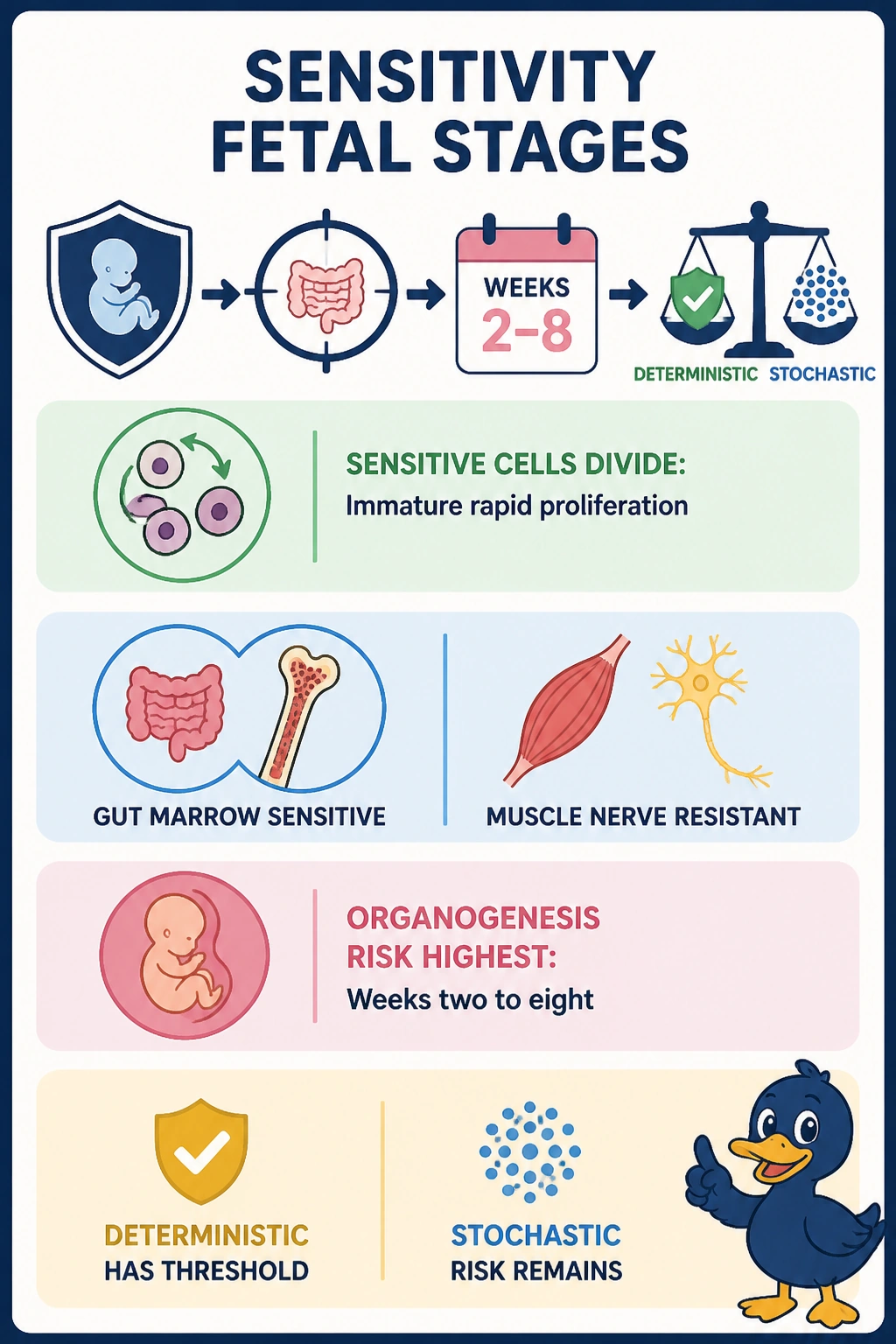
Bergonie and Tribondeau principles state that radiosensitivity is highest in undifferentiated, rapidly dividing cells with many future divisions, which explains why bone marrow, intestinal crypts, and basal skin are acutely sensitive while mature muscle and nerve are relatively resistant, and why somatic effects range from acute mucositis to late carcinogenesis. Embryo-fetus effects are stage dependent: preimplantation exposure operates on an all-or-none basis, organogenesis in weeks 2-8 carries the highest risk of deterministic congenital malformations above threshold doses, and fetal growth and central nervous system sensitivity persist with increased stochastic risk throughout pregnancy. Mature muscle and nerve are radioresistant, not rapidly dividing; fetal risk is not uniform and deterministic effects exhibit thresholds; and highly differentiated fixed cells are less sensitive than proliferative stem compartments. Exam caveat: link crypt-cell sensitivity to gastrointestinal syndrome at high doses and organogenesis to malformation risk. Practical check: confirm gestational age, involve the radiologist and medical physicist for fetal dose estimation, and document counseling without overstating low-dose diagnostic risk.