
A warehouse worker fell from a ladder onto the heels, with severe right heel pain and swelling, plus forefoot pain on the same side. The orders request right calcaneus and foot views, but the patient cannot bear weight and cannot dorsiflex well. Which projection set correctly evaluates calcaneal articulation and forefoot alignment under non-weight-bearing limits?
Select an answer to reveal the explanation.
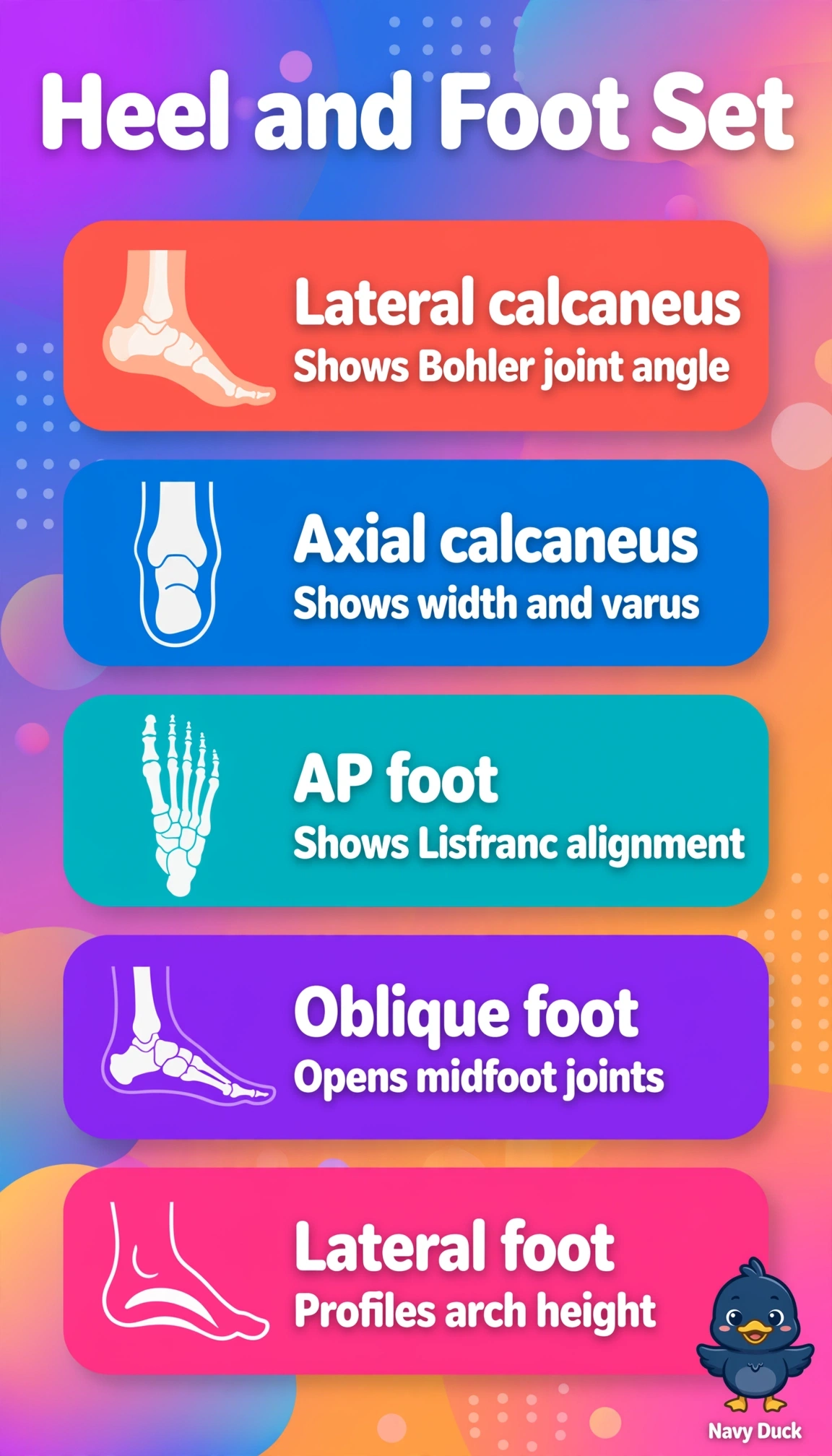
Short Explanation
You've got a sore heel that can't take load, so you bring the angles to the patient. Support and rotation reveal Bohler and Lisfranc lines without forcing stance, and that's the non-weight-bearing win here.
Full Explanation
The correct set is appropriate because axial loading onto the heels raises concern for comminuted calcaneal body fracture with subtalar depression, requiring lateral calcaneus to measure Bohler and Gissane angles and posterior facet step-off plus axial plantodorsal projection to show width, varus-valgus, sustentaculum tali and calcaneocuboid involvement, combined with complete AP, oblique and lateral non-weight-bearing foot views to detect associated midfoot-forefoot fracture, Lisfranc disruption and arch loss while accommodating inability to stand or dorsiflex through supine positioning with leg support and beam angulation. The lateral plus mortise ankle combined with foot views is a standard unstable ankle workup centered on tibiotalar congruity and syndesmosis, but it omits the dedicated axial calcaneal projection and therefore cannot profile subtalar articular depression or calcaneal widening that drive surgical planning. The calcaneus with only AP and oblique foot views preserves calcaneal detail but omits sagittal plane assessment, since without a lateral foot the arch, calcaneal pitch, talar declination and dorsal metatarsal displacement cannot be judged. The calcaneus with ankle views preserves hindfoot detail but substitutes tibiotalar anatomy for ordered forefoot anatomy, so metatarsal and tarsometatarsal injury implied by same-side forefoot pain remains unevaluated. Exam caveat is that weight-bearing foot alignment and Meary angle analysis is preferred for chronic deformity but is contraindicated and misleading in acute painful trauma. Practical check is to verify laterality markers, inclusion from posterior tuberosity through metatarsal heads, true lateral without rotation, and comfort with sandbags and leg support before exposure.