
A 28-year-old emergency patient fell onto the left chest, has point tenderness over ribs 7-9 in the midaxillary line, takes shallow breaths, and needs rib detail without repeating chest work already done. The physician wants the site of injury demonstrated with minimal superimposition. Which projection strategy best demonstrates left axillary rib injury?
Select an answer to reveal the explanation.
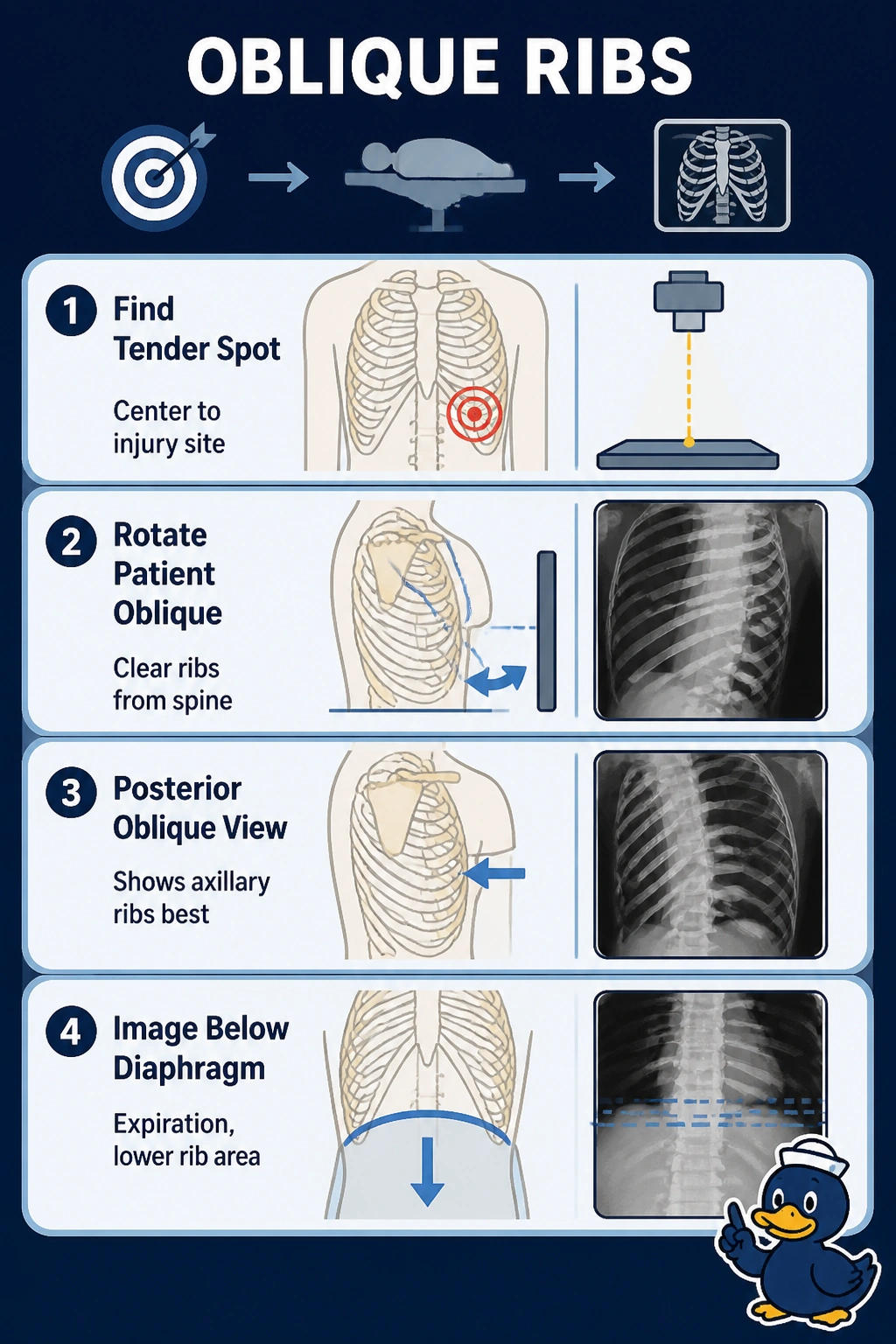
Short Explanation
You unfold those curved ribs with smart angles. Obliquity works like turning a fence to see between slats clearly.
Full Explanation
The correct strategy is appropriate because ribs 7-9 in the midaxillary line are lower ribs below the diaphragm, and AP plus left posterior oblique views, with the injured side toward the receptor, place the axillary portion of the left ribs in profile away from the spine and sternum, while low centering and expiration optimize density for that area without duplicating the chest examination already performed. Centering above the diaphragm fails by concept because upper-rib technique places the central ray, collimation and exposure for ribs 1-6, which excludes or underexposes the tender lower axillary zone and risks missing a nondisplaced fracture. Using right posterior obliques fails by laterality concept because even with correct low centering, the right side is then closest to the receptor, so the uninjured right axillary ribs are profiled and the painful left axilla is not. Requiring full suspended inspiration fails by breathing concept because ribs below the diaphragm are imaged on expiration, which raises the diaphragm so the lower ribs lie within uniform abdominal density, and a splinting trauma patient with shallow respirations cannot reliably take or hold a full inspiration. An exam caveat is that oblique rib projections supplement rather than replace the initial chest images for pneumothorax and pulmonary assessment, so confirm chest work is complete before coning to the area of interest. A practical check is to palpate and mark the point of maximal tenderness, verify the left marker, center below the diaphragm, and coach a gentle suspension at the end of expiration with immobilization for sharp cortical detail.