
An urgent-care adult with facial trauma after a fall has suspected orbital floor and maxillary sinus fluid levels, is upright and cooperative, and can extend the neck without C-spine precautions. The physician wants air-fluid levels and facial bones without CT. Which paranasal sinus projection best demonstrates air-fluid levels in the maxillary sinuses while showing facial bones?
Select an answer to reveal the explanation.
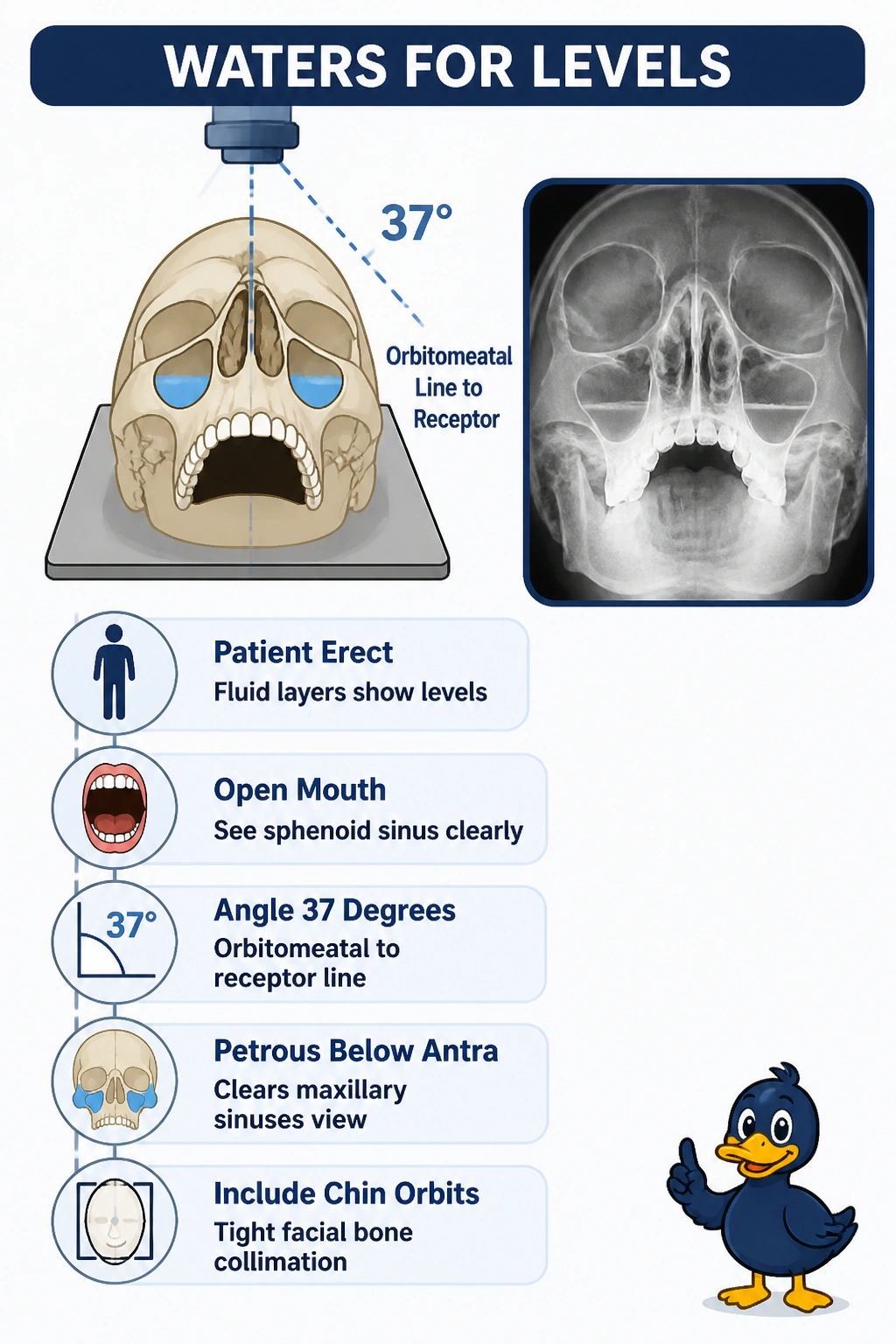
Short Explanation
Upright positioning lets fluid settle into a visible line you can actually use. Erect Waters projects the petrous ridges below the maxillary antra so levels and rims stand out.
Full Explanation
The erect parietoacanthial Waters method demonstrates the maxillary sinuses, orbits, and facial bones with the petrous ridges projected below the maxillary antra when the chin touches the receptor so the mentomeatal line is roughly perpendicular to it (orbitomeatal line about 37 degrees) and the mouth is open, and the erect position allows air-fluid levels to layer dependently for detection after trauma. The Caldwell projection with 15-degree caudal angulation through the frontal sinuses best shows frontal and ethmoid sinuses and superior orbital rims but projects dense petrous anatomy over the maxillary region and, if supine, fails to show air-fluid levels. A true lateral skull profiles the sella and calvarium but superimposes orbits and sinuses and does not separate fluid levels in the maxillae. The submentovertex shows the zygomatic arches, mandible, and skull base axially but foreshortens facial bones and does not display maxillary fluid levels. The exam caveat is to distinguish Waters for maxillary levels and inferior orbital rims from Caldwell for frontal and ethmoid detail, and the practical check is to verify no C-spine restriction, position erect, keep the midsagittal plane perpendicular and set the orbitomeatal line at 37 degrees, and collimate to include the chin and orbits.