
A 29-year-old interventional technologist declares pregnancy in writing at 16 weeks and continues fluoroscopy and portable work wearing a lead apron. Personnel monitoring shows a collar badge outside the apron and a waist badge under the apron, with prior monthly fetal estimates of 0.3 mSv. The RSO counsels on NCRP guidance and 21 CFR posting. Which monitoring and limit application best complies with embryo-fetus protection?
Select an answer to reveal the explanation.
Short Explanation
You kept mom at work safely. Keeping the waist badge under the apron tracks true fetal dose against the monthly and total limits without overrestricting duties.
Full Explanation
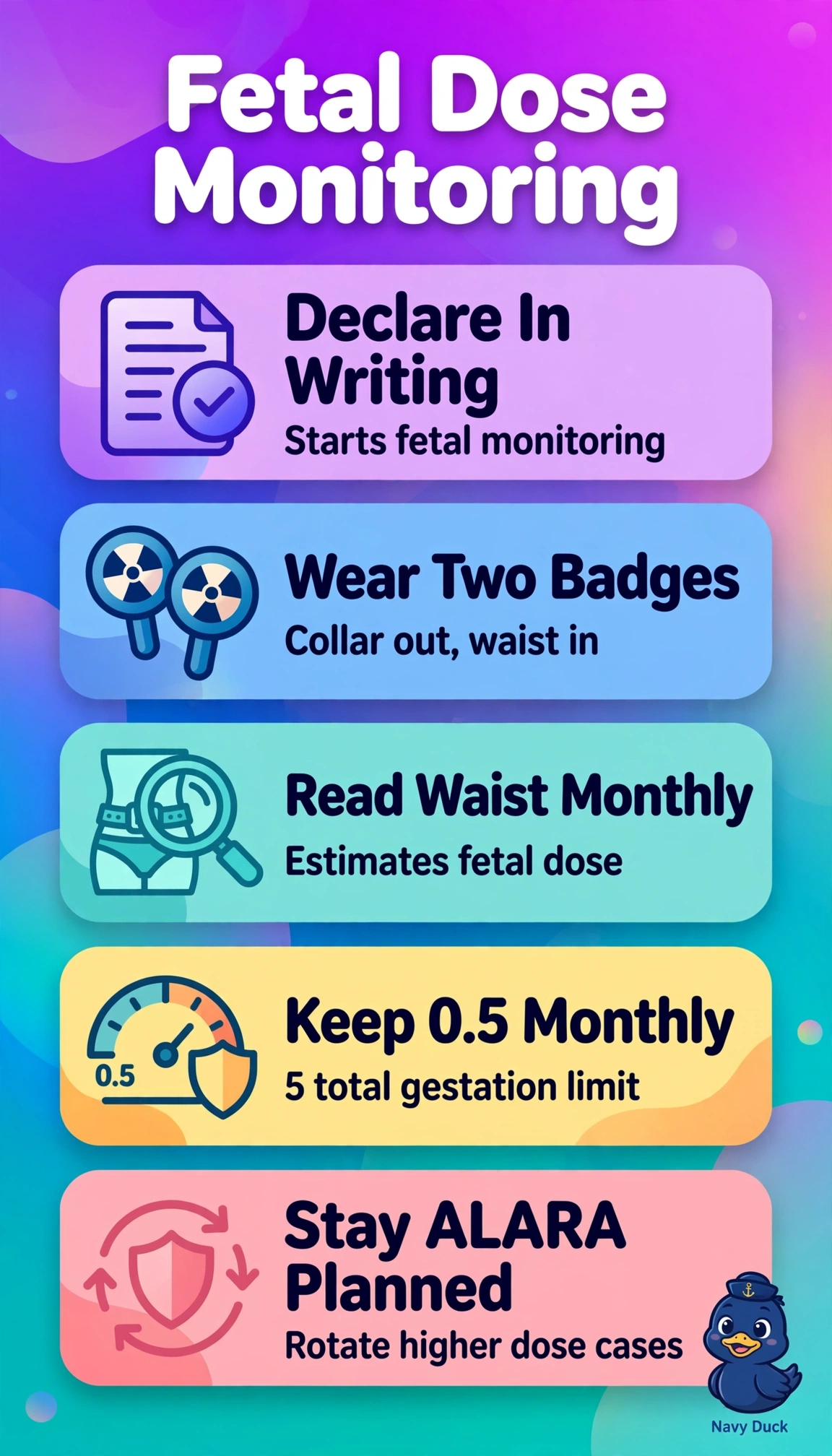
After written declaration the embryo-fetus receives special protection with a 5 mSv gestation limit and NCRP guidance for uniform exposure near 0.5 mSv per month, best assessed during fluoroscopy by a waist dosimeter worn under the lead apron because it measures shielded abdominal scatter representative of uterine dose, making continued under-apron monitoring with prior 0.3 mSv monthly results compliant. The gestation-total-only tracking concept fails uniformity because without monthly review a high brief exposure could still total below 5 mSv while violating monthly control, a key issue with substantial gestation remaining after 16 weeks. The collar-badge estimation concept fails placement because a dosimeter outside the apron measures unshielded head-neck exposure and overestimates fetal dose, so no correction reliably substitutes for the under-apron record dosimeter. The adult-limit monitoring concept fails limit selection because the 50 mSv annual occupational limit protects the worker and would allow about ten times the fetal allowance if misapplied to the conceptus. A common exam caveat is that fetal limits apply prospectively after written declaration and depend on badge position and apron shielding rather than posting or counseling alone. As a practical check verify the waist badge is worn at abdomen level under the apron each exposure, exchanged on schedule, and reviewed monthly by the RSO with duty review if results approach 0.5 mSv.