
For a bedside chest on a 130-kg patient in isolation without a Bucky, scatter is a concern, repeat exposure must be avoided, and only a wireless DR panel is available. Which imaging equipment configuration achieves direct conversion capture with scatter cleanup for this Bucky-less exposure?
Select an answer to reveal the explanation.
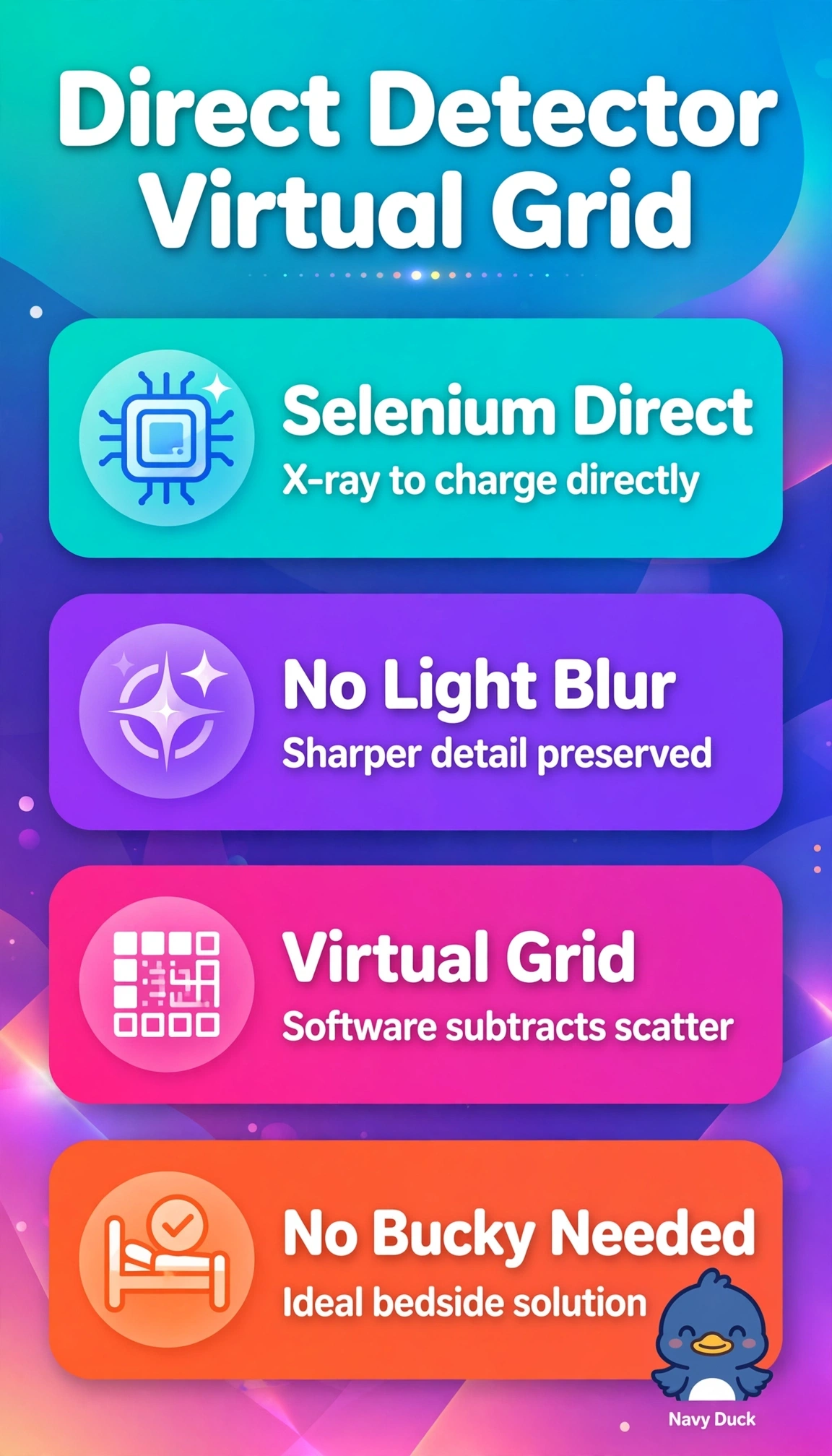
Short Explanation
You're pairing the right sensor with smart software because no Bucky is handy. Direct conversion with selenium turns x-rays straight to charge while virtual grid cleans scatter.
Full Explanation
The correct configuration pairs amorphous selenium direct conversion, where x-rays create charge directly without scintillator blur, preserving resolution and dose efficiency, with virtual grid software that models and subtracts scatter from thickness and exposure factors, ideal for a 130-kg isolation bedside without a Bucky where physical grids invite misalignment and repeats. A cesium iodide detector with virtual grid software is a standard portable solution with good scatter cleanup and efficiency from its structured phosphor, yet it remains indirect conversion through light to photodiode and therefore fails the direct-capture requirement. An amorphous selenium detector in the upright Bucky with oscillating grid delivers direct conversion and excellent scatter cleanup for routine department chests, yet it requires transport and a fixed Bucky system, violating the bedside isolation and wireless-panel-only constraints. An amorphous selenium detector using high kVp alone reflects routine chest technique for penetration and contrast, yet without physical or software scatter correction a large habitus produces severe scatter fog and contrast loss, risking repeat exposure. Exam caveat is to separate detector chemistry from cleanup method, remembering selenium means direct while cesium iodide with silicon means indirect, and physical grids differ from software correction for portables. Practical check is to verify detector type, enable virtual grid with correct body thickness, and confirm wireless linkage and centering before exposure.